Showing posts with label Historic Spots. Show all posts

Sunday, June 19, 2016

Chuuk Lagoon, Micronesia

Chuuk Lagoon, also known as Truc Lagoon (let's hear it for languages with semi-compatible phonemes!) is a natural harbor in the Caroline Islands.  The Japanese navy used it as a home base during the second World War.  This came to a sudden end on February 17, 1944, when a two-day battle began, resulting in the destruction of the base. More than 50 ships and hundreds of aircraft were destroyed, and thousands of Japanese soldiers lost their lives (400 of which are said to have been trapped in the hold of a ship which sank, drowning the men.
Since the war, the lagoon has become a popular destination for scuba divers who want to explore sunken wrecks (some sources place credit for this popularity with a 1969 documentary by Jacques Cousteau).

Although a significant number of bodies were eventually recovered and returned to Japan for burial, many remain in the depths of the lagoon. Many of those who have dived at the lagoon report supernatural goings-ons.

Several of the ships that sank were cargo ships, including at least one loaded with trucks, and divers have reported hearing the sound of automobile engines starting and idling under the water. Similarly, many divers have reported hearing machine-like grinding noises coming from the engine rooms of some of the sunken ships.

Divers have also reported hearing human voices emanating from the water, and rumor holds that the locals consider the islands to be haunted, with a television crew (from the inaccurately-named "Destination Truth") claiming to have heard stories about floating lights near the caves on the island, disembodied human voices heard throughout the island (though especially in the lagoon area), and one of the crew claiming to have been touched on the shoulder when nobody else was present.

By the way - you should check out the diver's photos available here.

Commentary:  Considering that battlegrounds across the world attract ghost stories, it is only natural that the same be true of a naval battleground (battlewater?), especially considering the volume of dead and the difficulties of recovering bodies from the water as compared to dry-land battlegrounds.  While the Japanese government has made efforts to recover and bury bodies from the lagoon, it is still common for divers to find human remains while exploring, which says more about the nature of massive shipwreck sites than about the efforts of the Japanese government.

I wonder about a few things here, though.  The first is whether or not the locals truly consider this place to be haunted, or if that is a European/U.S. story that we place on the location because in our ghost story traditions it seems like it should be haunted (haunted burial grounds, which is what this place has become, though a standard part of European and therefore U.S. folklore, are not a universal part of human views about burial places).  I don't know, and if any of the readers have had reason to visit Micronesia, perhaps you could inform me. If they do consider it haunted, I then wonder if this is a native view, or if it is something imported with wreck-diving tourism in the 1970s and later.  Again, I genuinely don't know, and would be grateful if any of my readers could fill me in.

Similarly, I know that many non-competitive sports sub-cultures have developed their own superstitions and supernatural beliefs common throughout (try talking to a surfer some time, or a mountain climber, and you will see exactly what I mean).  If so, then I would wonder whether or not those beliefs have fed this growing legend. I have already begun contacting divers that I know in order to ask them - if they get me any information, I will update this entry accordingly. (Edit to note: I have spoken with a couple of divers so far, they both think that this is likely a dead-end. While they have encountered supernatural divers, they have not encountered a supernatural view common to divers).

One final note - I have observed that, as with many other ghost stories of more recent vintage, the haunting of Chuuk lagoon is one that appears across the internet, often with the exact same information repeated over and over again, not quite word-for-word, but without much variation - so it's not the copy-and-paste style of folklore spread that I have noted for other ghost stories, but it is something close to that.  If you type Chuuk lagoon (or Truk Lagoon) into Google, you will pull up many web pages, but I only cite three below, because, frankly, no matter how many I went through, I never found anything new pertaining to the ghost stories, so I just included the first three that I found. Again, I have to wonder whether or not this suggests that the over-use of a few specific sources may be resulting in stagnation of folklore.  I also noticed that none of the sources cited primary print references for the ghost stories, instead relying on hearsay, other websites, and a relatively recent television show - this makes me wonder whether or not this legend may be more recent, originating in the 1990s or later, as the internet made sharing details of dives easier.  If this is the case, then perhaps this is a story that is emerging, rather than stagnating.

Friday, May 15, 2015

Poveglia Island, Italy

In the water near Venice sits Poveglia Island, a curious place on the whole. The island has clearly been modified by humans - it has far too many straight lines and smooth curves in it's outline to be completely natural - as both a place of residence and as a military fort, and later as a waiting station for ships entering Venice and finally as a hospital. Stories hold that Romans used the island as a quarantine station for plague victims, and that  the same was done with victims of the black plague, whose bodies were then buried in plague pits (mass graves of plague victims) on the island. Many of the bodies are said to have been burned, and it has been claimed that the ashes have created a distinctive dust on the island. These stories hold that over 160,000 people died over the course of the island's history. And the presence of the dead is said to still lurk on the island, making it a dark and forboding place approached only by the brave. Typically non-specific stories of strange shadows, disembodied voices, and shoves (or even blows) from unseen assailants abound.

Oh, and the pits in which the remains were placed is said to be below an area that was once used for growing wine grapes.  How's that for a strange vintage?

Legends further state that a building constructed in the 1920s housed psychiatric patients, who were overseen by a very literal mad scientist - a psychiatrist who performed cruel experiments upon his charges, and performed other additional acts of cruelty with no pretense towards research. He is also said to have performed neurosurgery with crude tools such as hammers and chisels. It is said that this psychiatrist eventually completely snapped after telling other hospital employees that he had encountered ghosts, climbed the bell tower (in which some stories hold he had performed his grisly work), and flung himself towards the ground. He survived the fall, but a white mist (possibly composed of ashes) rose from the ground, and enveloped and strangled the psychiatrist.

In addition to the torments inflicted on them by this psychiatrist, the patients are also said to have seen ghosts of Roman and Renaissance plague bearers, and to have heard disturbing whispers emanating from the walls of the building.

One story holds that the last people who attempted to settle on the island was a family that had been granted permission to build a vacation home. After the home was completed, they cut their first night short when their daughter was attacked "by something" and had her face split open, requiring 20 stitches.

And, of course, stories hold that the evil psychiatrist was interred in the bell tower, and that people in Venice can hear the bell tolling at night.

Sleep well, Venetians!

Commentary: Supernatural claims aside, Poveglia has an interesting history. In the early 5th century, people from Padua and Este settled on the island, fleeing from the barbaric invasions unfortunately common in Italy during the late Roman Empire. people continued to settle on the island, and over the centuries, a series of structures were built as the town formed.
In 1379, Venice and Genoa went to war, and the people of the island were removed as the island was converted for military use. A fort known as "the Octagon" was built, and the island become the home of a proper medieval town, but it was abandoned in the 14th century.

A couple of sources hold that in 1576, when the Black Death hit Venice, and the local authorities took the bodies of victims to Poveglia to dump them into mass graves, as well as a dumping ground for the bodies. But it appears to be the case that it was not Poveglia, but another island was used for quarantine. Mass graves of plague victims were pretty common throughout Europe during outbreaks, and in a place like Venice, where land is at a premium, an uninhabited island would be a good dumping ground, but it does appear that it was another island that was used and not Poveglia (though, I would not be surprised if documentation surfaced indicating that this island was also used).

Two hundred years later, in 1777, the island came under the jurisdiction of the Magistrato alla Sanita (or, as we'd call it in English, the Public Health Department), and it became a check point for ships entering and leaving Venice. In 1793, cases of plague were identified on two ships, and the island was used as a quarantine station for those who were suffering illness, and lodgings built. Napoleon Bonaparte made this function permanent in 1804, but the lodgings were demolished in 1814. It was again used as a quarantine station in the early 20th century.

And then, in 1922, the hospital was built to provide long-term care to the mentally ill. The construction of isolated hospitals for the mentally ill or those carrying contagious diseases was not uncommon in the late 19th and early 20th century, and many such hospitals (including one off shore from New York City) were built at that time. Naturally, many of these locations are now reputed to be haunted.

The hospital was eventually converted to a retirement home/convalescent hospital (or may have had one as part of it from the get-go, the sources are inconsistent on this point), but even it appears to have shut down in 1968. That said, what descriptions I could find of the latter days of the place make it sound amazingly pleasant.

Given this history, it's only natural that the island is home to a whole host of ghost stories. Even for Venice, a place that boasts more than its share of ghost stories, this place is invitingly creepy. The place is officially off-limits...but a quick Google search reveals that so many people have managed to spend the night there that the ban is clearly poorly enforced. This has, therefore, become quite the destination for legend trippers.

That said, the identities of the victims of ghostly violence always seem to be obscured. It's "the last family to settle here", not "John and Marsha Smith, who built a cabin in 1977." This is often a sign of the story being more non-specific urban legend than truth.

The only thing that amazes me is that there has been no horror movie, as of yet.


Note: Some great photos of the island are available here.  And if you are wealthy, you might just have a chance to buy the island.

Sources: Messy Nessy Chic, Wikipedia, Mental Floss, Gizmodo, news.com.au

Thursday, October 24, 2013

Dudleytown

In Cornwall, Connecticut, there is a location within the ominously-named Dark Entry Forest that is said to be among the most haunted locations in the Americas. The location is the ruins of Dudleytown, a once-prosperous town that was founded by a cursed family, and which was doomed as a result.  All that remains now are the cellar pits and odd bits of rock wall where once there were buildings and fences.  And there are those that say that spirits or demons also remain.

Legend holds that Dudleytown is the earthly receptical of a curse that began in 1510, when Edmund Dudley was beheaded after he was revealed to be conspiring to overthrow the King of England.  His son, John Dudley, tried to marry his son to Lady Jane Grey, thus entering the royal family...and all three were executed. Shortly afterwards, John Dudley's other son returned from France, bringing the plague with him and unleashing an outbreak that killed thousands of people.  John Dudley's third son decided to get out while the gettin' was good and left for the Americas in 1630.  Once there, he had sons, who would later settle in Connecticut...

Or, an alternate version is that Governor Thomas Dudley of the Massachusetts Bay Company was related to Edmund Dudley, and was the uncle of four Dudley Brothers who settled in Connecticut. In this version of the story, Thomas Dudley is a horrible tyrant who executes those who are not Puritans...

But regardless of the exact version, four brothers, Abijah, Barzillai, and Abiel, founded Dudleytown in the late 17th or early 18th century. Depending on which version of the story you are going with, these four brothers carried a curse with them, or one of Thomas Dudley's victims cursed him and all who dwellt near him (including his nephews), damning the land on which he lived, which would become Dudleytown. In the Governor Dudley version of the story, he is murdered - hacked to death and his body left on his land - and the murderer is never found.

The three Dudley borthers lived the rest of their lives in Dudleytown, Abijah and Barzillai dying of natural causes, apparently.  But Abiel...oh, Abiel went insane!  He lost his mind, and shorlty afterwards lost his fortune and even his home, dying a pauper

While Abiel was still alive, Nathaniel Carter bought Abiel's house (the unfortunate fellow could no longer afford it) in 1759, thus activating the curse*.  After displacing poor, mad Abiel, the Carter family moved out of Dudleytown in 1763 and went to reside in Bimghamton, New York...but somehow left their 13 year old son behind.  The result, rather unexpectedly, was that the son survived the rest of the family when a Native American raiding party attacked the Carter's New York homestead in 1764, gruesomely killing and scalping Nathaniel Carter, his wife, and even their infant child. In 1774, Nathaniel's borther, Adoniram, and his entire family died of cholera, thus adding more lives to the Dudleytown curse.

And the horror kept on coming.  In 1792, Gershon Hollister is said to have been murdered at the home of William Tanner.  Afterwards, Tanner reported seeing strange animals in the forest as well as demons, and this eventually drove him insane. In 1804, a General by the name of Swift was at home with his wife, when she walked out to the front porch and was killed after being struck by a bolt of lightning.  Mary Cheney was born in Dudleytown in 1811...and the curse followed her after she left, leading to disaster in her hsuband's career and sickness on her part, and she finally committed suicide in the 1830s. An unspecified plague hit the town in 1813, killing all of one family (the Jones family) and killing off many others.

As the 19th century wore on, crops failed, farm animals routinely vanished without explanation, and unexplained deaths continued. Come the end of the 19th century, only the Brophy family (transplants from elsewhere who arrived in 1892) remained.  First the Brophy sheep began vanishing, then his sons vanished (though it is worth noting that they were wanted by local law enforcement...so, "on the lam" might be a better description than "vanished").  After a few years, Mrs. Brophy died of unknown causes.  He was sometimes seen around Cornwall, muttering about "demons"...and then his house burned to the ground and he vanished, as well.

Dudleytown remained abandoned to whatever demons Mr. Brophy had encountered until 1930, when Dr. William Clark, a pathologist from New York, decided to build a summer home at that location.  Things were quiet until 1937, when Dr. Clark left on a business trip, leaving his wife behind. When he returned home, he found her in an upstairs room, cackling to herself, having gone quite mad.  She never recovered, eventually dying in an asylum.

Dr. Clark was the last resident, but the Clarks weren't the last people to encounter evil at Dudleytown.  Local folklore tells of a satanic biker gang that enters the Dudleytown area to hold rituals.  People report being attacked by demonic creatures with cloven hoofs and strange green eyes.  People report seeing shadow people, floating balls of light, dark human forms rising out of the cellar pits, having weird images show up on film (or in digital pictures), and that animals seem to be strangely absent from the area.  And, as is so often the case, stories persist that a TV news crew arrived to film a story around Halloween, only to have their equipment fail while they were present.


*For the life of me, I can not figure out why the curse is said to begin with one of the Dudley ancestors...when A) they weren't actually related, and B) the alleged displacement of an unfortunate madman seems to be reason enough to cause the curse without the convoluted stuff from the previous centuries.

Commentary:  As ghost stories go, this is one of the greats.  Dudleytown is creepy, famous, and a real place...all of which make for a good story.  The story of the curse, the demonic creatures having been sighted by residents, and the fact that the ruins are still there (though entry is prohibited by the current landowners, and people do get arrested for trespassing, so, really, stay out), it all makes this particular tale all the more delicious as ghost stories go.

Unfortunately, for all of the giddy creepy thrill that the story supplies, it really doesn't stand up to any sort of scrutiny.  As at least one source has pointed out, the story of the curse and the early deaths/madness actually doesn't hold up very well, even using just the information provided in the common versions of the story itself - pretty much everyone who is said to have died or been driven insane by the curse was quite elderly at the time...and, well, therefore would be expected to be experiencing dementia or death (for example, Abiel was 90, and the symptoms of his madness are pretty consistent with dementia).  Moreover, the number of people who are said to have died in various versions of the stories are, actually, well short of what you would expect for a rural 18th/19th century community, indicating that being in Dudleytown might actually have been good for your health. So, ya'know, not so scary, that.

A short but accurate and useful write-up of Dudleytown's history if provided on it's Wikipedia entry (accessed October 23, 2013):

Dudleytown was never an actual town. The name was given at an unknown date to a portion of Cornwall that included several members of the Dudley family. The area that became known as Dudleytown was settled in the early 1740s by Thomas Griffis, followed by Gideon Dudley and, by 1753, Barzillai Dudley and Abiel Dudley; Martin Dudley joined them a few years later. Other families also settled there.
As with every other part of Cornwall, Dudleytown was converted from forest to farm land. Families tilled the land for generations. Located on top of a high hill, Dudleytown was not ideally suited for farming. When more fertile and spacious land opened up in the mid-West in the late 19th century, and as the local iron industry wound down, Cornwall's population declined.
During the early 20th century, old farms in Cornwall were sold to New Yorkers seeking a better life in the countryside. Much of the Dudleytown area land was acquired by the Dark Entry Forest Association, which planted thousands of trees. During the 1930s, New York's Skidreiverein Club spent their winter weekends skiing on trails they built in Dudleytown; in the summers, they canoed down the Housatonic River.

Then, even the mysterious or horrifying deaths turn out to be more mundane than legend would hold.  Records show that Gershon Hollister was not, in fact, murdered, but instead died due to an accident during a barn raising.  Mary Cheney did not kill herself, but died of a lung disease, likely tuberculosis, and she had never been to Dudleytown - her death is especially easy to trace, as she married Horace Greeley.  Harriet Clarke did commit suicide, but in New York, not Dudleytown. General Swift lived in another location near, but outside of, Dudleytown (also, Swift was, like Abiel, quite elderly when he "went mad" so it was probably just dementia again).  Mrs. Clark was not driven insane, and in fact continued to live in the area after her husband's death in 1943.  And so on and so forth...

What's more, the verifiable history of Dudleytown is rather different than the legend holds.  There's no known relation between the Dudleys of Connecticut and Edmund Dudley.  Similarly, if you match up the time the periods during which the Dudleys of Dudleytown lived (the mid-to-late 18th century) with the life of Thomas Dudley...that he was their uncle seems remarkably unlikely...and they didn't settle in the area until after others already had, so their uncle would not have lived there, and in fact he died of natural causes at his home in Roxbury in 1653. Also, the Dudley brothers were actually Gideon, Barzillai, and Abiel, there wasn't an Abijah.

What's more, there is plenty of evidence that the town was deserted not because of weird supernatural goings-on, but because of the difficulty in obtaining freshwater, poor conditions for agriculture (rocky ground and a placement that resulted in shade from the hills and trees pretty much all the damned time), and variations in the local iron industry all provided potential causes for abandonment.  Add to this that Dudleytown was never really a town (stories of it having been a more substantial settlement are false), but rather part of Cornwall, and, well, many residents probably just moved to other parts of the town or county when land became available.

One Reverend Dudley, the author of the Legend of Dudleytown page linked to below, traces the origin of the ghost stories to the 1938 publication of the book They Found a Way, though it is conceivable that elements of the story already existed in local folklore, but even that isn't too terribly odd a thought.  After all, frequently shadowy location with an abandoned town?  If you don't make up a ghost story for that, then you are just being a lazy sod.

Still, even knowing all of this, I still love this story.  It still creeps me out, and if I ever find out that I will be visiting Connecticut, I will try to get permission to visit this site.

Sources: Wikipedia, The Legend of Dudleytown, Cornwall Historic Society, Prairie GhostsGhostvillage, Damned Connecticutghosttowns.com (wildly inaccurate information, but a fun read), The Illustrious Internet!, The Ghosts Of Ohio (because, of course, a website about Ohio will cover Connecticut), Exciting Earth, paranoid ramblings from the Illustrious Internet

Wednesday, October 9, 2013

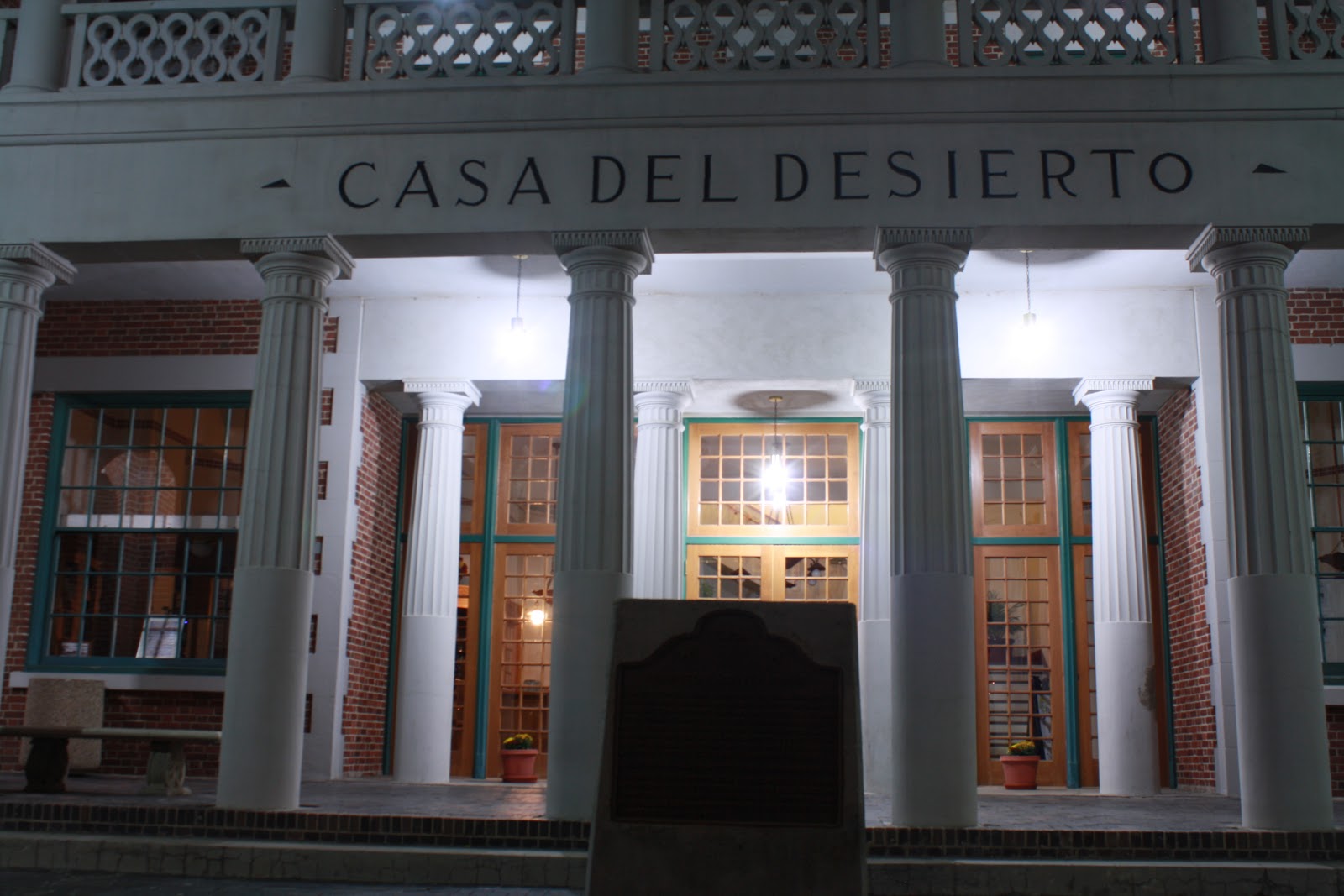
The Haunting of Harvey House, Barstow, California

In the town of Barstow, California, there is a delightful example of early 20th century architecture: The Harvey House/Casa de Desierto.


The Casa de Desierto (Desert House), one of the Harvey House chain of hotels and restaurants that once were common along the railroads, was built in 1911, to replace an earlier structure that had been destroyed in a fire. It is a rather beautiful building, standing next to the railroad tracks, and conspicuous, as the rest of Barstow's architecture, while quite pleasant and often gorgeous in its own right, tends to be more utilitarian than this former hotel.

Naturally, it is said to be haunted.

The most common experiences reported are, as is so often the case, vague feelings of uneasiness, "being watched," and the ubiquitous "cold spots."  More interesting are the apparitions that people report seeing, including Harvey Girls (travelling waitresses who worked for the Harvey company) who are seen walking the halls of the building (including one who appears to simply walk the same route from the kitchen to the dining room, with something in her hand, repeating the walk again and again), and a woman named Rachel who is seen on the balcony, depending on the telling, is either a Harvey Girl or a young woman waiting for her fiance or husband to return from the war (I assume WWI).  In the latter tellings, Rachel is said to have committed suicide - a common ghost story motif.

In addition to the apparitions, there are smells and sounds.  The smell of tobacco smoke is said to signify the presence of Buchanan, a man who was crushed between two rail cars and whose dying wishes were to see his family and to have a cigarette.  A little girl names Emily is said to occasionally laugh as people walk by, and her apparition plays "peek-a-boo" as people walk up the lobby stairs.

Commentary:  The Harvey Houses were an interesting institution - a chain of hotels linked by the railroads, known for their quality and comfort when these were rare during travel through the western United States.  People often claimed (no doubt with encouragement from the Harvey Company's marketing office) that the Harvey Houses "tamed the wild west."  This is, of course, not true.  However, they did provide amenities that might otherwise be scarce in the Great Basin and desert Southern California.

That this one has had ghost stories attached to it is unsurprising.  As noted above, the building really does stand out.  Barstow is located on Route 66, and has it's fair share of historic and unique buildings and rather friendly people - for all of it's sometimes bad reputation as a destination, I have always found Barstow to be a pleasant place when I have traveled there for work - but the Casa de Desierto stands apart from the rest.  It's a mix of east-coast brick, neo-classical, and Moorish designs that looks...well, the best word that I can think of is "classy."  It's a very nice building that looks very out of place next to the railroad tracks and a dry riverbed.

Given that it is both a conspicuous structure and that it has long been a landmark for those riding the trains as well as those living in Barstow, it is unsurprising that it has gathered ghost stories.  I must admit that I am a bit disappointed that the stories are so pedestrian.  The sightings of Emily are reminiscent of the sightings of another ghostly child at the Brookdale Lodge, but the stranger and more menacing apparitions at the Santa Cruz County hotel are missing in Barstow.

Still, what the stories at Casa de Desierto lack in originality, they make up for in colorfulness.  The smoke that calls to mind Buchanan's demise, the details regarding where Rachel will be standing (and the alternating versions of her reason for being there), and the fact that the stories are folded within the manufactured mythology of the Harvey Company make for an enjoyable set of tales.

Sources:  Newspaper, Internet, Internet, Strangeusa.com, Wikipedia, and, again, Wikipedia

Monday, October 29, 2012

Calico Ghost Town


The town of Calico, now abandoned (sort-of), is a ghost town in more ways than one.

Portions of the old abandoned town of Calico have been re-built and are now a regional historic park in San Bernardino County.  The setting, in the Calico Hills in the California portion of the Mojave Desert, seems eerie and otherwordly at the best of times.  And, naturally, the old town is said to be haunted.

Among the ghosts of Calico are Lucy Lane, who was born in Bismark - which overlooked Calico - and married John Robert Lane when she was 18.  The Lane's ran the general store, but left Calico when it was in decline in the late 19th century, only to return again in 1916, and take up residence in several different buildings throughout the remained of her long life (she lived to the age of 93).  Her spectre is said to have been spotted walking between the last house in which she lived (now a museum dedicated to the Lanes) and the store that she and her husband ran, wearing a black lace dress (which, naturally, many people hold is the dress in which she was buried).  Also, her rocking chair in that final house is said to often start rocking on its own.  Also, people working in the store have reported seeing movement out of the corner of their eyes, as well as hearing odd sounds, all of which is naturally credited to Lucy.

The Lane Museum, Lucy Lane's final home

The school house, which occupies the highest spot in town, is said to be another hot spot for spectral activity.  Some visitors have reported seeing a small, moving ball of red light (sometimes said to emit a beam of white light from within it) within the school house; and numerous visitors claim to have seen both female adults (thought to be school teachers) as well as children, all in late 19th-century clothes, through the windows of the school.  One very common sighting is that of a girl, aged 11 or 12, who is primarily seen by children and teenagers, appears in the window and seems to be aware of passers-by, though she vanishes mysteriously.

Calico schoolhouse, and the bridge crossing the gully to it
One story holds that two British tourists visited the schoolhouse, where they interacted with a costumed staff member who was playing the part of a school teacher.  They had their picture taken with her, but, upon having the film developed, discovered that she did not appear in the photos.  Follow up inquiries found that there had been no costumed staff members at the school on that day.

At the old hotel, people report feeling unseen hands grabbing, pulling, and (in one case) punching them.

Hank's Hotel, where you can get groped or assaulted by a ghost

The mines were dangerous, if sometimes rewarding, places to work, and so it is no surprise that many men met their ends there.  It is, perhaps, even less of a surprise that many people believe these tunnels and shafts to be haunted by the spirits of the past workers.

Looking out from one of the old mine tunnels
While intriguing, and rather creepy (having been in one of the tunnels, myself), I must admit that I am a bit disappointed by what is said about the mine tunnels.  It's vague, non-specific stuff about weird uneasy feelings and cold spots (which, really, is not uncommon underground).  In the midst of these much more wonderful stories about apparitions and strange phenomenon, can't help but be something of a letdown.


Other ghosts said to haunt Calico include the apparition of "Tumbleweed" Harris, the last marshal of Calico (whose tombstone int he cemetery is pictured above); Dorsey the mail-carrying dog (subject of a Kenny Rogers song), whose specter has been reported at the Calico cemetery; a ghost named Esmeralda who is said to haunt the old theater (now a mineral shop); and a mysterious woman in white who wanders the outskirts of town.  And, of course, there are numerous claims of feeling as if one is being watched, people just glimpsed out of the corner of one's eyes, weird smoke-like mists, and the now-ubiquitous claims of "shadow people."  All in all, Calico is rich in ghostly as well as historic lore.

Commentary: Calico was founded in 1881 by a group of miners who headed into the local mountains looking for silver. Within two years, the town had grown to house around 1,200 residents, had 500 mines, and the usual accompaniments of a successful old west town (justice of the peace, post office, hotels,restaurants, numerous brothels, etc.). Before long, Colemanite borate (an ore of Boron that can be purified, and can itself be used for the manufacture of glasses, medicines, cosmetics, as well as for numerous industrial processes). The town swelled to 3,500 people, with settlers from both Europe and Asia joining the American settlers. However, the Silver Purchase Act of 1890 had the effect of reducing the price of silver. As the decade wore on, Calico's silver mines became less economically viable, and the town began to depopulate. By 1898, the post office shut down, followed by the school, and the town was pretty much abandoned by 1900.

 In 1915, an attempt was made to recover unclaimed silver from the old mines, using cyanidation (a metallurgical process for the extraction ore using the chemical properties for cyanide). While this did result in the brief resurgence of silver mining, it did not cause Calico to boom again. In 1951, Walter Knott, of Knott's Berry Farm, bought Calico and began restoring many of the buildings. While the purchase of historic buildings by the wealthy is hardly unusual, this was a unique turn in two ways: 1) Walter Knott had, as a young man, been a local homesteader and helped to build the cyanidation facilities, and 2) he turned it into a historic park with restored buildings, repaired or re-built based on old plans and photographs, and donated it to the County of San Bernardino in 1966.

 So, that is the history, but what is one to make of the ghost stories? Certainly, people may well have had strange experiences here, but a few things should be kept in mind when evaluating these tales of dread. As is the case with California's missions, western ghost towns are among the few signs of antiquity on California's relatively young European-historic landscape. As such, they tend to attract tales of ghosts, as they are among the few places/objects that most Californians will encounter that seem old and semi-mysterious.

 Another part of the equation is that tourism is both important to the local economy, and increasingly harder to come by. Calico is located off of the appropriately named Ghost Town Road just off of Interstate 15, one of the major thoroughfares between southern California and Las Vegas. The region was once an important stopping-off point for travelers on Route 66, but as the Interstate Freeway system has become more efficient (and cars more comfortable), sight-seeing road trips have taken a backseat to those travelling to get to a particular destination. As a result, the old reliable stopping places along the way have had to step up the razzle-dazzle in order to get travelers to pause for a bit and check things out.  In this context, it shouldn't surprise us to see a historic park playing up local ghost stories in order to bring in more travelers - and indeed, when I visited in October, of 2012, the entire place was done up with, frankly, very tacky prop skeletons and ghosts in order to advertise the various "haunted" events.

All of which makes it difficult to tease out what people have actually experienced from the hype.  Still, without the hype, I'd likely not have been made aware of the stories, so there is that for which one might be grateful.

The sign pointing to the ghost town, photographed after sunset


Sources:  Legends of America, Paranormal California, Calico Ghost Walk

Monday, April 30, 2012

The Ghost of Marco Polo's Wife

After Polo returned from Asia to Italy, he was imprisoned, due to his involvement in a war then occurring between Venice and Genoa.  However, there are rumors that persist to this day, nearly 700 years after his death, that Marco Polo was imprisoned for reasons other than involvement in the war.  According to these rumors, he was imprisoned on the orders of the church, because he had married a non-Christian, the daughter of Kubla Kahn, Hao Dong.

According to these stories, Hao Dong came back to Italy with Marco Polo, but found the people to be unaccepting of her due to differences in appearance, religion, and language.  She became increasingly alienated from all but those closest to her, and became an effective shut-in.  Her only solace was Marco himself, and singing - she is said to have had a beautiful singing voice.

When Marco was arrested, his sister went to Hao Dong and told her that Marco had been executed.  In despair, Hao Dong lit her clothing on fire, and then jumped out of the house's window, into one of the Venetian canals, drowning herself.

It is said that people traveling along the canals at night can hear her singing, as if she was not ready to forgive the treachery of her sister-in-law or let go of her husband even centuries after his own death.

Commentary:  I was delighted to discover this ghost story.  Marco Polo was, by any standard, one of history's great adventurers.  His travels to China are, quite literally, the stuff of legend.  It is open to debate how many of the more fantastic elements of his writings were due to his claims, and how many were due to a writer to whom Marco Polo dictated his narrative.  This writer, Rusticcello, was a writer of romances (generally adventure stories) popular at the court, and it is concievable that, even if Polo had said everything accurately, it might have been embellished.  It is also possible that Polo did the embellishing, and Rusticcello took faithful dictation.  We'll likely never know.

However, even the more mundane elements of Marco Polo's books are sufficient to show that this was a man who lived a life the likes of which most of us would only ever dream of.  He travelled the world during a time when it was rare to travel far from your home town.  He spent time in the court of China during a time when most Europeans were only vaguely aware that this place called "China" even existed.  And then he returned to Europe to tell his story.

Given that there is a good deal of confusion regarding how much of Marco Polo's story is true vs. hullabaloo, it is only fitting that a ghost story would be associated with him that is likely far more myth than fact.

The historical record indicates that Marco Polo married a woman named Donata Badoer as his first and only wife, with whom he had three daughters.  There seems to be little more than rumor to suggest that he was married to Hao Dong, indicating that it probably did not occur.  Still, medieval record-keeping being what it was...

It should also be noted that the majority of references to this story are found on the websites for walking tours, suggesting that it may be of a more recent vintage than it's proponents would like to think, and that it may be more a product of tourism than paranormal activity.  Also, the claim that Hao Dong had lit herself on fire seems more consistent with a 1960s/70s view of Asia (when footage from the Vietnam War showed protestors setting themselves alight) than the expedient suicide of a heartbroken 14th century woman (also, if you wanted to burn yourself to death, why would you then jump into water?  Seems like there could be more about the story said here, but I have yet to see anything of the sort). 

Anyway, there seems to be some parallels between this story and two of my other favorites: La Llarona, and Paganini's Phantom Violin.  On the whole, it's a good story.


Sources:  Discovery.com, HowStuffWorks.com, Stuff You Missed in History Class Podcast

Tuesday, April 26, 2011

Meux Home, Fresno, CA

Updated 4-30-2011, photos added


Victorian mansions-turned-museums are common enough in California's Central Valley. My own old stomping grounds in Modesto had the McHenry Mansion, and Fresno has the Meux Home. It is a beautiful Victorian building, open for public tours and surrounded by a scenic garden.

Unlike the McHenry mansion, however, the Meux home is said to be haunted. Symptoms of the haunting include the sounds of children laughing in the upstairs of the home, even when it is known to be empty; strange knocking sounds and general noise are said to have been reported by people in the house after-hours; claims that objects (including fixed objects such as door knobs) have gone missing or been moved after everyone had left for the night abound in local folklore; and there are stories that a fuzzy, but clearly human apparition has been seen looking out the windows at passers-by. Although there are numerous claims about the activities of the ghosts, there is little information regarding their origins.


One local, but completely untrue, story holds that the ghosts are the spirit of slaves kept in the house prior to the civil war. The claim is that their cruel masters treated them horribly, and that their restless spirits continue to haunt the mansion, making mischief and frightening whoever they can.

The museum management does not publicly acknowledge the hauntings, and at least one local enthusiast claims to have been given the brush-off when he asked for a chance to investigate. Though, to be fair, there are enough strange people with an interest in ghosts that anyone running such an establishment has good reason to be wary of people asking to investigate.


Commentary: One of the things that fascinates me about this story is that it illustrates how distanced from reality the local folklore can become when describing the past.

The house was built between 1888 and 1889 by one Dr. Thomas Richard Meux, a physician and former Confederate soldier who came out west int he decades following the American Civil War. Dr. Meux died in 1929 (at the age of 91, quite old now, especially old in the early 20th century), leaving the house to his daughter, who lived there until her death in 1970. The house subsequently was placed on the National Register of Historic Places, and became a museum dedicated to illustrating 19th century life in California. Pretty simple, pretty straightforward. While there was, no doubt, much drama and excitement in the lives of the people who lived in the house, it wasn't the stuff normally associated with ghost stories.


So, of course, people began to make things up. One popular story holds that the house was built in the 1820s and that the homeowners had numerous slaves. They were, of course, very cruel masters, and the ghost stories are attributed to the restless spirits of the slaves. There are a few problems with the story though, notably that Fresno didn't exist until the 1860s, California was never a slave state, and the house wasn't built until 60-70 years after the slavery story claims. The fact that Dr. Meux served in the Confederate army may be the source for this story.

So, I am torn. As a ghost story/folklore enthusiast, I love the fact that the story has changed for the sake of drama and to place it within a broader tradition of folkloric versions of American history. As someone who is trained and works professionally in historic preservation, this sort of fast-and-loose-with-facts history annoys me.

Sources: Local Folklore, Published Book, Weird Fresno, Meux Home Website

Tuesday, September 21, 2010

Mary King's Close, Edinburgh, Scotland

A "close" is a narrow street, usually surrounded by high buildings. Mary King's Close, in Scotland, was one such street, surrounded by tenement houses, and once the main shopping street in the city of Edinburgh. The street is said to be named after Mary King, who owned a stall selling items such as lace goods, but this story is probably apocryphal. Being a medieval street, sanitation was poor, with the contents of night soil buckets and bedpans being emptied into the street in the mornings, and being a narrow street, quarters were tight. Although the bubonic plague was the most virulent disease to spread through this region, it's a fair bet that diseases such as cholera and dysentery claimed more than a few lives.


Photo from offbeattravel.com


It is said that in the mid-17th century, when the bubonic plague was laying waste to Edinburgh, Mary King's Close was sealed up in order to stop the plague-ridden from getting out. The story goes that, after a year, the close was re-opened and over 600 bodies pulled out, cut up by the local butchers, and disposed of in a mass grave (but see the commentary below).

In the 19th century, a new City Chambers was constructed in this area, using lower levels of the original buildings as foundations. The result was that Mary King's Close literally went underground, buried beneath the new buildings, but still accessible. The close, as well as other connected closes, was were shut off from the public and not accessible for much of the 20th century, but was re-opened again early this century. Now, guided tours are available, and both ghost story enthusiasts and history buffs go both to see a place that is both creepy, and a well-preserved example of a 17th century street.

Mary King's Close has since gained a reputation for being one of the most haunted places in Scotland. People report seeing shadowy figures, strange smells, and noises with no apparent source. Other sightings include the apparitions of people walking through the close and, interestingly, headless animals.

One particular spirit said to haunt the close is that of a 10-year old girl named Annie. She is said to inhabit one room within a house on the close, and those visiting the room report feeling her presence, hearing her voice, or in some cases even seeing her. Visitors often leave toys and candies in the room as offerings to Annie.


Photo from alltopmovies.net


Rumor holds that the ceilings in some of the rooms are made of the ash remains of plague victims - this sounds like B.S. to me, but I will look into it to see if I can find any confirming evidence. Until such time as I can find any information, I would assume that this isn't true.

One family is said to have had a larger amount of trouble than others with the ghosts of the close, and that is the Colthearts, who lived in the Close during the 17th century.

Legend holds that the Colthearts, having decided that the tales of hauntings were nonsense, moved in to the Close and set up their home. Mr. Coltheart was a legal advisor, and the location provided some benefits for him. One night, while reading to her husband (who was sick - raise your hand if you think that it might have had something to do with the raw sewage in the streets), Mrs. Coltheart looked up to see the disembodies head of a scraggly-haired old man staring at her. Mrs. Coltheart fainted, in the manner of all good 17th century middle-close stereotypes.

Some days later, Mr. Coltheart saw it as well, although there is no word as to whether or not he fainted. And after that, Mr. Coltheart was awakened by the spectral head at night. After waking up his wife (no doubt while saying that 17th century equivalent of "dude, check it out!"), he lit a candle and began to pray. This didn't do much good, because not only did the head not vanish, but a second one, this of a child, appeared, as did a disembodied arm (because the heads really needed a hand*). After a time, the various body parts vanished, accompanied by a load groaning noise.

Some years later, one of Mr. Coltheart's clients is said to have awoken to the sight of Mr. Coltheart, shrouded in mist, hovering above the client's bed. The next morning he headed to the Coltheart's house only to discover that Mr. Coltheart had died during the night.


*Thank you, I'll be here all week, tip your waitresses!


Commentary: This is a near-perfect ghost story. A buried street, ghosts from pestilence, and a city so afraid of plague that it sealed some of its own inhabitants away and let them die slowly and painfully (add to this that it is often mentioned that the doomed were primarily Catholics). The street is haunted, and the spirit of an innocent child is trapped in the dark amongst more sinister spirits.

When you hear a ghost story so perfect, you have reason to suspect that there is something more going on than simply a scary story. To get at that, we have to get into the actual history of Mary King's Close.

The common story holds that Mary Kings Close was especially hard hit by plague, and that it was bricked off, trapping the inhabitants inside and letting them die horribly, in order to stop the spread of the plague. The truth is that the close was never bricked up, and there is no verifiable information that indicates that it was any harder hit by the plague than any other part of Edinburgh. It died, slowly, as the economic and social realities of Edinburgh changed during the 18th and 19th centuries. Some limited access and use was still allowed as late as the early 20th century.

The close went underground quite literally in the first half of the 19th century, when city government buildings were constructed over it, using the lower levels of the local buildings as foundations. This resulted both in making the place rather eerie, and in effectively removing is from view as a normal street. It is likely that the stories of the haunting of the close began, or at least became particularly popular, around this time. The inclusion of details regarding the bricking up of people and the poor treatment of their remains may come from the class system, and corresponding class animosity, that was prominent in 19th century Europe.

Since the end of the 20th century, the close has become a tourist attraction, with much of the focus of the advertising campaign on the ghost stories. Although much is made about the historical and archaeological research done on the area, this seems to come second to the money-making power of supernatural tourism.

I would provide a bit more discussion of my own, but I think that The BS Historian pretty much hits the nail on the head:

So I think what we have here is an interesting survival of a piece of folklore – the original ghost story was an emotionally powerful way of retelling the old myth that the mysterious mostly-abandoned Close was a) the result of the authorities’ disdain for common people and b) haunted as a result. And the MKC attraction perpetuates it despite the fact that their tours were designed specifically to debunk the myths of the Close, and even cites that research to enhance the “truthiness” of the story. As a money-making (though not for profit) company, it’s easy to see why they would retain such a great piece of marketing. Sex may sell, but so do ghosts! Even my misinformed tour guide later made noises to the effect that the Annie story’s veracity didn’t really matter – it was just an exemplar for the sort of short, brutish, poverty and disease-ridden lives that a majority of people in Edinburgh/Scotland’s history have suffered. And a way to raise money (see also here) for ill young children at an Edinburgh hospital. Needless to say, it also maintains the attraction of the place to a wider range of visitor types and therefore helps keep the funds coming in. Periodic ghost “sightings” and other press and media work must help keep heads above water too. But do these ends justify the means? Does misrepresenting facts of history and of science justify the money it brings in? Are we content to prostitute unique pieces of built and cultural heritage in order to help keep them going? I suspect the answer is “yes”, but we don’t all have to like it, and we should try for better.


Sources: Wikipedia, Edinburghdarkside.com, Stuck On Scotland, the B.S. Historian, Wisegeek.com, Edinburgh.org.uk, Offbeattravel.com

Saturday, May 1, 2010

The Ghost of Mary Nichols

On the night of August 31st, 1888, a woman named Mary Ann Nichols was on her way to a boarding house after having spent the evening at a local pub. She discovered upon arrival that she lacked the money for a bed that night, and so went to work to make the money - Nichols was a prostitute and was aware that she would be able to walk the streets and produce the money in short order.

At 3:40 am, she was found by a local carter, laying on her back on Bucks Row (now Durward Street) with her legs stretched out and her skirt up. The carter didn't look too closely and didn't know if she was alive or dead. When the police finally arrived, it was found that she had been savagely attacked, and her head nearly cut off. Her murderer was never found, but in short order Mary Ann Nichols became known as the first confirmed victim of Jack the Ripper.

Since that time, people walking on the road at night have reported seeing a strange, green glowing figure of a woman huddled in the gutter of the street at the spot where the body was discovered.

Commentary: As I prepare for my trip to London, I decided to look up London ghost stories, and figured that there would be some related to Jack the Ripper - and I was not disappointed. In addition to the story of Mary Ann Nichol's ghost, there are also hauntings attributed to Annie Chapman, the second victim, and Catherine Eddowes, the fourth victim. This isn't surprising, as Jack the Ripper has held the public imagination consistently since 1888. Given that the locations of the murders are well known, anything that seemed odd in these locations would be likely to be attributed to the ghosts of his victims, and it would be a shock if ghost stories weren't told about the murder locations.

What is both interesting and disturbing about the fascination that we have with these murders is what it says about our history, as well as our present. The murder victims were of the lower ranks of Victorian society, living in the slums, and working as prostitutes at the time of their deaths. Had the murders not been so grisly, it is possible that they wouldn't have gathered the attention from law enforcement that they did. That being said, some of the accusations thrown at the police force - that it would have captured the murderer had it been more concerned about the victims - are probably unfair to at least some degree. While it is likely that more effort would have been made especially early on if the victims hadn't been prostitutes, it is also true that this case grabbed such media and official attention that the police were being pressured to find the murderer, regardless of whether they were inclined to do so or not. So, while class politics likely played a role in the investigations, there is no reason to expect that the murderer would have been caught if middle-class or upper-class women had been the targets.

It is also worth considering that someone who is unknown, Jack the ripper, is the focus of the public fascination with the case. While the victims' names are known, all that most people know about them otherwise is that they were prostitutes. They are sometimes portrayed as victims made vulnerable by a profession that they were forced into, sometimes as outsiders whose "immoral" profession adds additional spice to an already wild story. The reality is rather different. Look here for a brief biography of Mary Nichols, and even in these few paragraphs, she appears neither as a wanton harlot nor as a faceless victim, but as someone with a rather more complex past who ended up where she was through a variety of circumstances, some forced upon her and others of her own making. This is worth remembering, as all of us (including, obviously, myself, based on the fact that I went looking for, and posted, a ghost story related to this) are prone to probing the sensationalism and forgetting that these were real people with real lives who were killed by Jack the Ripper.

One final note: Look through the sources. You'll notice that the cut-and-paste is once again present in them thar inter-tubes.

Sources: Mysterious Britain, Internet, Paranormal Database, Internet

Wednesday, November 11, 2009

The Underground of Old Town Sacramento

Sacramento, like San Francisco, was a city born of the 1849 Gold Rush. Located along the primary river route, it served as a lifeline for supplies to the gold fields of the Sierra Nevada. The original waterfront of the town, part of which has been preserved as the Old Town Sacramento district, does not sit at ground level. Floods from the Sacramento River damaged the goods and properties of the people working and living in this area, prompting them to construct an upper level to which most businesses and homes were moved. To the casual observer, the upper level appeared to be the ground level.

The lower level did not vanish, however, it simply became invisible to those who lacked access to the tunnels via the former-first floors (now basements) and various tunnel entrances. While the tunnels were likely used for numerous legitimate activities (storage, lodging, etc.), they likely also served the (now literally) underground economy as a home to prostitution and opium dens. The tunnels are no longer readily accessible - you have to have access to a property with a connecting basement to get into them - but are still there and can be entered by those who know a way in (mostly owners of buildings with connecting basements, although some other folks find access as well). Much like similar tunnels in Portland, Oregon, these tunnels eventually gained a reputation for being the dwellings of unnatural horrors.

Rumors abound of strange lights and unexplained shadows in the tunnels. Property owners (and those who work in the area) with access to the tunnels are rumored to report a strong sense of malice directed at them when they enter the tunnels. One rumor holds that even transients won't sleep in the tunnels due to constant feelings of being threatened by some unseen force.

Although there are likely more specific hauntings known for the area, these are hard to find through research. It's the ambiguous lighting and feelings of menace that one finds mention of when looking for information on the tunnels.

Commentary: Abandoned places attract ghost stories like Paulie Shore attracts loathing, and a place that is not only abandoned, but hidden? Well, that's a recipe for stories of hauntings. So, the fact that the subterranean portion of Old Sacramento is reputed to be haunted is not surprising.

What is surprising is how little information is in any way specific. While I have no doubt that had I the time to go and interview people who have spent time in the tunnels I would have heard at least a few specific stories (a particular location where lights are seen, a ghostly voice that calls out, an apparition of a person or animal, etc.), in trying to research this remotely online, all I can find are rumors, references to vague feelings of dread or evil, and announcements that some people refuse to enter the tunnels.

It's a bit anti-climactic.

So, in the end, the idea of a town buried under your feet is a bit creepy to begin with, and the fact that this town is reputed to be haunted amps up the spookiness level. But if you look too deep, you tend to find no meat to sink your story-collecting teeth into. It's frustrating.

Oh well, at least it's still a cool location.


Extra Stuff: A series of photos of exposed underground locations can be found here.

Sources: Internet, Internet, The Illustrious Internet, Internet

Monday, June 22, 2009

Mission La Purisima, Lompoc, CA

Prompted both by British interests in western North America and Russian incursions onto the west coast, the Spanish government decided in the 18th century to begin colonizing Alta California (or, as we now call it, the state of California). Missions were established at regular intervals from San Diego up to San Francisco, all of them falling within a relatively short distance from the coast.

The missions have their share of ghost stories, some due to the amount of death and misery that occur ed within them, others due to the simple fact that these are amongst the few recognizably historic features on California's relatively young constructed landscape. I lived, for a time, just a few miles from Mission La Purisima Concepcion, just outside of the town of Lompoc, near Vandenberg Air Force Base. I spent many afternoons at the mission, enjoying walks through the open land as well as wandering in and out of the mission buildings. And, of course, I began to hear rumors of ghosts who stalked the mission grounds.

In and around the main building, the chapel, people have reported seeing a monk walking the halls, as well as phantom monks walking about inside the building. Cold spots and feelings of being watched are common, as are the sounds of voices. Some people have claimed that "energy vortexes" (often claimed, never explained) are found within the chapel. One park ranger, and a few visitors, has reported seeing a man in a white sleeping gown (described by the ranger as "Benjamin Franklin in drag") in the old living quarters. Others claim to have seen various different priests, neophytes (the Native Californians who resided within the missions), and various workers appear and vanish within the various outbuildings and workshops at the mission.

Outside of the mission's buildings, mysterious lights have been reported in the cemetery as have voices and other sounds. Speaking voices, the sound of flutes, and singing have been heard throughout the ground. People claim to have sen shadows moving at night. Strange sounds are often reported on the mission grounds. A phantom greyhound dog has also been reported.

Commentary: The La Purisima Concepcion state park exists at the second location of Mission La Purisima. The first mission was founded in 1787 at a location that now resides within the central portion of the City of Lompoc. The mission was damaged in an earthquake in 1812, and the decision was made to move the mission several miles to the north, in the location where the restored buildings currently stand. The mission operated until 1834, when it, along with most of California's other missions, was secularized. After this, the mission lands passed through the hands of a succession of landowners - most of them ranchers - and the buildings and other facilities fell into a state of disrepair. Many of the buildings, including the mission's impressive chapel, were reconstructed in the 1930s as part of the efforts of the Civilian Conservation Corps.

California's colonial era is largely mythologized, the missions being the subject of both demonization and romanticization, and even those who think of themselves as well-informed usually know more myth than fact about this period of California's history.

To be certain, the missions would have been a miserable place for many of the neophytes, due to the physical constraints placed on them by mission life, the probably incomprehensible ritual required by the padres who ran the missions, and the disease caused by cramped quarters and poor sanitary conditions.

The Spanish priests and soldiers likely weren't much happier about conditions. They were far from home, the military and religious authorities clashed bitterly over who should be responsible for the colonization of Alta California, and violence both among the Spanish and between the Spanish and the native people of the area was not uncommon.

In short, everyone was miserable. When one considers that the mythology that has risen up around the missions tends to amplify and exxagerate this misery, and the fact that the missions are some of the few recognizably historic landmarks on California's relatively recent constructed landscape, it is no surprise that all of them seem to have a reputation for hauntings.

La Purisima is often described as the "most haunted" mission (though, again, I suspect that every mission has at least some number of people who will label it the "most haunted"), and has been a mecca for many self-styled paranormal investigators.

Amongst these investigators is Richard Senate, who I find to be a fascinating character. First off, the guy is clearly a good sport, even agreeing to be filmed for Penn & Teller's Bullshit (though the segment was ultimately never broadcast). And, after reading a number of his articles and books, I am inclined to think that he is an honest person who is really trying his hardest to research something. The problem is that he does so with a methodology that is so sloppy that it is bound to give useless results.

For example, in his book Ghosts of the Gold Coast, Senate describes visiting La Purisima, and discovering that there was something strange and powerful in the main chapel. His evidence for this was the fact that people in the group that he brought kept going to the same spot in the chapel and spinning around, as well as reporting cold spots, feeling as if there was a presence nearby, and so on. The problem is that he had all of these people in the room together at the same time, so that, even if they were not speaking with each other, they were seeing each other's behavior and taking cues from each other. He had brought the people in to observe their behavior as an experiment, but he failed to put even the most rudimentary controls on that experiment (such as leading people in one at a time to observe them). This sort of sloppiness permeates his investigations at La Purisima, as well as many of the others that he has performed elsewhere.

Ultimately, Senate demonstrates the right attitude (experiment, gather data, see if there really is something), but all of the wrong methods.

Anyone who truly wishes to investigate, rather than just sight-see, would do well to take a lesson from this, otherwise you're more likely to simply reinforce your own preconceived notions than to find anything real.

Video Treat:

I love it when I can post videos as well. This one has a moment in which the two young women featured in the video tell a spirit that it can not leave the grounds of the mission - which lead me to wonder if the legal prohibitions against taking anything from state or federal lands also applies to supernatural entities. What would the attorney general say?


Sources: Printed Book, Newspaper, Local Folklore, Richard Senate, Richard Senate - again, Internet, Internet

Saturday, June 13, 2009

Andersonville Prison, Georgia

Andersonville Prison (A.K.A. Camp Sumter), near Americus Georgia, is often brought up as an example of the brutal conditions of Civil-War era military prisons. The prison was really little more than wood and cloth temporary structures surrounded by a stockade wall, patrolled by armed guards who were generally willing to kill anyone who passed the "deadline" - a line that created a buffer between the prisoner's area and the prison's walls.

Like most prisons of its day, the camp was plagued by poor sanitation, crowding, and violence both among the prisoners and between the prisoners and guards. One notable group was "Mosby's Raiders", a group of prisoners led by Mosby Collins who would terrorize and take advantage of the other prisoners. Eventually, the warden allowed the prisoners to put several of the "raiders" on trial and execute them.

Up to 13,000 prisoners died during the prison's operation. The prison population could equal 20,000 prisoners at any one time. In 1864, with Union soldiers pushing their way into Georgia, most of the prisoners were vacated from Andersonville and moved to other locations. A group of approximately 1,500 prisoners was left behind, guarded by a skeleton crew of Confederate soldiers. The prison was closed down in 1865 due to the end of the war.

In the century and a half since the closing of the prison, numerous frightening stories have been told about the place. Phantom soldiers have been said to appear and vanish. Overnight campers, taking part in civil war reenactments, have reported developing a strange sickness during the course of the night and feeling an overwhelming malevolence that compelled them to leave. Other visitors have reported being physically pushed by unseen forces; hearing the sounds of screams, marching, and gunshots; seeing figures faintly during fog, accompanied by sounds of screaming and moaning; Hearing voices calling for specific individuals known to have been at the prison; and being overwhelmed by a strong charnel-house smell.

One noteworthy apparition is that of Captain Wirz - the designer and warden of the prison, who was put on trial for war crimes after the end of the war. He was summarily executed.

One popular story holds that a soldier in era-uniform has been seen walking down the road near the prison, visible by the light of the lantern he carries. When the Hometown Tales guys began to speak with people about this story, they quickly found the likely origin of this particular story. One of their contacts, a Civil War re-enacter, was walking along the road during an event-related camping trip. When a truck passed by, the driver appears to have caught a glimpse of the uniformed man and nearly crashed, but took off again without finding out what was really going on.


Commentary: The Civil War occupies a unique place in the American mind. Although inter-state antagonism is not unusual, most people within the nation will identify themselves primarily as citizens of the United States, and secondarily as Georgians, Floridans, Californians, Hoosiers (residents of Indiana), etc. Although this story was different during the late 18th and early 19th century, this hierarchy of identities has long been typical of the people of the U.S.A.

As such, the Civil War represents a breakdown of the perceived natural order. And it is a festering psychic scar on the American consciousness, one that has come to represent different things to different people. To most of us, it represents the final death knell of slavery within the U.S. To a small, but vocal, group, it represents the tyranny of industrial progressives over God-fearing rural people. Of course, neither mythologized view is quite correct, but that doesn't stop them from maintaining popularity.

The Civil war is also significant in the American mind in that it is one of only two wars in which a significant number of people died on U.S. soil, the other being the Revolutionary war (smaller conflicts resulted in deaths on a smaller scale, or a large number of deaths but over a larger period of time - such as wars against Native American groups), and of these two, the Civil war was by far the bloodier. As a result, sites associated with the Civil War take on great significance even amongst those who do not subscribe to supernatural beliefs.

To those who do subscribe to such beliefs these locations are hallowed and haunted ground. Stories of civil war ghosts run the gamut from rather prosaic stories about seeing a single individual in uniform appearing and vanishing to stories about battles being re-enacted by spectral armies. Although Gettysburg is the best known example, others are in ready supply throughout the south, mid-west, and on the east coast.

That Andersonville should have weird events attributed to it is not surprising. Aside from being significant in terms of its ties to the Civil War, it is also a place that witnessed considerable misery and cruelty. Even those who do not believe in ghosts may feel themselves creeped out by such places.


...and another video treat from you, from the rather groovy fella's at

Hometown Tales:


...and another one from another source...


Sources: Hometown Tales, Internet, Internet, National Park Service