I don't know how I have managed to keep this blog as long as I have and not brought up one of the great American spooky stories, but I have, so it is long since time that I brought this up.
The story goes that one night, some time between the late 1920s and the mid-1930s, shortly before midnight, at a crossroads near Dockery Plantation in Mississippi, a good harmonica player but lousy guitar player named Robert Johnson begasn a ritual to summon the Devil. Johnson pulled out his guitar and began to play, quite poorly. Shortly after the stroke of midnight, a large man, his skin and clothing as black as coal, approached, took the guitar from Johnson, tuned it, played a short tune, and handed it back to Johnson.
Johnson got the guitar into position, played, and was shocked to discover that he was now amazing. He looked up towards the coal-black man, only to find that he had vanished. Johnson walked back through the dead of night, and would soon discover that he was now a brilliant guitarist not just on the instrument that he had brought to the crossroads, but on every guitar that he picked up.
Johnson's newfound skill began to bring him success. He had became a popular guitarist and singer at the juke joints of the American south, and also found himself popular with the ladies.
But he knew that there was a cost, and that the Devil would quite literally collect his due. Johnson knew that in exchange for his talent, he had pledged his soul to the Devil, and that he would burn for eternity after his death.
As he shot to local fame, Robert Johnson wrote and performed songs with the usual blues subject matter of hard women and harder working conditions, difficult lives, and the need for relief. But he also wrote and performed other songs. Songs about bad dealings at crossroads. Songs about being pursued by demonic hounds. And songs about the Devil pursuing him. Some hold that he was writing songs based on the folklore of the region, but others claim that he was trying to tell people about what he had done.
One day, in August 1938, Johnson began behaving strangely, and people reported seeing him walking on all fours and howling like a dog. He had been working as a musician at a dance hall in Greenwood Mississippi at the time, and despite his odd behavior, he showed up for work that night and performed as normal. Later on, he fell ill, and suffered from painful convulsions that lasted for three days. Finally, he died. Some say he was poisoned by a jealous husband (again, he was popular with the ladies, not all of whom were single), some say that he simply dropped dead without cause. Most agree, though, that the Devil had made good on his part of the bargain, and now expected Robert Johnson to pay the bill.
Commentary: As I said above, this is one of the great American spooky tales, and I am surprised that I haven't covered it before. However. I am happy to do so now.
For anyone who tells you that overt connections between music and Satan began with heavy metal, let me introduce you to the mother genre of all rock music - the Blues. Stories such as this one surround Robert Johnson, one of the great early figures of the blues, but some would hold that other musicians (including Tommy Johnson - there were a lot of men with the surname Johnson in early blues, just as there were a lot of men with the surname King in mid-20th century blues) made the same deal. And blues music often contained Satanic imagery and subjects, such as Robert Johnson's own The Devil and Me Blues and Hellhound on My Trail Blues. Overtly Christian imagery and subjects were also, of course, part of early blues, which makes sense as blues is closely connected to Gospel music.
Robert Johnson was born in 1911, and died in 1938 at the age of 27 years. He had wandered the south as a musician and manual laborer during the 1920s and 30s, with accounts holding that he had either run away from home or been kicked out by his father as a teenager. However, as is typical for an African American in the early 20th century, his life was not well documented, and it is difficult to sort out what was true and what was rumor.
One thing that does seem to be certain - he hung out at juke joints as a young man, and played harmonica well. However, he wanted to be a guitar player, and was so bad at it that many musicians, including iconic bluesmen such as Son House, recall him "annoying people to death" with his attempts to coax any sort of decent sound out of a guitar. Then he vanished for somewhere between six months and a year, and when he re-appeared, Son House recalls being amazed at how skilled a guitar player Johnson had become.
I set the story in Dockery, Mississippi, but others would place the story in other locations throughout the south. Robert Johnson was a traveling worker and musician, and there is no shortage of crossroads in the south that claim to have been the location of his Faustian bargain.
Although the story of Robert Johnson is the prototype of the bargain between a musician and Hell, it is not the first such story. As documented in one of my earlier entries, the violinist Paganini is said to have either made such a pact himself, or to have bee the product of a pact between his mother and a demon. And, of course, in more recent years, heavy metal musicians play up this Satanic imagery to create their own mythologies.
Of course, the truth probably has less to do with deals made in Hell than with hard work. As noted, Robert Johnson vanished from the juke joints for somewhere between six months and a year. Though the documentation is sparse, he probably traveled to work, possibly with his family, and while doing so, he appears to have found a guitar teacher. The identity of the guitar teacher is unclear (and, really, it might have been more than one) but most sources point towards Ike Zimmerman (or, in some records, Zinnerman) being the teacher. It is said that the two played guitar at night in cemeteries in order to be in a quite place for practice, which may explain another variation of the story, where Johnson is said to have made his deal with the Devil in a cemetery, while playing his guitar on a tombstone.
Sources: Wikipedia, Open Culture, UDiscover Music, NPR, The Guardian
Sunday, September 30, 2018


Haunted Bathroom, Bangladesh
As report by NBC news, in 2013:
Thousands of workers at a garment factory in Bangladesh stopped working and rioted earlier this week, demanding that a ghost be removed from their building. The problem began when a female worker said she felt sick and attributed her condition to “an attack by a ghost” inside a toilet in the women’s washroom. According to news reports over 3,000 frightened workers at a plant in the city of Gazipur protested, with dozens of them vandalizing the factory before police used tear gas to quell the riot.
As later reported by Stranger Dimensions, "The woman didn’t actually see a ghost. However, after falling ill, she assumed the vengeful toilet spirit was the cause of her illness. A djinn, perhaps."
The reports all suggested that factory owners brought in religious leaders to perform a ceremony to either exorcise the spirit or else put it to rest. Regardless, searching for this found no further reference after 2013, so I assume that the matter is resolved.
Little is said about the nature of the ghost, other than that it may be a Djinn rather than a ghost, and even there it is unclear if that is the web site author's views or the view of the local people, so make of that what you will.
Commentary: Unfortunately, I don't have much in the way of stories for south Asia, as I am not literate in the languages of the region. As a result, I tend to see stories from this region only when they emerge into common world folklore, or when they are considered "wacky" and grab people's attention. But as one considers this particular story, the initial jokiness of "hey a haunted bathroom!" fades away as you wonder what conditions led to people being ready to riot.
As is pointed out by the Center for Inquiry and NBC, this appears to be a case of mass hysteria, where one worker became ill, and it set off a series of self-reinforcing events that included panic, violence, and mass action. Such events are fairly common throughout history, and that this appears to be such a case is unsurprising.
What interested me is a comment within Stranger Dimensions' write-up, not typically a website that I see containing these insights, but I think that they hit on something here. They note that conditions in many of these factories can be difficult, are often exploitative, and these tend to be unpleasant places to work. I do not know if these descriptions apply to this factory, but if they do, then that would explain tensions being at a point where something that might, under other circumstances, be considered silly would lead to mass violence. I wonder if anything beyond the ritual was done to try to ease the workers' minds.
Sources: NBC News, Center for Inquiry, Stranger Dimensions, Mysterious Universe
Thousands of workers at a garment factory in Bangladesh stopped working and rioted earlier this week, demanding that a ghost be removed from their building. The problem began when a female worker said she felt sick and attributed her condition to “an attack by a ghost” inside a toilet in the women’s washroom. According to news reports over 3,000 frightened workers at a plant in the city of Gazipur protested, with dozens of them vandalizing the factory before police used tear gas to quell the riot.
As later reported by Stranger Dimensions, "The woman didn’t actually see a ghost. However, after falling ill, she assumed the vengeful toilet spirit was the cause of her illness. A djinn, perhaps."
The reports all suggested that factory owners brought in religious leaders to perform a ceremony to either exorcise the spirit or else put it to rest. Regardless, searching for this found no further reference after 2013, so I assume that the matter is resolved.
Little is said about the nature of the ghost, other than that it may be a Djinn rather than a ghost, and even there it is unclear if that is the web site author's views or the view of the local people, so make of that what you will.
Commentary: Unfortunately, I don't have much in the way of stories for south Asia, as I am not literate in the languages of the region. As a result, I tend to see stories from this region only when they emerge into common world folklore, or when they are considered "wacky" and grab people's attention. But as one considers this particular story, the initial jokiness of "hey a haunted bathroom!" fades away as you wonder what conditions led to people being ready to riot.
As is pointed out by the Center for Inquiry and NBC, this appears to be a case of mass hysteria, where one worker became ill, and it set off a series of self-reinforcing events that included panic, violence, and mass action. Such events are fairly common throughout history, and that this appears to be such a case is unsurprising.
What interested me is a comment within Stranger Dimensions' write-up, not typically a website that I see containing these insights, but I think that they hit on something here. They note that conditions in many of these factories can be difficult, are often exploitative, and these tend to be unpleasant places to work. I do not know if these descriptions apply to this factory, but if they do, then that would explain tensions being at a point where something that might, under other circumstances, be considered silly would lead to mass violence. I wonder if anything beyond the ritual was done to try to ease the workers' minds.
Sources: NBC News, Center for Inquiry, Stranger Dimensions, Mysterious Universe
Sunday, September 16, 2018
Haunted Lake (AKA The Pond outside of Francestown, NH)
Near Francestown, New Hampshire, there is a pond or small lake, known both as Scoby Pond (after David Scoby, who built a grist mill in the area) and by the more evocative name of Haunted Lake.

The pond is, despite it's moniker, a rather picturesque place (rather like a place I worked once, a remote and quite beautiful lake with the dreadful name of Hell Hole Reservoir, but that is a story for another time). There are a number of explanations as to how the pond came to be named Haunted Lake, and the one that is, unfortunately, most likely true is that a fire burned the area at some point prior to 1753 (when the diary of Matthew Patten refers to it as Haunted Lake) and the burned-out and skeletal-looking remains of trees suggested to the settlers that the place had an eerie and otherworldy nature.
However, there are other possible origins for the name (and for these, go to the link for the History of Francestown below and start on Page 432).
One story holds that the children (and likely grandchildren) of David Scoby made tremendous sport out of running about in the dark to frighten people (described delightfully in the history as "Liquor-Laden Loafers") by pretending to be spirits and monsters. Given that a similar thing seems to be the origin of ghost stories at California's Rispin Mansion, I have to admit to a fondness for this explanation. That said, the "Scoby Boys" weren't active until the 1780s at the earliest, and, as noted above, the lake was referred to as "Haunted Lake" by 1753, so while this may have kept the name going, the name likely inspired the Scobys and was probably not inspired by their antics.
Another story says that two travelers bought land in the area, and in the 1740s, travelled to the area, starting out separately but eventually meeting and traveling together. One night, while camping near, or on the shore of, the pond, they fought, and one killed the other. The murders gave the victim a half-hearted burial and left the body. When Matthew Patten (a land surveyor) was sent out to perform surveys of the area, he and his chain men (people who assisted the surveyor by using chains that helped to measure distance) camped on the shore of the lake, and heard groaning and shrieking, as if from a man in desperate pain. The work crew, despite Pattens' efforts, left for Bedford the next day without completing the survey.
Yet another story holds that Davis Scoby found a skeleton of a large, but young, man while preparing the land for his mill. It is not specifically said that there are any haunting elements associated with this discovery, but that would seem appropriate for the lake's name.
Finally, one more story: Two hunters set out to hunt and trap near the lake. They would camp together at night, but head out in different directions during the day. One evening, one of the campers failed to return to camp. When the other camper went out to find him the next day, he discovered that his companion had been killed by one of the animals that prowled the area. The surviving hunter headed back for the
The odd thing is that, aside from the lake's name, and the 18th century reference to the sounds of pained shrieks and moans, there is little to indicate that anyone has had weird experiences out here. This is disappointing, but there you go.
That said, there is a lengthy list of deaths that occurred (or, at least, are said to have occurred) at the lake up through the late 19th century. None of them are said to be supernatural, but it will still make you feel somewhat creeped out.
Commentary: This is a fun one. Most likely, the name haunted lake is due either to an eerie post-fire appearance, as noted above, or to bits of local folklore with little basis in reality. It's just the way that these things tend to go. But, that said, every community needs its local haunted property, and given that it is filled with water and typically literally opaque to humans, a lake makes for a good one.
There really isn't too much to say about the story itself, but I would like to discuss something having to do with two of the sources that, given what I do as my day job, I find interesting. The first is the diary of Matthew Patten - diaries such as these were kept by many people in the 18th and 19th centuries, and most were lost, a few found there way into special collections, and a few of those were published. These are often used by researchers who have to do historic research, and I found myself often consulting my copy of a similar diary, though this of a sailor, called Three Years Before the Mast when working on my masters thesis (this contained discussions of early Santa Barbara, California, and as my masters thesis looked, in part, at the archaeology of culture contact, this was a useful resource).
The second thing that is interesting is the late 19th century town history of Francestown. Books like this were common in the late 19th and early 20th century, and for people doing any sort of historical research, or research into local folklore, these are gold mines. I often use these when writing historic contexts for my day job, and have found them consistently useful. Plus, it's fun to find out what all of the various places names in your town actually mean.
Sources: iO9, Cow Hamphshire Blog, Diary of Matthew Patten, Published Book, History of Francestown, New Hampshire's Haunted Places,
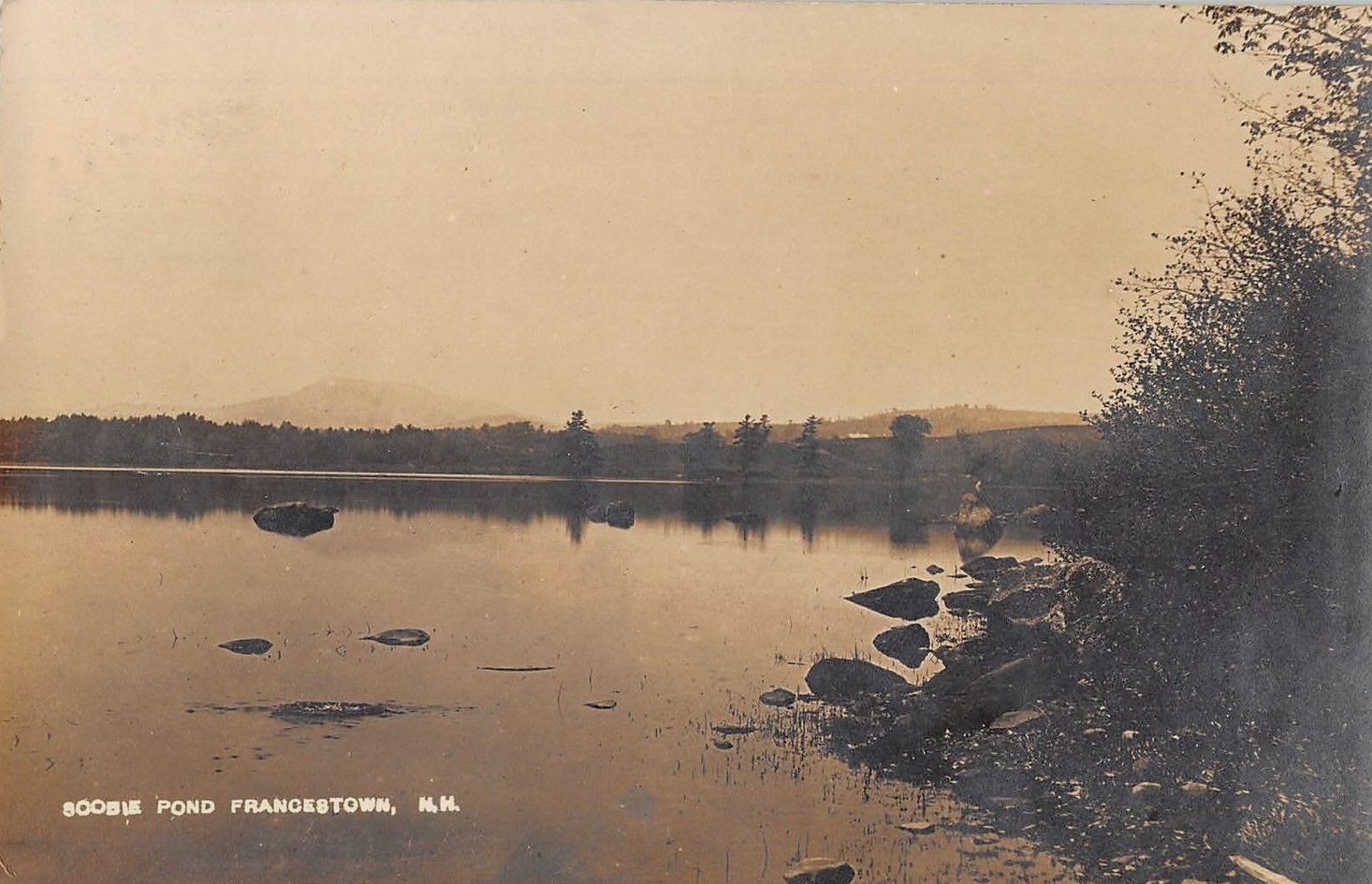
Image from old postcard of Scoby (AKA Scobie) Pond
However, there are other possible origins for the name (and for these, go to the link for the History of Francestown below and start on Page 432).
One story holds that the children (and likely grandchildren) of David Scoby made tremendous sport out of running about in the dark to frighten people (described delightfully in the history as "Liquor-Laden Loafers") by pretending to be spirits and monsters. Given that a similar thing seems to be the origin of ghost stories at California's Rispin Mansion, I have to admit to a fondness for this explanation. That said, the "Scoby Boys" weren't active until the 1780s at the earliest, and, as noted above, the lake was referred to as "Haunted Lake" by 1753, so while this may have kept the name going, the name likely inspired the Scobys and was probably not inspired by their antics.
Another story says that two travelers bought land in the area, and in the 1740s, travelled to the area, starting out separately but eventually meeting and traveling together. One night, while camping near, or on the shore of, the pond, they fought, and one killed the other. The murders gave the victim a half-hearted burial and left the body. When Matthew Patten (a land surveyor) was sent out to perform surveys of the area, he and his chain men (people who assisted the surveyor by using chains that helped to measure distance) camped on the shore of the lake, and heard groaning and shrieking, as if from a man in desperate pain. The work crew, despite Pattens' efforts, left for Bedford the next day without completing the survey.
Yet another story holds that Davis Scoby found a skeleton of a large, but young, man while preparing the land for his mill. It is not specifically said that there are any haunting elements associated with this discovery, but that would seem appropriate for the lake's name.
Finally, one more story: Two hunters set out to hunt and trap near the lake. They would camp together at night, but head out in different directions during the day. One evening, one of the campers failed to return to camp. When the other camper went out to find him the next day, he discovered that his companion had been killed by one of the animals that prowled the area. The surviving hunter headed back for the
The odd thing is that, aside from the lake's name, and the 18th century reference to the sounds of pained shrieks and moans, there is little to indicate that anyone has had weird experiences out here. This is disappointing, but there you go.
That said, there is a lengthy list of deaths that occurred (or, at least, are said to have occurred) at the lake up through the late 19th century. None of them are said to be supernatural, but it will still make you feel somewhat creeped out.
Commentary: This is a fun one. Most likely, the name haunted lake is due either to an eerie post-fire appearance, as noted above, or to bits of local folklore with little basis in reality. It's just the way that these things tend to go. But, that said, every community needs its local haunted property, and given that it is filled with water and typically literally opaque to humans, a lake makes for a good one.
There really isn't too much to say about the story itself, but I would like to discuss something having to do with two of the sources that, given what I do as my day job, I find interesting. The first is the diary of Matthew Patten - diaries such as these were kept by many people in the 18th and 19th centuries, and most were lost, a few found there way into special collections, and a few of those were published. These are often used by researchers who have to do historic research, and I found myself often consulting my copy of a similar diary, though this of a sailor, called Three Years Before the Mast when working on my masters thesis (this contained discussions of early Santa Barbara, California, and as my masters thesis looked, in part, at the archaeology of culture contact, this was a useful resource).
The second thing that is interesting is the late 19th century town history of Francestown. Books like this were common in the late 19th and early 20th century, and for people doing any sort of historical research, or research into local folklore, these are gold mines. I often use these when writing historic contexts for my day job, and have found them consistently useful. Plus, it's fun to find out what all of the various places names in your town actually mean.
Sources: iO9, Cow Hamphshire Blog, Diary of Matthew Patten, Published Book, History of Francestown, New Hampshire's Haunted Places,
Wednesday, June 7, 2017
Devils Gate, Pasadena, Los Angeles County
At Devil's Gate Gorge in Arroyo Seco there sits a large rock outcrop that many believe is shaped like Satan's head, hence the name of the location. Factual information about the location's history is hard to come by, having been buried in tall tales and folklore, and these have, in turn, influenced much of what people say and have written about it in the tight circle of fact and nonsense that is human collective memory.
Holy crap, I read what I just wrote and realize that I have been listening to a lot of Aaron Mehnke's podcast* lately.
Regardless, what become common belief tends to color what people wish to write about and tends to change stories that we hold to be true of older stories. So, keep in mind that, especially when talking about Tongva beliefs below, there is a fair chance that the story is more nonsense than sense. But it's entertaining nonsense, and in the end, isn't that the highest form of truth? The answer is no.
Okay, I promise that I have all of that out of my system now.
As noted above, the rock formation, from one angle, looks like a devil's head. See what you think:

Local stories holds that the sounds of the river moving through the gorge sounds like laughing, which was allegedly thought by members of the local Tongva ethnolinguistic group to be the culture hero Coyote laughing**. Some telling shold that the Tongva felt that the location was supernaturally powerful and to be avoided, and others that it was the gateway to the afterlife and therefore to be shunned by the living. I am skeptical of the claim that the Tongva had these story, especially the variations about avoiding the location - this sort of embellishment is often added to ghost stories to make them seem more authentic, but is almost always false.
In 1920, the gorge was dammed to create a reservoir and control flooding in the Los Angeles river system. However, the Devil's Head remained above water and continues to be visible
As time went on, the place began to collect other stories, the most entertaining of which involve Alastair Crowley, L. Ron Hubbard, and their friend, Jet Propulsion Laboratory c-founder and scientist and all around really weird guy, Jack Parsons. According to the story, Ol' Al , Ron, and Jack were convinced that the Devil's Gate Gorge was a gateway to Hell (one of specifically seven) and full of all manner of supernatural power. Some folks have claimed that the location of the Jet Propulsion laboratory was intended to use power from the Devil's Gate, and is tied in to the various occult movement that have become popular in Los Angeles and Hollywood during the 20th century. While these stories tend to breakdown into incoherency pretty quickly, they are fun to hear and tell.
Among the stories are claims that Hubbard and Parsons too part in rituals at the gorge with the intention of tapping into the Hell gate's energy, possibly to create a Moon Child, a being that would embody a feminine divine force. Parsons and Hubbard did, in fact, engage in rituals for this purpose in 1946, though whether they did anything at Devils Gorge is not reported anywhere.
In the 1950s, a series of children went missing in the area, including 13-year-old Donald Lee Baker and 11-year old Brenda Howell in 1956, and 8 year-old Tommy Bowman in 1957 and 6-year-old Bruce Kremen in 1960. Bruce Kremen is especially baffling, as the boy was attending a YMCA camp, and left the counselors to walk 300 yards back to the camp lodging, only to vanish. The 1956 disappearances were explained years later when serial killer Mack Ray Edwards was caught. The later disappearances are still unsolved, and may have been tied in to Edwards, or may be due to some other cause. Regardless, they have added to the grisly history of the area.
Modern L.A.-area ghost hunters like too claim that these rituals opened the gate, allowing evil entities into our world. And they flock to the location hunting for these entities (I wonder what the OSHA requirements for protective equipment are? A Mojo hand? a gris-gris bag?). Stories for the location include the (disappointedly mundane given the history above) usual orbs in photos and phantom voices. In one case, someone did report hearing singing coming from the metal gate shown in the picture above, and seeing red eyes peering from the back of the tunnel.
The folks at Offbeat L.A. provided a short and enjoyable description of the area, though they refer to mysterious wood structures that, to this individual who deals with utilities, look exactly like transmission line structures, so, you know, grain of salt and all.
*Which, if you haven't been listening to it, I have to ask, what is wrong with you? If you like the sordid tales that I post here, Aaron Mehnke's providing you the stronger stuff, and in excellent, if sometimes very wordy, format.
** I am not a specialist in Tongva mythology, but I am a professional archaeologist and anthropologist that works in California, and this explanation of allegedly local Native American belief sounds to me more like a 20th-century white-person claim than an actual part of the local Native Folklore, but, again, as I am not an expert on the stories of this particular region (my graduate research was performed farther north in the Santa Barbara area, and my professional life has been primarily in the San Joaquin Valley and Sierra Nevadas), I may be wrong and it is possible that this place was forbidden in the Tongva belief system. Incidentally, as I refer to utility companies later in this entry, I am an archaeologist employed currently by a utility company to help them comply with federal and state cultural resources laws - so I help protect archaeological sites, historic buildings, and spots important to Native Americans - yep, it's an actual job with a good career path and decent pay, so if you decide to get a Masters degree in archaeology, yes you can actually have a good job, no matter what all of those condescending assholes will imply.
Commentary: Naturally, the ghost hunters who visit the area are looking for the "norm" of our time - orbs, cold spots, and the like. Which is disappointing given the allegedly deep supernatural meaning of this place. I have to admit that, in reading LA Ghost Portal's write-up, I was a put off by their description of trying to reach out to the spirits of missing and dead children. That just seemed really tasteless to me. On the other hand, I included them in my description here, so perhaps I am guilty of the same tastelessness.
What I like about this story is the way that it weaves numerous different strands present in other ghost stories together. Appeals to Los Angeles supposed hedonism? Check! Reference to a cult? Check, and bonus (both Crowley's temple and Scientology make an appearance!)! Reference to dark rituals? Check! Reference to Native American sacred sites? Check! Turning the mundane (a gate) into something creepy? Check!
The story is, undoubtedly, mostly bullshit, though, wonderfully, the one element that might be true is the most outlandish - while I can't confirm that Parsons and Hubbard ever engaged in rituals at the Devils Gate, it would not have been any weirder than things that these two were confirmed to have gotten up to around that point in time.
Source: Atlas Obscura, LA Ghost Portal, Timeout, Offbeat L.A., Weird U.S.
Holy crap, I read what I just wrote and realize that I have been listening to a lot of Aaron Mehnke's podcast* lately.
Regardless, what become common belief tends to color what people wish to write about and tends to change stories that we hold to be true of older stories. So, keep in mind that, especially when talking about Tongva beliefs below, there is a fair chance that the story is more nonsense than sense. But it's entertaining nonsense, and in the end, isn't that the highest form of truth? The answer is no.
Okay, I promise that I have all of that out of my system now.
As noted above, the rock formation, from one angle, looks like a devil's head. See what you think:

Local stories holds that the sounds of the river moving through the gorge sounds like laughing, which was allegedly thought by members of the local Tongva ethnolinguistic group to be the culture hero Coyote laughing**. Some telling shold that the Tongva felt that the location was supernaturally powerful and to be avoided, and others that it was the gateway to the afterlife and therefore to be shunned by the living. I am skeptical of the claim that the Tongva had these story, especially the variations about avoiding the location - this sort of embellishment is often added to ghost stories to make them seem more authentic, but is almost always false.
In 1920, the gorge was dammed to create a reservoir and control flooding in the Los Angeles river system. However, the Devil's Head remained above water and continues to be visible
As time went on, the place began to collect other stories, the most entertaining of which involve Alastair Crowley, L. Ron Hubbard, and their friend, Jet Propulsion Laboratory c-founder and scientist and all around really weird guy, Jack Parsons. According to the story, Ol' Al , Ron, and Jack were convinced that the Devil's Gate Gorge was a gateway to Hell (one of specifically seven) and full of all manner of supernatural power. Some folks have claimed that the location of the Jet Propulsion laboratory was intended to use power from the Devil's Gate, and is tied in to the various occult movement that have become popular in Los Angeles and Hollywood during the 20th century. While these stories tend to breakdown into incoherency pretty quickly, they are fun to hear and tell.
Among the stories are claims that Hubbard and Parsons too part in rituals at the gorge with the intention of tapping into the Hell gate's energy, possibly to create a Moon Child, a being that would embody a feminine divine force. Parsons and Hubbard did, in fact, engage in rituals for this purpose in 1946, though whether they did anything at Devils Gorge is not reported anywhere.
In the 1950s, a series of children went missing in the area, including 13-year-old Donald Lee Baker and 11-year old Brenda Howell in 1956, and 8 year-old Tommy Bowman in 1957 and 6-year-old Bruce Kremen in 1960. Bruce Kremen is especially baffling, as the boy was attending a YMCA camp, and left the counselors to walk 300 yards back to the camp lodging, only to vanish. The 1956 disappearances were explained years later when serial killer Mack Ray Edwards was caught. The later disappearances are still unsolved, and may have been tied in to Edwards, or may be due to some other cause. Regardless, they have added to the grisly history of the area.
Modern L.A.-area ghost hunters like too claim that these rituals opened the gate, allowing evil entities into our world. And they flock to the location hunting for these entities (I wonder what the OSHA requirements for protective equipment are? A Mojo hand? a gris-gris bag?). Stories for the location include the (disappointedly mundane given the history above) usual orbs in photos and phantom voices. In one case, someone did report hearing singing coming from the metal gate shown in the picture above, and seeing red eyes peering from the back of the tunnel.
The folks at Offbeat L.A. provided a short and enjoyable description of the area, though they refer to mysterious wood structures that, to this individual who deals with utilities, look exactly like transmission line structures, so, you know, grain of salt and all.
*Which, if you haven't been listening to it, I have to ask, what is wrong with you? If you like the sordid tales that I post here, Aaron Mehnke's providing you the stronger stuff, and in excellent, if sometimes very wordy, format.
** I am not a specialist in Tongva mythology, but I am a professional archaeologist and anthropologist that works in California, and this explanation of allegedly local Native American belief sounds to me more like a 20th-century white-person claim than an actual part of the local Native Folklore, but, again, as I am not an expert on the stories of this particular region (my graduate research was performed farther north in the Santa Barbara area, and my professional life has been primarily in the San Joaquin Valley and Sierra Nevadas), I may be wrong and it is possible that this place was forbidden in the Tongva belief system. Incidentally, as I refer to utility companies later in this entry, I am an archaeologist employed currently by a utility company to help them comply with federal and state cultural resources laws - so I help protect archaeological sites, historic buildings, and spots important to Native Americans - yep, it's an actual job with a good career path and decent pay, so if you decide to get a Masters degree in archaeology, yes you can actually have a good job, no matter what all of those condescending assholes will imply.
Commentary: Naturally, the ghost hunters who visit the area are looking for the "norm" of our time - orbs, cold spots, and the like. Which is disappointing given the allegedly deep supernatural meaning of this place. I have to admit that, in reading LA Ghost Portal's write-up, I was a put off by their description of trying to reach out to the spirits of missing and dead children. That just seemed really tasteless to me. On the other hand, I included them in my description here, so perhaps I am guilty of the same tastelessness.
What I like about this story is the way that it weaves numerous different strands present in other ghost stories together. Appeals to Los Angeles supposed hedonism? Check! Reference to a cult? Check, and bonus (both Crowley's temple and Scientology make an appearance!)! Reference to dark rituals? Check! Reference to Native American sacred sites? Check! Turning the mundane (a gate) into something creepy? Check!
The story is, undoubtedly, mostly bullshit, though, wonderfully, the one element that might be true is the most outlandish - while I can't confirm that Parsons and Hubbard ever engaged in rituals at the Devils Gate, it would not have been any weirder than things that these two were confirmed to have gotten up to around that point in time.
Source: Atlas Obscura, LA Ghost Portal, Timeout, Offbeat L.A., Weird U.S.
Sunday, May 21, 2017
An Evil Gnome in Tulare County
A family moved in to a farm house near the Tule River in the area around Porterville, in rural Tulare County, California.
After moving in, the mother, Tammy, began to feel on edge, as if she was always being watched. And one location, in particular, made her uneasy: the barn. Even the family's animals (pets as well as fowl such as geese and chickens) avoided the barn, and everyone got the creeps when near it. They could never put a finger on what bothered them, but knew that something was not right.
One night, when returning home from the grocery store with one of her children, Tammy heard a sinister chuckling and saw movement out of the corner of her eyes. Turning, she saw a small (2-3 feet tall), gnome-like creature. It as wearing a red hat, a gold-colored shirt, and black pants, and when it "smiled" at her, it revealed to rows of brown, decayed, and sharp teeth.
Eventually, a woman named Charlie and her family moved into the house, and it all began again. They noticed that animals, both domestic and wild, avoided a building that they called "the shack" (presumably the barn that made Tammy uneasy). On at least one occasion, Charlie felt so unnerved while walking near the shack that she picked up her two young children and broke into a sprint to get away from it.
And then, one day, things picked up and became much more frightening.
Charlie heard what sounded like a car fighting with something inside the shack. When her husband went to investigate, he found a cat alright, entirely skinned on one side and with a huge bite taken out of its neck. He stepped out to clear his head, and when he stepped back in, the cat was gone.
A short time later, at 3 a.m.*, Charlie and her husband woke to a guttural, eerie singing coming from the back yard. Looking out their window, they saw the same creature. It was looking at them as they looked through their window at it. It pulled a fish out of the koi pond that Charlie had installed, and smiled as it ate the fish and stared at the couple. Charlie's husband yelled out the window that he was going to call the police, an the gnome flipped them off** and then walked away, laughing the entire time. When the police arrive,d they found nothing but child-sized foot prints.
The creature returned every night at 3 a.m., messed about with their lawn ornaments (mostly gnome and fairy ornaments, naturally) and eating the fish in the pond. Finally, the family locked the ornaments away and put the fish into a tank in the house. When the creature showed up the following night, it was pissed. It proceeded to scream in it's odd, guttural language, while running in circles around the house. Charlie ran downstairs to find the dogs barking at the dog door, which she quickly secured from the inside before running upstairs to lock all of the windows.
The family left shortly thereafter. When a writer introduced Charlie and Tammy to each other, they went back to look in on the property. The barn/shack was gone, but when they went to speak with the current resident, they were rudely rebuffed and sent packing. A commenter claiming to be Tammy claimed that she would later learn, however, that others in the area had been terrorized by the creature for years, and that, some years later, the creature seemed to follow her to her new home. Some web commenters from the area claim that, while they never saw anything, they always felt uneasy in the vicinity and avoided the property in question.
* I make a point of noting the time only because 3 a.m. plays a prominent role in modern ghost folklore. This seems to be a development of the last few decades, with midnight being important in earlier folklore. Initially, the 3 a.m. time, from what I have read, comes from the three numbers that mark "the beast" in the book of revelations, which has come to be the "number of the devil" in popular folklore, and so the fact that there are three numbers have made 3 a.m. (get it get it?) important to many people who like a religious bent to their ghost stories. I have also heard that as this is three in the dark, it can be a dark reflection or parody of the holy trinity. Personally, I have always thought this was a rather silly conceit that generally just makes me roll my eyes, but that's me.
** Well, rude hand gestures ARE the universal language, after all.
Commentary: While not specifically a ghost story, I feel like this one falls more on the weird spirit side of the spectrum than the cryptozoological one, so I decided to add it here.
That said, the story fits very nicely into the tradition of the western European Faerie stories. Although we tend to use the term "fairy tale" nowadays to describe something both fantastic and gentle if not childish, the actual folklore from which the term "fairy" comes were, in fact, more often dark and molevolent (indeed, if you were to tell a 10th century person that they were "fae" they wouldn't think that you were calling them feminine, they would think that you were saying that they were doomed to a horrible fate at the hands of the supernatural). When Black Sabbath sang about fairies in boots dancing with dwarves, they weren't trying to call up a cartoonish image, but were, instead, trying to describe something otherworldly and terrifying.
So, the idea of a malicious gnome terrorizing a family in an isolated farmhouse is absolutely in keeping with these older traditions. That said, the description of the creature in the story doesn't match that of a gnome so much as it does a faerie (later Christianized as a demon) from northern Europe known as a Redcap - these creatures looked in many respects like the garden gnomes that we appreciate so much, but were vicious murderers whose hats were red with the blood of their victims. Should their hats dry out the redcap would die (or be sent back to Hell, or be banished from the material plan, etc. etc.). The redcaps wore iron boots (unlike other such folkloric creatures, they weren't afraid of iron), but nonetheless ran faster than any human could. They were vile, often dirty, and enjoyed the pain and suffering of others.
It is interesting to me, as a resident of the San Joaquin Valley, where this story takes place (Tulare County is just south of Fresno County, where I currently live) that this story is reliant on northwestern European faerie mythology, and not the more common Latino folklore that permeates much of our local ghost folklore (in fact, I went for a walk this afternoon along a trail said to be haunted by a La Llorona spirit). Given the tendency for many neo-pagan groups to rehash selective elements of Celtic and Germanic folklore, it may be that this is the source of this, or it may be something else. Regardless, it makes for an interesting story.
Naturally, the internet being the internet, on the web pages where this story was posted there is a lot of speculation as to what happened, ranging from discussions of fairies to speculation that the little man might have been an escaped mental patient. And in one web forum the there is an active debate as to whether or not one more fervent evangelic Christian poster is justified in calling this thing a demon.
The text of the story at Weird Fresno is taken from Mysterious Universe, so they may seem redundant, but the blog comments at Weird Fresno are worth a look. First, off, there is someone who claims to be the "Tammy" from the story, further describing her experiences. Secondly, there is a commenter who claims to have seen the same type of creature at another location in another state. As stated above, this story bears more than a passing resemblance to some of the faerie folklore from which gnomes are derived, so it seems only fitting that others would claim similar encounters.
Sources: Weird Fresno, Mysterious Universe
Sunday, June 19, 2016
White Rock Lake
Sit back and buckle in for an interesting variation on the vanishing hitchhiker, from the Lone Star State!
Drivers on the roads around White Rock Lake near Dallas, Texas, may encounter a young woman, soaked to the bone and wearing what appears to be a white evening gown from the 1920s. If the driver decides ot be a good samaritan and stops to offer help, the young woman will ask to be driven to an address on Gaston Avenue. In some versions of the story, the young woman explain that there has been an accident and her car has fallen into the lake, while in others she is barely verbal due to a stupifying state of shock. Upon arriving at the destination, the driver will discover that the young woman has vanished, but that there is water covering the seat where she had been sitting.
In some versions of the story, the woman will specify that the house to which she has asked ot be driven belongs to her father. On arrival, the driver will observe that the young woman has fallen asleep, will go to the house and knock on the door. The door is then opened by an elderly man who is angered when this stranger claims to be bringing the elderly fellow's daughter home - you see, she had dided years earlier when her car plunged into the lake, and he doesn't appreciate these sorts of jokes. It is at this point that the driver returns to the car to find that woman is gone and the seat is wet.
The identity of the woman is not known, nor is why she is trying to reach the house on Gastone Avenue.
There is one other variation on the story, one which is much, much creepier and bears no resemblance to the hitchiking ghost story outside of the presence of a young woman in an evening gown. In this version, people boating on the lake or out at the docks at night report seeing a body floating face down, carried (seemingly by the currents, though we know better) towards the observers. It appears to be the body of a drowned young woman in a fancy evening gown. As the body come close to the observers, it turns over, and those present can see that the skin is bright white, as if drained of bloood. As it reaches the observers, the eyes spring open and the body emits a ghastly, disturbing shriek. Allegedly, those present always run away at this point, because, let's face it, so would you and I.
Commentary: There really are two separate ghost stories here, whether or not they have the same origin is unclear. The first is a standard vanishing hitchiker story, but with the ghost leaving behind water rather than a jacket or sweater (which, when you get down to it, is just really damn rude on the ghost's part). The second is a much stranger and more sinister story that has some truly creepy and disturbing elements. I suspect that this is a case where elements from one story (woman drowning when a car plunges into a lake) were adopted into a new story because, let's face it, the vanishing hitchhiker story is ubiquoutous to the point of becoming a bit boring. Another possibility is that the creeepier story, of the floating corpse, is the original tale, and that it was adopted into the ubiquoutous vanishing hitchiker story by people getting their stories a bit garbled. Regardless, while I appreciate the hitchiker story as a form of folklore, I am much more likely to tell the latter story should I be sitting with friends around a campfire.
The ghost story has also become an element of one of Dallas's odder pop-culture moments. In October of 1967, local radio personality Chuck Boyles decided to invite his listeners to join him at White Rock Lake in order to search for the phantom and try to solve the mystery behind her (lest you are inclined to think of this as a serious investigation, keep in mind that he was a radio DJ given to the self-promotion necessary to that profession and that this was likely intended as a goofy lark). While he likely expected to result in a few dozen people coming out (he set the meeting for the very early hours of the morning, likely to discourage many people from joining him), something in the neighborhood of 1000 people (mostly under the age of 25) arrrived. This, in turn, resulted in the police coming out, hoping to prevent a riot. While there was a bit of mischief, it was, ultimately, anti-climatic and nothing happened. However, the city government was sufficiently displeased to put Boyles in a position where he felt the need to make an on-air apology a few days later.
And that, my friends, is how you ensure the continuation of a piece of folklore. My gratitude goes ot Chuck Boyles, even though those living near the lake were likely less than please with him.
Chuuk Lagoon, Micronesia
Chuuk Lagoon, also known as Truc Lagoon (let's hear it for languages with semi-compatible phonemes!) is a natural harbor in the Caroline Islands. The Japanese navy used it as a home base during the second World War. This came to a sudden end on February 17, 1944, when a two-day battle began, resulting in the destruction of the base. More than 50 ships and hundreds of aircraft were destroyed, and thousands of Japanese soldiers lost their lives (400 of which are said to have been trapped in the hold of a ship which sank, drowning the men.
Since the war, the lagoon has become a popular destination for scuba divers who want to explore sunken wrecks (some sources place credit for this popularity with a 1969 documentary by Jacques Cousteau).
Although a significant number of bodies were eventually recovered and returned to Japan for burial, many remain in the depths of the lagoon. Many of those who have dived at the lagoon report supernatural goings-ons.
Several of the ships that sank were cargo ships, including at least one loaded with trucks, and divers have reported hearing the sound of automobile engines starting and idling under the water. Similarly, many divers have reported hearing machine-like grinding noises coming from the engine rooms of some of the sunken ships.
Divers have also reported hearing human voices emanating from the water, and rumor holds that the locals consider the islands to be haunted, with a television crew (from the inaccurately-named "Destination Truth") claiming to have heard stories about floating lights near the caves on the island, disembodied human voices heard throughout the island (though especially in the lagoon area), and one of the crew claiming to have been touched on the shoulder when nobody else was present.
Commentary: Considering that battlegrounds across the world attract ghost stories, it is only natural that the same be true of a naval battleground (battlewater?), especially considering the volume of dead and the difficulties of recovering bodies from the water as compared to dry-land battlegrounds. While the Japanese government has made efforts to recover and bury bodies from the lagoon, it is still common for divers to find human remains while exploring, which says more about the nature of massive shipwreck sites than about the efforts of the Japanese government.
I wonder about a few things here, though. The first is whether or not the locals truly consider this place to be haunted, or if that is a European/U.S. story that we place on the location because in our ghost story traditions it seems like it should be haunted (haunted burial grounds, which is what this place has become, though a standard part of European and therefore U.S. folklore, are not a universal part of human views about burial places). I don't know, and if any of the readers have had reason to visit Micronesia, perhaps you could inform me. If they do consider it haunted, I then wonder if this is a native view, or if it is something imported with wreck-diving tourism in the 1970s and later. Again, I genuinely don't know, and would be grateful if any of my readers could fill me in.
Similarly, I know that many non-competitive sports sub-cultures have developed their own superstitions and supernatural beliefs common throughout (try talking to a surfer some time, or a mountain climber, and you will see exactly what I mean). If so, then I would wonder whether or not those beliefs have fed this growing legend. I have already begun contacting divers that I know in order to ask them - if they get me any information, I will update this entry accordingly. (Edit to note: I have spoken with a couple of divers so far, they both think that this is likely a dead-end. While they have encountered supernatural divers, they have not encountered a supernatural view common to divers).
One final note - I have observed that, as with many other ghost stories of more recent vintage, the haunting of Chuuk lagoon is one that appears across the internet, often with the exact same information repeated over and over again, not quite word-for-word, but without much variation - so it's not the copy-and-paste style of folklore spread that I have noted for other ghost stories, but it is something close to that. If you type Chuuk lagoon (or Truk Lagoon) into Google, you will pull up many web pages, but I only cite three below, because, frankly, no matter how many I went through, I never found anything new pertaining to the ghost stories, so I just included the first three that I found. Again, I have to wonder whether or not this suggests that the over-use of a few specific sources may be resulting in stagnation of folklore. I also noticed that none of the sources cited primary print references for the ghost stories, instead relying on hearsay, other websites, and a relatively recent television show - this makes me wonder whether or not this legend may be more recent, originating in the 1990s or later, as the internet made sharing details of dives easier. If this is the case, then perhaps this is a story that is emerging, rather than stagnating.
Subscribe to:
Posts (Atom)


 Posts
Posts

