In the late 18th century, a young woman lived with her uncle at the townhouse located at 50 Berkeley Square. Her uncle was a cruel and abusive man, and it was known that he was doing her harm, though the specific nature of that harm was never specified. One night, she opened the window of her top floor room, and flung herself out, falling to her death. Since then, her spirit has been seen in the upstairs of the house, and some say that simply seeing it has the power to frighten a person to death.
In addition to the young woman (or, in some tellings, in place of) the specter that haunts the top floor is said to be that of a young man who was kept locked in a room and feed through a hole in the door. In other tellings, it is the spirit of a little girl. And, in some stories, the ghost could be any of the three, or something else entirely, and takes the form of a horrifying vaguely human-shaped mist.
At some point, the house became the home of George Canning, a former Prime Minster who lived in the house until his death in 1827 (stories differ as to whether or not he was the abusive uncle). Canning, is is alleged, heard strange sounds in the night, from empty parts of the house, but never reported being especially frightened. After Canning's death, the house was then leased to one Miss Curzon, who lived there until she died at the ripe age of 90 in the 1850s*.
Allegedly, in 1840, a young man, reportedly a student, named Robert Warboys (apparently on his day off of defending the Citadel on behalf of Immortan Joe) was drinking with friends at a nearby tavern, and heard that the house at 50 Berkeley square was haunted. Filled with alcohol and testosterone, he accepted a dare to stay the night in the house. Arriving at the door, he made enough noise to wake the landlord, who rebuffed him. Warboys proceeded to make such a nuisance of himself that the landlord agree to let him stay in one of the more haunted rooms on two conditions - 1) Warboys be armed (whether the pistol he took with him was his own or was borrowed from the landlord is unclear); and 2) at the first sign of trouble, Warboys pull a chord in the room that would ring a bell and summon the landlord. After an hour, the bell began to ring frantically, and the landlord heard a pistol shot. On arriving at the room, the landlord found that Warboys was cowering in a corner, smoke coming from the barrel of his pistol, a bullet embedded in a wall, and nothing else. Warboys was clearly agitated, but said nothing, and fled the house (in some versions of the story, Warboys is said to have been dead, or catatonic, when the landlord arrived).
In 1859, Thomas Myers moved in, bringing in the dankness that every good haunted house requires, as well as a heaping helping of weird.
Initially, things looked bright for Myers. He was engaged to be married, and had bought the house and begun furnishing it to fit his bride and hopefully his future family. When his fiance jilted him, however, he is said to have become a recluse, keeping to himself on the top floor, going days at a time without speaking to anyone, and leaving his room only at night to wander the house by candlelight**. He allowed the house to fall into disrepair, neither cleaning the house nor carrying out maintenance. He died in 1874, allegedly quite mad (though some stories put his death in the 1880s).
During Mr. Myers time in the house, one incident of particular notoriety occurred. In 1872, George Lyttelton, a prominent politician and member of the aristocracy, arranged for a room at the house for one night. He brought with him a firearm, a shotgun by some versions of the story. Late at night, he fired at an apparition that he saw. When he went to look for it by the light of the next morning, he found his cartridges, but no sign of whatever he had shot at. Lyttelton is said that he shot at some creature with tendrils, brown in color. Whether the creature appeared in from of him, or he saw it enter the room, varies from telling to telling, but allegedly it led to Lyttelton declaring the house "supernaturally fatal to body and mind."
An article published in Mayfair Magazine in 1879 reported that a maid, who was working in the attic in the service of a family that had just bought the house, broke into a sudden, terrified scream. When the new owners made it up the stairs, they found the maid weeping on the floor, and murmuring "don't let it touch me". Allegedly, that was the last comprehensible thing that she said, and she died the next day in an asylum.
The maid was preparing the room for one Captain Kent, fiance to the family's daughter, for whom the attic room was being prepared. Despite the fate of the maid, he chose to stay in the room anyway, perhaps as a show of bravery. He went to bed, and 30 minutes later, his fiance's family heard him screaming, followed by the sound of gunshot***. When they reached his room, he was catatomnic, dying shortly thereafter.
A final story holds that, in 1887, two sailors were looking for lodgings, and decided to break into the now-deserted house to save money (or, according to some versions of the story, they did so out of strong thrill-seeking streak that one or both of them possessed). The men bedded down somewhere on the upper floors, and after a series of strange sounds, managed to fall asleep. One of the sailors woke in the night to see his companion struggling with...something. It was an amorphous, blob-like creature with tentacles that was strangling the man. In some tellings, the free sailor tried to attack the thing that was killing his colleague, in others he simply took off running in fear. Regardless of the specifics, the sailor being attacked by the creature died, and appeared to have circular wounds similar to suction cups on his neck and torso.
There is another version of the sailor's story, however, which does not discuss the creature. In this version, the sailors woke up, and one of them saw the ghost of Mr. Myer, who approached them threateningly - he woke the other sailor, and both fled, with the sailor who had seen the ghost tripping as he fled the house, falling, and dying from an injury from the fall (some versions hold that he tripped near a window, fell out, and was impaled on the metal fence that surrounds the house).
One final version of the sailor story has it all occurring in 1943. In this version, the sailors broke in to the basement in order to obtain free lodging for the night. However, finding the basement to be dank and rat-infested, they headed upstairs to the attic room. They started a fire in the fire place, settled in for the night, and tried to get to sleep. They were awoken by the sound of a door opening, followed by a wet, scraping sound. The sailors saw and felt the tendrils of some strange creature touching them, and those appendages soon wrapped around the neck of one of the sailors as he was reaching for his gun. The other sailor, terrified, fled the room and the house, finding a police officer for help. When the sailor and the cop returned to the house, they found no sign of the other sailor in the room, but did discover his dismembered corpse, with the head turned in a manner clearly indicating a broken neck, in the basement, a look of terror on his face.
Stories from the 1870s onward (increasing int he 20th century) report people, often unnamed, seeing soemthign strange in or aroudn the house, described variously as a "shadowy mean," a slimy amorphous bag with tentacles, a "collection of writhing shadows" and more standard human-like apparitions.
The house was bought by an antiquarian book seller in the 1930s, and continued in that function until 2015. These owners said that nothing unusual has ever occurred there, even noting that they can demonstrate the flaws in each of the various stories and how those stories fail to comply with the documented history of the building. Many people point to the management (or, possibly, police) having, at least at one time, closed off the upper floors, where the haunting is said to be at its most severe. The owners, however, point to the building having been damaged during the London Blitz, and indicate that is the reason for the upper floors having been closed off for a time.
*This reminds me of Dudleytown, another allegedly horrifically haunted site where people nonetheless seemed to enjoy absurdly long lives considering the period of history.
**Okay, yes, the guy sounds miserable, and probably mentally unstable, but have you ever noticed that it's only the wealthy that can get away with this sort of spookiness. I mean, the rest of us have to get up in the morning and go to work.
***With all of the guns showing up int his story, I imagine that Victorian London was rather like modern-day Texas.
Commentary: My mother, who was a fan of In Search Of and many of the various paranormal and New Age books and "documentaries" that peaked in popularity in the 70s and the first half of the 80s, would often give my sisters and I books filled with ghost stories, and this story was included in one of them. We lost the book eventually, and as a teenager and adult, I would try to find the story again. Every time I would try to look up ghost stories for England, I would find the Borley Rectory, the Brown Lady photo, and a handful of others, but none of them had the mist-like ghost or sailors being attacked by some strange tentacled beast. And so, I thought I would never track this story down, until I came across a Youtube video titled "The Unnamed Horror of Berkeley Square" - I didn't know it would be this story, but something about the title tickled my memory, I watched it, and it was the story I had spent so many years trying to track down - and now that I know that it was in Berkeley Square, finding additional information is remarkably easy.
I am, however, very happy to have found this story again - it was a formative one for me. I would likely have retained an interest in ghost stories regardless - the entertainment and creep factor alone is enough to pull me in - but this story really grabbed me at a young age. Where so many stories were over the top to a ridiculous extent, or were rather cookie-cutter and boring, this one was weird and disturbing in a rare way, and most of my interest in ghost stories ever since has been caught up in a search for that feeling.
That said, one of the things that surprised me as I became re-acquainted with the story is how many retellings are focused on a strange creature often said to be an octopus, when I remember it being focused on the ghosts, and even the creature being thought of as more of a ghostly manifestation than a physical entity. So, in looking at the articles and videos that I found on this subject, I was interested to find that most of the focus is on a discussion of whether the weird creature is some kind of unknown animal, often a mutant octopus that has adapted to live on dry land is suggested (and yes, I know how dumb that sounds). But, I am not certain that the people who began telling these stories in the late 18th and early 19th centuries would have seen it that way.
Now, admittedly, I am currently working under the influence of Paul Barber's book Vampires, Burial & Death, but he makes an interesting point in that book that may be applicable here. The book is primarily about vampire folklore, which is radically different from the vampires of literature, film, and pop culture, and tying that folklore in to actual observations made about decomposition (his thesis being that almost everything that is in the actual folklore for vampires is actually pretty neatly tied to elements of natural decomposition). Along the way, he makes the observation that most of the people who believed and spread this folklore didn't make a sharp distinction between supernatural phenomenon, and would have viewed vampires, ghosts, witches, werewolves, and all manner of other things as being inextricably tied to each other, often with the terms for different "types" of creatures being used interchangeably, and thus suggesting that the people telling these stories didn't make a distinction. And I have to wonder if the same thing may be going on here - the ghosts, the mist-like thing, and the slimy alleged octopus were all simply different manifestations of "weird" without a clear differentiation.
But, then, perhaps I am allowing my own views on how people of the past perceived the weird to color my views. So, you can take or leave my hypothesizing.
Another likely blow against my take on things is that most elements of the ghost story appear to date to the second half of the 20th century, and not the 19th. A few elements are probably earlier - Myers family members (including Lady Dorothy Nevill) and descendants point to his tendency to roam the house by candlelight at night having led to some ghost stories during his residence there. Additionally, many elements of the story appear to have been lifted directly from Edward Bulwer-Lytton's 1859 story "The Haunted and the Haunted." Moreover, as the house sat unoccupied for stretches of time, it was far more decayed and decrepit than neighboring homes, which always helps a haunted reputation. The Spiritualists of the late 19th century apparently tried to get access to the house, but never had luck finding an owner that would let them in. That said, many of the story elements became best known from 20th century writings - specifically the 1907 publication Haunted Houses by Charles G. Harper and the 1975 book Haunted London by Peter Underwood.
So, this is probably more a case of sensationalist literature throwing everything at the wall to see what sticks rather than a result of organic folklore development, as much as I may wish it were otherwise. There is certainly a shortage of verifiable facts among the more exciting claims, and many others seem to have more mundane answers. More's the pity.
Fun fact - in researching this story, I came across a few examples of people claiming that Miss Havisham of the Charles Dickens novel Great Expectations was inspired by Mr. Myer's over-the-top reaction to being jilted.
Sources: Bedtime Stories, Wikipedia, Haunted London, Lore Podcast, Mental Floss, ABC News, Strawberry Tours, The Evening Standard, Astonishing Legends (the blog), Mysterious Universe,
Sunday, November 24, 2019


Sunday, May 5, 2019
Cooley's Conjure Chest
Some time around 1840, Jacob Cooley, of Frankfort Kentucky, was expecting his first child. His wife was pregnant, and Jacob had to make sure that his child had all needed items, including a chest of drawers for their bedroom. To this end, he ordered one of his slaves, a furniture-maker named Hosea, to build the chest.
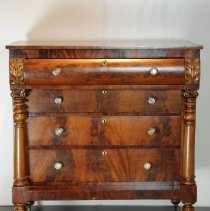
Though most people would hold that the chest was well built and quite beautiful, Cooley disliked it, and in a fit of rage, beat Hosea to death.
The other slaves saw this as a move too far by the master, and they saw the need to address it. Among the slaves was a conjure man, who told the others what to do: they snuck the chest out of the house, and brought it to the conjure man's cabin. He lead them in a chanted incantation, while sprinkling owl's blood into one of the chest's drawers. The chest was, thus, cursed.
For reasons unclear, but possibly due to the curse itself, Cooley decided to make use of the chest despite his dislike of it, and placed it in his son't room. His son died a few days after birth.
From there, a number of people are said to have died after storing their goods in the chest. Rather than type out a blow-by-blow, I am going to copy from the Kentucky Historical Society:
In other words, worries about what you were storing items in didn't begin with people freaking out over chemicals in Tupperware.
In the end, a descendant of Jacob Cooley inherited the chest, and consulted a conjure woman named Annie, who informed her that the following conditions would have to be met for the curse to be lifted (stealing from Fairweather Lewis's blog):
Well, shortly afterwards, someone sent Mrs. Hudons's son the owl, unprompted (WHAT ARE THE ODDS????) , and she and Annie proceeded to carried out the rest of the ritual. Annie told Mrs. Hudson that, if one of them died, then they would be the last victim and the curse would be lifted. Annie died shortly afterwards, making her the 17th and last victim of the curse.
The chest was donated to the Kentucky Historical Society in 1976*. It is claimed by some that the Kentucky Historical society has placed a talisman consisting of the feathers of an owl in the chest in which owl's blood is said to have been sprinkled nearly two centuries ago.
The original source for this story appears to be a book of short stories and reminiscences titled Flapdoodle, Trust, and Obey by Virginia Hudson, a descendant of Cooley.
*I do not know what the cataloging system is for the Kentucky Historical Society, so it may well have been donated in 1976. But the catalogue number would indicate a 1980 donation in the systems that I have used. Again, though, they may be using a system that I am not familiar with, and the number may indicate different information than it looks like to me.
Commentary: Before I get into the things that I think are interesting here, I would like to make a quick point. Many of the images you see online for this show a chest, not a chest of drawers. A chest of drawers is an antiquated term for what we would typically call a dresser now. The image above is an image from the Kentucky Historical society, a photo of the item discussed here. So, that is what it looks like.
There are many ways for this story to be read. One is simply as the modern story, shared among those of us for whom American chattels slavery is a thing long gone, where this can be seen by many as nothing more than a creepy story.
Another way to read it is as a story about the anxieties of people whose position in society is dependent on keeping others in a subservient position. In this reading, the slaves are not weak and have the potential to lash out if provoked, thus both justifying pushing the lower classes of a society away from any source of power and influence, as well as acting as a cautionary tale about how far the subservient classes may be pushed without reprisal. These two contradictory meanings - we must keep people down, but don't try to hard keeping them down or you will get a backlash - can be found in stories touching on slavery from Rome to the American South, and the themes continue to be read in stories from people who have opposed the labor movement of the 20th century and who fear migrant laborers in the U.S. and Europe today. In this way, this can be seen as a mirror image of the stories from African about Zombie Trains.
Another reading is that this is a story that speaks to a sense of collective guilt among many white Americans where we see slavery as an evil, and one from which we still benefit even a century and a half after it ended (whether we will admit it or not). In such a story, we can place the guilt for the institution on individuals of the past, such as Jacob Cooley, and use this story to make Cooley symbolically pay for this original sin of American society. If you think that sounds like too much, I will simply remind you that these sorts of symbolic sacrifices are the bases of many religions (and keep in mind that the story was first introduced to the world in a book written by Virginia Hudson, in which she claimed to want to put forward her Christian religious views, and symbolic sacrifice is central to Christianity, meaning that there would likely have been some resonance there). It's a common way that humans have processed our feelings about guilt and the need for past crimes and violence to be paid for. In this case, in casting Cooley as a horrible man and not a benevolent one, as is often done in religion, it also lets us put a distance (whether real or fictional) between us and the people who perpetuated slavery - "this man was a vile murder, nothing like me, if I were born into that society, I wouldn't have been a slave owner, clearly, because I'm not that kind of person! I'd never beat someone to death!" It's a way to ignore that these people were as human as us, and were we born into the pre-Civil War, we likely would have been very much like Cooley. The story allows us not only to sacrifice Mr. Cooley (or, rather, his family) for the sins that we benefit from, it also allows us to dehumanize him and pretend that the differences between us and him are due to something other than the circumstances of where and when we were born.
Another reading is that of a resistance narrative. The slaves are subservient, downtrodden, and literally made the property of others, but they are not powerless. They have access to magic and supernatural power that is not available to the white masters. They may be in a low place, but they won't remain there, and when pushed, they have means to push back that the masters cannot understand or protect against. Again, such stories are not uncommon throughout human history, and can serve as a comfort for people in an underclass, even when the stories are about another time and place.
There are, no doubt, many other ways you can read this, and none of these readings are mutually exclusive. They are all available simultaneously, and new readings are likely to be created as needed, as is common with folklore.
One final note - the curse began with a white slave owner beating his slave to death, and then ends with an unrelated black woman descended from slaves dying as the curse's final victim. I don't know what to make of that, but it seems...unsavory to me.
Sources: Fairweather Lewis's Blog, The Unexplained Mysteries, Kentucky Historical Society, published book, newspaper, another published book
Though most people would hold that the chest was well built and quite beautiful, Cooley disliked it, and in a fit of rage, beat Hosea to death.
The other slaves saw this as a move too far by the master, and they saw the need to address it. Among the slaves was a conjure man, who told the others what to do: they snuck the chest out of the house, and brought it to the conjure man's cabin. He lead them in a chanted incantation, while sprinkling owl's blood into one of the chest's drawers. The chest was, thus, cursed.
For reasons unclear, but possibly due to the curse itself, Cooley decided to make use of the chest despite his dislike of it, and placed it in his son't room. His son died a few days after birth.
From there, a number of people are said to have died after storing their goods in the chest. Rather than type out a blow-by-blow, I am going to copy from the Kentucky Historical Society:
1.The baby clothes of the child for whom the chest was made were put in the chest: he died in infancy
2.One of Jacob Cooley's older sons used it for his son: he was stabbed on his 25th birthday by his body servant
3.The chest was moved to the attic but was later given to a newly married couple Melinda and Sean: Melinda got sick and died
4.Sean was killed in an accident
5.Their daughter Evelyn and her husband cared for an orphan, Arabella, and later her wedding dress was put in the chest: her husband died young
6.The baby clothes of Arabella's child were put in the chest: the child died
7.Evelyn's oldest son married and the wedding clothes of his bride were put in the chest: the young woman died
8.Evelyn's servant, "Aunt Sarah," hid gloves and a scarf she knitted as a Christmas gift for her son in the chest: he fell through a train trestle two days before Christmas and was killed
9.Evelyn's daughter, Norah's wedding clothes were put in the chest: her husband deserted her
10.Evelyn's daughter, Ruthie, put her childhood clothes in the chest: she was injured & died a cripple
11.Evelyn, distressed by loss, took her own life
12.The chest was brought to the house of Virginia Cary Hudson (the storyteller). The clothes of Virginia's first child went into the chest: the baby died
13.The clothes of Virginia's daughter were put in the chest: she was stricken with infantile paralysis
14.The wedding clothes of another of Virginia's daughters were put in the chest: her husband died
15.Virginia's son Stanley put his hunting clothes into the chest: he was shot
16.Virginia's son Robbie put his clothes in the chest: he was stabbed through his hand at school
In the end, a descendant of Jacob Cooley inherited the chest, and consulted a conjure woman named Annie, who informed her that the following conditions would have to be met for the curse to be lifted (stealing from Fairweather Lewis's blog):
. . .someone would have to give Mrs. Hudson, unprompted, a stuffed dead owl.
. . .a pot filled with leaves from a willow tree would have to be boiled from sunrise to sunset, with the owl sitting nearby.
. . .and then, the likker [fluid containing chemicals from the plant] off the boiled willow would have to be poured into a jug and the jug buried under a flowering bush, with the jug’s handle facing east, toward the morning sun.
Well, shortly afterwards, someone sent Mrs. Hudons's son the owl, unprompted (WHAT ARE THE ODDS????) , and she and Annie proceeded to carried out the rest of the ritual. Annie told Mrs. Hudson that, if one of them died, then they would be the last victim and the curse would be lifted. Annie died shortly afterwards, making her the 17th and last victim of the curse.
The chest was donated to the Kentucky Historical Society in 1976*. It is claimed by some that the Kentucky Historical society has placed a talisman consisting of the feathers of an owl in the chest in which owl's blood is said to have been sprinkled nearly two centuries ago.
The original source for this story appears to be a book of short stories and reminiscences titled Flapdoodle, Trust, and Obey by Virginia Hudson, a descendant of Cooley.
*I do not know what the cataloging system is for the Kentucky Historical Society, so it may well have been donated in 1976. But the catalogue number would indicate a 1980 donation in the systems that I have used. Again, though, they may be using a system that I am not familiar with, and the number may indicate different information than it looks like to me.
Commentary: Before I get into the things that I think are interesting here, I would like to make a quick point. Many of the images you see online for this show a chest, not a chest of drawers. A chest of drawers is an antiquated term for what we would typically call a dresser now. The image above is an image from the Kentucky Historical society, a photo of the item discussed here. So, that is what it looks like.
There are many ways for this story to be read. One is simply as the modern story, shared among those of us for whom American chattels slavery is a thing long gone, where this can be seen by many as nothing more than a creepy story.
Another way to read it is as a story about the anxieties of people whose position in society is dependent on keeping others in a subservient position. In this reading, the slaves are not weak and have the potential to lash out if provoked, thus both justifying pushing the lower classes of a society away from any source of power and influence, as well as acting as a cautionary tale about how far the subservient classes may be pushed without reprisal. These two contradictory meanings - we must keep people down, but don't try to hard keeping them down or you will get a backlash - can be found in stories touching on slavery from Rome to the American South, and the themes continue to be read in stories from people who have opposed the labor movement of the 20th century and who fear migrant laborers in the U.S. and Europe today. In this way, this can be seen as a mirror image of the stories from African about Zombie Trains.
Another reading is that this is a story that speaks to a sense of collective guilt among many white Americans where we see slavery as an evil, and one from which we still benefit even a century and a half after it ended (whether we will admit it or not). In such a story, we can place the guilt for the institution on individuals of the past, such as Jacob Cooley, and use this story to make Cooley symbolically pay for this original sin of American society. If you think that sounds like too much, I will simply remind you that these sorts of symbolic sacrifices are the bases of many religions (and keep in mind that the story was first introduced to the world in a book written by Virginia Hudson, in which she claimed to want to put forward her Christian religious views, and symbolic sacrifice is central to Christianity, meaning that there would likely have been some resonance there). It's a common way that humans have processed our feelings about guilt and the need for past crimes and violence to be paid for. In this case, in casting Cooley as a horrible man and not a benevolent one, as is often done in religion, it also lets us put a distance (whether real or fictional) between us and the people who perpetuated slavery - "this man was a vile murder, nothing like me, if I were born into that society, I wouldn't have been a slave owner, clearly, because I'm not that kind of person! I'd never beat someone to death!" It's a way to ignore that these people were as human as us, and were we born into the pre-Civil War, we likely would have been very much like Cooley. The story allows us not only to sacrifice Mr. Cooley (or, rather, his family) for the sins that we benefit from, it also allows us to dehumanize him and pretend that the differences between us and him are due to something other than the circumstances of where and when we were born.
Another reading is that of a resistance narrative. The slaves are subservient, downtrodden, and literally made the property of others, but they are not powerless. They have access to magic and supernatural power that is not available to the white masters. They may be in a low place, but they won't remain there, and when pushed, they have means to push back that the masters cannot understand or protect against. Again, such stories are not uncommon throughout human history, and can serve as a comfort for people in an underclass, even when the stories are about another time and place.
There are, no doubt, many other ways you can read this, and none of these readings are mutually exclusive. They are all available simultaneously, and new readings are likely to be created as needed, as is common with folklore.
One final note - the curse began with a white slave owner beating his slave to death, and then ends with an unrelated black woman descended from slaves dying as the curse's final victim. I don't know what to make of that, but it seems...unsavory to me.
Sources: Fairweather Lewis's Blog, The Unexplained Mysteries, Kentucky Historical Society, published book, newspaper, another published book
Saturday, January 12, 2019
Haunted Fiance, or Haunted House?
So, this is one that a friend told me about the other night. It is a story about some friends of his who live in Lake St. Louis, a suburb of St. Louis in Missouri.
He has a close friend, who for the purposes of this entry we will call Jack, who is engaged to a woman, who for the purposes of this entry we will call Melinda.
Melinda reports that she is routinely pushed and even knocked over by some unseen force within her house. She also reports that she sees people, usually non-descript but human-shaped figures, momentarily appear at various places in her house.
My friend tells me Jack's various ex-girlfriends have reported similar incidents, leading him to believe that that Jack is being followed by spirits that create grief for the women involved with him.
Commentary: I am always happy when someone tells me a story rather than me going and looking through dozens of essentially identical websites to report on some place. The face-to-face trading of stories is always more fun.
I don't know Jack or Melinda. I do not know any of Jack's ex-girlfriends. I cannot speak to the veracity of any of this story. I am doubtful, based on things that I have heard about Jack in the past (his friend has told me stories about him that leave me suspecting that there is a bit of tall-tale telling that occurs, though my friend doesn't see it that way).
From what I can gather, Jack is not doing anything to harm his fiance or the ex-girlfriends, though the potential "story to explain domestic violence" angle had occurred to me. This seems to be more of a "late at night, when people are generally telling creepy stories, this comes up" thing, rather than an attempt to explain obvious injuries or otherwise try to inject real-life violence into someone's awareness through a motaphoric story.
That said, I don't really know what's going on here. But, this is a story that came my way, so I am putting it up here.
Source: Personal Story (third-party)
The Stanley Hotel, Estes Park, Colorado
In Estes Park, Colorado, stands the Stanley Hotel - a large, beautiful edifice that houses many of the tourists that pass through or come to stay in Estes Park. The hotel was built between 1906 and 1909 by Freelan Oscar Stanley (who, according to the hotel's promotional material, was suffering from consumption - that is, tuberculosis, when he arrived and was somehow miraculously healed by the surroundings...color me skeptical - also, along with his brother, he was a co-inventor of the early automobile known as the Stanley steamer), and was something of a luxury palace: a hydroelectric plant built up-mountain supplied electricity to the hotel (keep in mind that much of the US was not yet on the electrical grid at the time), and telephones (still something of a luxury item in 1909) were installed in each room. That said, it was a summer resort, closed int he winter, with the only heat coming from fireplaces on the first floor until a more extensive heating system was installed in the 1970s or 1980s, depending on which source you trust.
Like many such landmark buildings, the Stanley Hotel has a reputation as a haunted place. And, like many an allegedly haunted hotel, the symptoms of the haunting are usually location-specific. So, to that end, I am going to structure this entry by location:
General Hauntings
Yeah, for all that I say about the localized nature of the claims, there are a few things that are reported throughout the hotel. This includes apparitions stealing guests belongings (the sources are unclear as to whether this is in one room or in multiple rooms, so I'm placing it in this section); figures, sometimes looking very much like living people, sometimes more shadowy or faded, appearing in guest rooms at night, and just standing there; some visitors have reported seeing people walking through the hallways, who then would hide and/or vanish (though this was reported by the TV crew of the show Ghost Hunters*, so take it with a table spoon of salt); people have also reported hearing children running and playing on the floor above wherever they are, only to find the area empty (again, though, this was reported by the crew of the same sensationalistic TV show); Allegedly, Stephen King saw two unattended children in the hotel during his short novel-inspiring stay in 1974 (though I suspect that this story was retrofitted into the hotel's legends to accommodate the events of the novel The Shining); and, finally, people report seeing a well-dressed man who looks like Freelan Stanley standing or walking at various places throughout the hotel, though he is reported to favor some specific locations (described below).
The Ball Room
One of the more persistent stories is that hotel staff, often specifically stated to be the kitchen staff, will hear a party occurring in the ball room, but find the room empty on investigation. At other times, staff and guests have reported hearing someone playing the ballroom's piano, again only to find the room empty, and the piano unattended, upon investigation. It has been claimed that the unseen pianist is the ghost of Flora Stanley, Freelan Stanley's wife, who apparently was quite the pianist in life. It should be noted that different stories hold that this music is heard not from the ball room but from the music room and the concert hall, so there is that.
The Music Room
As noted, the ghostly Mrs. Stanely has been said to play the piano in this room, as well. Again, Mr. Stanley is said to appear in this room. There is also a flag hanging on one wall that, allegedly, a face will mysteriously appear on from time to time (or the face is always there as part of the fabric...the sources are inconsistent on this one).
The Billiard Room
People report seeing Mr. Stanley (or, the more ambiguous "feeling his presence") in here, said to be one of his favorite rooms in life.
The Lobby
The Lobby is yet another place where people report seeing Mr. Stanley.
The Bar
Again, Mr. Stanley is said to be strolling through the bar on his way to the kitchen.
The Grand Staircase
While probably technically part of the lobby, the staircase is plenty impressive and deserves its own entry, if for no other reason than that I get to link to a photo. People have seen a woman in early 20th century clothing descending down the stairs, and she has been said to show up in photos even if she were not visible when the photo was taken.

Room 217
Probably the most famous room at the hotel due to the fact that this is where Stephen King was inspired to write The Shining while staying in this room at the mostly empty hotel in the days before it closed for an extended period. Other than a nightmare that shocked him awake, nothing spooky is said to have happened to MR. King here. However, legend holds that during a power outage in 1911, a maid named Elizabeth Wilson entered the room, sparking a gas explosion (gas was used for lighting in the building at the time, a common arrangement in the late 19th and early 20th centuries). The resulting explosion did considerable damage, and sent Ms. Wilson hurtling to the floor in the room below...but she survived and apparently lived a long life. However, guests have reported seeing a young woman in period clothing appearing in the room, and then walking through a wall where the door once was, and many have assumed that this is Elizabeth Wilson. People have also reported clothing being mysteriously folded, having suitcases unpacked and items mysteriously put away, doors opening and closing on their own, lights turning on and off, and an unseen force (assumed to be Ms. Wilson) getting into the bed to separate unmarried couples.
The Fourth Floor
The fourth floor is reputed to be the most haunted part of the building. Stories include hearing children rushing and playing through the halls, despite there being no children present (allegedly the children of wealthy visitors and their families would stay on the 4th floor - though some stories report that the hotel maids lived with their children on this floor); the ghost of two little girls are said to be seen on a pair of couches in the hallway on the 4th floor; apparitions seen walking in the halls and vanishing; noises have been said to come from the elevators even when the elevators are not operating; and several rooms specifically said to be haunted, including:
Room 401
This room is reputed to be haunted by an apparition of a man who appears and steals guest's belongings - mostly small objects such as jewelry, keys, and wallets. The closet doors are also said to unlock, objects (including furniture) are said to move, and the Ghost Hunters staff (who, again, are a bunch of sensationalist doofuses) claim that one of theirs stayed in the room and his water glass mysteriously cracked. People also report seeing the spirit of one Lord Dunraven, former owner of much of the land that is now Rocky Mountain National Park, in this room.
Room 407
People report Lord Dunraven's ghost standing in a corner of this room. Apparently just sort of standing there, hanging out...doing some sort of Lord Dunravenly thing. People outside of the hotel have reported seeing a face peering out the window from this room even when the room was empty. Also, the lights are said to turn on and off of their own accord.
Room 418
Allegedly the most haunted of the fourth floor rooms (I'm always really curious as to how people measure "most haunted" as allegedly most haunted places are usually somewhat less creepy and busy than the supposedly less haunted places nearby), staff report hearing noise (primarily of children playing) coming from the room despite it being empty. The apparition of a little boy is said to appear to guests. People have reported seeing an impression on the empty bed, as if an invisible person were lying on it.
Room 428
A shadowy figure in a cowboy hat has been said to appear and frighten people in this room. Frequently he startles them by appearing at the foot of the bed and watching them sleep...which is creepy even for a ghost. In addition, the furniture is said to routinely re-arrange itself.
The Tunnel
The Concert Hall
A separate building, but on the hotel grounds, the concert hall is also said to be haunted. One ghost said to inhabit the hall is a former handyman by the name of Paul. He had his own room on the basement level. Paul is said to like to mess with flashlights (though I couldn't confirm whether this refers to a common parlor trick of making flashlights flicker as a form of poor-man's Ouija board, or something different), he is reported to have pushed or nudged a man working on the floors of the concert halls, he is said to be the voice on an EVP saying "get out" (one source suggests that this may be Paul trying to maintain curfews), and another one of the sources I used said that Paul "interacts with men" - though it is unclear as to what that means.
Another ghost often associated with the concert hall is that of a woman named Lucy. Who she was is unclear, though most sources report her as being a homeless woman - possibly a runaway. Children report interacting with her, and she is also said to mess with flashlights (again, not clear on what that means).
The Creepy Mirror
Finally, in the basement of the concert hall, there is a haunted object. Typically referred to as the "Creepy Mirror." Stories of people taking selfies in the mirror only to have a second person show up in the image, someone not present when the photo was taken, abound. So, all in all, the Stanley Park hotel has an abundance of ghost stories for you. Which, considering that it was, apparently, the inspiration of one of the best known horror novels ever, seems appropriate.
* Just for the record, in case I seem like I am overly dismissive of the people from Ghost Hunters - they have a long history of transparently editing video and making highly dubious claims for the sake of ratings. If they were generally just viewed as being goofy entertainment, then this wouldn't bother me, but they tend to portray themselves, and be portrayed by their fans, as serious researchers, when these guys wouldn't know actual honest research if it crawled out of a dark allegedly haunted swamp and bit them. They annoy me intensely.
Commentary: Although now known primarily as the hotel that inspired Stephen King to write The Shining, the Stanley Park Hotel has a long history tied in to the development of health resorts (which promised all manner of essentially magical healing) in Colorado during the late 19th and early 20th centuries.
One of the things that really struck me in researching this entry is the degree to which it is so typical of the haunted hotel archetype. Rather than a single over-arching haunting, there are numerous room-specific hauntings, with each of them exhibiting it's own trends and flavor. Given the Steven-King derived fame of this hotel, I have to wonder whether it fits this mold so well because the pattern set at this hotel has been exported to others, or if people felt the need to make this hotel's stories fit an archteypical structure in order to fit Stephen King's model into something more familiar.
Even most of the specific haunting elements are almost prototypical - the phantom parties in the ballroom are commonly reported in haunted hotels. The late Mrs. Stanley playing the piano is a different touch, not entirely unique (I can think of several other similar claims at other places, including hotels) but it is not the standard hotel haunting, unlike the phantom party.
In going through the various alleged hauntings that I listed above, I tried to steer clear of stuff that seems to have been purely from the novel The Shining. You see, the paranormal waters have been muddied by two facts: 1) The Shining was conceived here after Steven King had a nightmare, and as a result many of the sources take elements from the novel and place them in the hotel, despite the fact that those elements are purely products of Stephen King's imagination; 2) the hostel has discovered that it can cash in on it's haunted reputation (in fact, the allegedly most haunted of the rooms, up on the fourth floor, have to be booked by a specific section of the hotel's website, and haunted tours regularly occur and are a fair money maker for the hotel), meaning that there is a lot of impetus to keep the stories rolling. As a result, it is difficult, and possibly impossible, to tell what people have experienced, what people have claimed to have experienced, what is people muddling fiction with fact, and what is just pure marketing.
Sources: The Bloggess, Wikipedia, Allstays, Haunted Places in America, Spooky Mountain News, Legends of America, TV News, Hotel Website, CSICOP, Amy's Crypt, My Haunted Library, Rocky Mountain Paranormal, TripSavvy.com,
Like many such landmark buildings, the Stanley Hotel has a reputation as a haunted place. And, like many an allegedly haunted hotel, the symptoms of the haunting are usually location-specific. So, to that end, I am going to structure this entry by location:
General Hauntings
Yeah, for all that I say about the localized nature of the claims, there are a few things that are reported throughout the hotel. This includes apparitions stealing guests belongings (the sources are unclear as to whether this is in one room or in multiple rooms, so I'm placing it in this section); figures, sometimes looking very much like living people, sometimes more shadowy or faded, appearing in guest rooms at night, and just standing there; some visitors have reported seeing people walking through the hallways, who then would hide and/or vanish (though this was reported by the TV crew of the show Ghost Hunters*, so take it with a table spoon of salt); people have also reported hearing children running and playing on the floor above wherever they are, only to find the area empty (again, though, this was reported by the crew of the same sensationalistic TV show); Allegedly, Stephen King saw two unattended children in the hotel during his short novel-inspiring stay in 1974 (though I suspect that this story was retrofitted into the hotel's legends to accommodate the events of the novel The Shining); and, finally, people report seeing a well-dressed man who looks like Freelan Stanley standing or walking at various places throughout the hotel, though he is reported to favor some specific locations (described below).
The Ball Room
One of the more persistent stories is that hotel staff, often specifically stated to be the kitchen staff, will hear a party occurring in the ball room, but find the room empty on investigation. At other times, staff and guests have reported hearing someone playing the ballroom's piano, again only to find the room empty, and the piano unattended, upon investigation. It has been claimed that the unseen pianist is the ghost of Flora Stanley, Freelan Stanley's wife, who apparently was quite the pianist in life. It should be noted that different stories hold that this music is heard not from the ball room but from the music room and the concert hall, so there is that.
The Music Room
As noted, the ghostly Mrs. Stanely has been said to play the piano in this room, as well. Again, Mr. Stanley is said to appear in this room. There is also a flag hanging on one wall that, allegedly, a face will mysteriously appear on from time to time (or the face is always there as part of the fabric...the sources are inconsistent on this one).
The Billiard Room
People report seeing Mr. Stanley (or, the more ambiguous "feeling his presence") in here, said to be one of his favorite rooms in life.
The Lobby
The Lobby is yet another place where people report seeing Mr. Stanley.
The Bar
Again, Mr. Stanley is said to be strolling through the bar on his way to the kitchen.
The Grand Staircase
While probably technically part of the lobby, the staircase is plenty impressive and deserves its own entry, if for no other reason than that I get to link to a photo. People have seen a woman in early 20th century clothing descending down the stairs, and she has been said to show up in photos even if she were not visible when the photo was taken.
Room 217
Probably the most famous room at the hotel due to the fact that this is where Stephen King was inspired to write The Shining while staying in this room at the mostly empty hotel in the days before it closed for an extended period. Other than a nightmare that shocked him awake, nothing spooky is said to have happened to MR. King here. However, legend holds that during a power outage in 1911, a maid named Elizabeth Wilson entered the room, sparking a gas explosion (gas was used for lighting in the building at the time, a common arrangement in the late 19th and early 20th centuries). The resulting explosion did considerable damage, and sent Ms. Wilson hurtling to the floor in the room below...but she survived and apparently lived a long life. However, guests have reported seeing a young woman in period clothing appearing in the room, and then walking through a wall where the door once was, and many have assumed that this is Elizabeth Wilson. People have also reported clothing being mysteriously folded, having suitcases unpacked and items mysteriously put away, doors opening and closing on their own, lights turning on and off, and an unseen force (assumed to be Ms. Wilson) getting into the bed to separate unmarried couples.
The fourth floor is reputed to be the most haunted part of the building. Stories include hearing children rushing and playing through the halls, despite there being no children present (allegedly the children of wealthy visitors and their families would stay on the 4th floor - though some stories report that the hotel maids lived with their children on this floor); the ghost of two little girls are said to be seen on a pair of couches in the hallway on the 4th floor; apparitions seen walking in the halls and vanishing; noises have been said to come from the elevators even when the elevators are not operating; and several rooms specifically said to be haunted, including:
Room 401
This room is reputed to be haunted by an apparition of a man who appears and steals guest's belongings - mostly small objects such as jewelry, keys, and wallets. The closet doors are also said to unlock, objects (including furniture) are said to move, and the Ghost Hunters staff (who, again, are a bunch of sensationalist doofuses) claim that one of theirs stayed in the room and his water glass mysteriously cracked. People also report seeing the spirit of one Lord Dunraven, former owner of much of the land that is now Rocky Mountain National Park, in this room.
Room 407
People report Lord Dunraven's ghost standing in a corner of this room. Apparently just sort of standing there, hanging out...doing some sort of Lord Dunravenly thing. People outside of the hotel have reported seeing a face peering out the window from this room even when the room was empty. Also, the lights are said to turn on and off of their own accord.
Room 418
Allegedly the most haunted of the fourth floor rooms (I'm always really curious as to how people measure "most haunted" as allegedly most haunted places are usually somewhat less creepy and busy than the supposedly less haunted places nearby), staff report hearing noise (primarily of children playing) coming from the room despite it being empty. The apparition of a little boy is said to appear to guests. People have reported seeing an impression on the empty bed, as if an invisible person were lying on it.
Room 428
A shadowy figure in a cowboy hat has been said to appear and frighten people in this room. Frequently he startles them by appearing at the foot of the bed and watching them sleep...which is creepy even for a ghost. In addition, the furniture is said to routinely re-arrange itself.
The Tunnel
There is a tunnel cut into the granite beneath the hotel, connecting the staff entrance to the hotel proper. A good deal of what I have read describes this as a cave system, and suggests that it is as old as the hotel, but from what I can tell, it was constructed in the early 1980s. People have reported seeing a ghostly cat with glowing green eyes in the tunnel (how they would distinguish it from a normal cat is unclear), as well as smelling what appear to be baked goods, a phenomenon normally attributed to the ghost of a chef who worked at the hotel.
The Concert Hall
A separate building, but on the hotel grounds, the concert hall is also said to be haunted. One ghost said to inhabit the hall is a former handyman by the name of Paul. He had his own room on the basement level. Paul is said to like to mess with flashlights (though I couldn't confirm whether this refers to a common parlor trick of making flashlights flicker as a form of poor-man's Ouija board, or something different), he is reported to have pushed or nudged a man working on the floors of the concert halls, he is said to be the voice on an EVP saying "get out" (one source suggests that this may be Paul trying to maintain curfews), and another one of the sources I used said that Paul "interacts with men" - though it is unclear as to what that means.
Another ghost often associated with the concert hall is that of a woman named Lucy. Who she was is unclear, though most sources report her as being a homeless woman - possibly a runaway. Children report interacting with her, and she is also said to mess with flashlights (again, not clear on what that means).
The Creepy Mirror
Finally, in the basement of the concert hall, there is a haunted object. Typically referred to as the "Creepy Mirror." Stories of people taking selfies in the mirror only to have a second person show up in the image, someone not present when the photo was taken, abound. So, all in all, the Stanley Park hotel has an abundance of ghost stories for you. Which, considering that it was, apparently, the inspiration of one of the best known horror novels ever, seems appropriate.
* Just for the record, in case I seem like I am overly dismissive of the people from Ghost Hunters - they have a long history of transparently editing video and making highly dubious claims for the sake of ratings. If they were generally just viewed as being goofy entertainment, then this wouldn't bother me, but they tend to portray themselves, and be portrayed by their fans, as serious researchers, when these guys wouldn't know actual honest research if it crawled out of a dark allegedly haunted swamp and bit them. They annoy me intensely.
Commentary: Although now known primarily as the hotel that inspired Stephen King to write The Shining, the Stanley Park Hotel has a long history tied in to the development of health resorts (which promised all manner of essentially magical healing) in Colorado during the late 19th and early 20th centuries.
One of the things that really struck me in researching this entry is the degree to which it is so typical of the haunted hotel archetype. Rather than a single over-arching haunting, there are numerous room-specific hauntings, with each of them exhibiting it's own trends and flavor. Given the Steven-King derived fame of this hotel, I have to wonder whether it fits this mold so well because the pattern set at this hotel has been exported to others, or if people felt the need to make this hotel's stories fit an archteypical structure in order to fit Stephen King's model into something more familiar.
Even most of the specific haunting elements are almost prototypical - the phantom parties in the ballroom are commonly reported in haunted hotels. The late Mrs. Stanley playing the piano is a different touch, not entirely unique (I can think of several other similar claims at other places, including hotels) but it is not the standard hotel haunting, unlike the phantom party.
In going through the various alleged hauntings that I listed above, I tried to steer clear of stuff that seems to have been purely from the novel The Shining. You see, the paranormal waters have been muddied by two facts: 1) The Shining was conceived here after Steven King had a nightmare, and as a result many of the sources take elements from the novel and place them in the hotel, despite the fact that those elements are purely products of Stephen King's imagination; 2) the hostel has discovered that it can cash in on it's haunted reputation (in fact, the allegedly most haunted of the rooms, up on the fourth floor, have to be booked by a specific section of the hotel's website, and haunted tours regularly occur and are a fair money maker for the hotel), meaning that there is a lot of impetus to keep the stories rolling. As a result, it is difficult, and possibly impossible, to tell what people have experienced, what people have claimed to have experienced, what is people muddling fiction with fact, and what is just pure marketing.
Sources: The Bloggess, Wikipedia, Allstays, Haunted Places in America, Spooky Mountain News, Legends of America, TV News, Hotel Website, CSICOP, Amy's Crypt, My Haunted Library, Rocky Mountain Paranormal, TripSavvy.com,
Saturday, January 5, 2019
Freetown State Forest
The Freetown-Fall River State Forest, near Freetown Massachusetts, has a reputation for being one of the eastern U.S.'s true hot spots for the just plain weird. All manner of strangeness is alleged to occur here, from the ghost stories that I love so well to the presence of strange folkloric creatures, and both cult activity and UFO sightings are ubiquitous.
Off the top, I will note that many of the stories that I have seen attribute some of the weirdness here to the strained and often violent relationship between the Native American population and the various white settlers. I am going to avoid bringing that up except for where it is particularly relevant for three reasons: 1) the "cursed by a shaman", "Native American burial ground," and other such type explanations are, frankly, overdone and played out, and usually indicate a lack of imagination on the part of the storyteller; 2) as I work with Native American leaders as part of my day job, I have a lot of conversations about oddball topics that bother them, and they have often brought up that these stories can be irritating because they are often more connected to beliefs about the perceived alienness of Native Americans than to anything that is actually happening; 3) because I have access to archaeological and ethnographic records archives, I have been able to look up what is actually located at various locations where all manner of Native American sites are said to be be the cause of hauntings...and there is pretty much never anything to the stories.
The Forest covers around five and a half thousand acres of land, and has numerous unpaved roads and paths running through it. It is popular with hunters, campers, hikers, and other outdoors folks. The forest falls within an area that many paranormal enthusiasts call the "Bridgewater triangle," a portion of southeast Massachusetts where all manner of weirdness is said to occur. As put by Mysterious Universe:
The forest sits squarely within the infamous “Bridgewater Triangle,” a 200 square mile area within southeastern Massachusetts that is the epicenter of a mind boggling array of inexplicable bizarre phenomena reported since colonial times, including strange creatures, Bigfoot, UFOs, ghosts, specters, ominous black helicopters, mysterious orbs of light, strange disappearances, giant snakes, poltergeist activity, and cattle mutilations, to name but a few. The exact boundaries of the Bridgewater Triangle are nebulous, but were perhaps most clearly laid out by cryptozoologist Loren Coleman in his book Mysterious America: The Ultimate Guide to the Nation’s Weirdest Wonders, Strangest Spots, and Creepiest Creatures. Coleman defines the Bridgewater Triangle as being comprised of the towns of Abington, Rehoboth and Freetown at the points of the triangle, and Brockton, Whitman, West Bridgewater, East Bridgewater, Bridgewater, Middleboro, Dighton, Berkley, Raynham, Norton, Easton, Lakeville, Seekonk, and Taunton inside the triangle. Within this cauldron of weird occurrences, Freetown State Forest is said to be the most active; a veritable wellspring of the weird and bizarre.When discussing the numerous cases of strange phenomena within Freetown State Forest, it is hard to even know where to begin.
So, let's start with the general weirdness of the forest, shall we. The forest is alleged to be the location of all manner of Satanic and/or occult activity, with rumors of cult rituals, animal and human sacrifices, and the summoning of demons and spirits. The presence of "occult" graffiti (from images I saw, most likely from kids who saw their older brother's heavy metal album covers) is frequently used to back up claims of cult activity. The area is also reputed to be the sight of a large amount of violent crime, including murders, and one doesn't have to look far to find a list of bodies said to have been found within the forest (I have not been able to actually fact-check any lists, though, so I have no idea what, if any, truth there is to these claims).
UFOs are also said to be frequent visitors to the area. As noted below, Ronald Reagan of all people is reputed to have seen one here in the 1970s. There seems to be little specific information on them, but they are definitely part of the folklore.
And where there are cults and UFOs, what else do you always have? That's right, cattle mutilations! Allegedly two incidents of cattle mutilation occurred in the late 1990s, with internet lore attributing them to cult activity. Rumor holds that there were other, earlier episodes as well, though I couldn't find any specifics.
Finally, the area is said to be rife with bigfoot sightings. While this is interesting to many, I am more of a ghost guy than a bigfoot guy (or UFO guy, for that matter), so I will note this and move on.
Now on to the specifics.
For starters, the Forest is reputed to be a refuge of the Pukwedgies, a race of dwarf/troll-like creatures around 2-3 feet tall, who are said to glow some of the time. The creatures are known from stories told by Wampanoag peoples, but are similar to dwarf-type of creatures found in folklore throughout the Americas (and, really, throughout the world). The Pukwedgies seem to delight in frightening people, playing pranks, pushing, throwing rocks, and the like. They have been said to get more vicious, though, attacking people with spears and knives, pushing people off of cliffs, and allegedly luring people into the forests to their deaths.
Continuing with the folklore, there is a rock known as Profile Rock, AKA Joshua's Mountain. The rock looks like a stylized profile of a human face (really, it is pretty cool, look at the photo below). Local lore claims that Native American lore holds that this is the image of Wampanoag Chief Massasoit, and that it stands where the chief's son died - but the truth is that the profile was created by activities in the 19th century, likely involving dynamite for construction and/or mining. Personally, I think this looks more like a Yeti in a Darth Vader costume. Regardless, people report hearing voices, feeling sinister presences, and even seeing evil-looking (though surprisingly non-specific) apparitions here. In addition, the apparition of a lone man is said to appear atop the rock, sitting and looking out, and there are rumors of ghostly warriors that dance around the rock. The location has been subject to a large amount of vandalism, and clean-up efforts appear to be a never-ending chore.

Let us now move our tour to the former quarry of the Fall River Granite Company, where the 80 foot drop down is topped by the Assonet Ledge, AKA The Ledge. It is said that people who visit here are overwhelmed with a sense of dread, which may contribute to the allegedly high number of suicides that take place here - and one of the suicide victims, a woman who waited for her boyfriend who never showed up, is said to now be a ghost that haunts the ledge. It is also alleged that then-California Governor Ronald Reagan was flying over the ledge in a Cessna when he spotted a UFO (though I am skeptical of this sort of claim for a variety of reasons, not the least of which is that planes move fast and even if he did see a UFO, there's no reason to think he was over this specific spot). Oh, and naturally this is said to be the location of all manner of Satanic Activity.
Dighton Rock, a 40-ton boulder (measuring roughly 5 feet by 9 feet by 11 feet) covered in all manner of symbols and drawings. The rock was described by Cotton Mather in the 17th century, and at the time lay in a creek bed. It has since been moved to Dighton Rock State Park. The inscriptions have attracted a good deal of attention over the years, with people attributing them to everyone from Phoenicians to Vikings. I am not an expert in Eastern US Rock Art, but I am an archaeologist, and based on what I have been able to find, the carvings on the rock, while unusual and ornate, are nonetheless not out of the wheelhouse of most Native North American groups, and indeed some of the panels have been shown to be remarkably similar to local native rock art. Additional carvings may have been made by settlers from the 17th century onwards. Most of the "oh, aren't these mysterious" writings regarding the rock art appear to be based on pre-20th century assumptions about the "primitiveness" of Native Americans, the same assumptions that prevented people from recognizing them as the builders of Cahokia...in other words, it's mostly racist and garbled nonsense.
Finally, on our little travelogue we come to the Hockomock Swamp. Although not entirely located within the Forest (the swamp's 16,950-acre size dwarfs the forest) it is nonetheless adjacent to the forest, and likely deserving its own entry. As I think I will give it its own entry down the road, I will only briefly touch on it here and note that early settlers called it "The Devil's Swamp," and that all manner of weird creatures, ranging from bigfoot-type beings to red-eyed dogs to a pterodactyl-type flying creature have been spotted here, and it is reputed to be the haunt of many a spirit.
Commentary: There is a lot going on here, but there is one type of event that often comes up in discussing the Freetown State Forest that I have only briefly touched on in this entry. Most of the online discussion I have found bring in numerous murders in the area over the years. I will not be discussing these, as most of those for which information is readily available are recent enough that many immediate family and friends of the victims are still alive. While I doubt that I get enough circulation to grab the attention of any of those impacted by the murders, I find it distasteful to use someone else's family tragedy to gain cheap thrills. When something has retreated enough into the past and acquired enough folkloric baggage for it to no longer cause hurt to living people, then I am comfortable discussing it. But these cases are not appropriate for a blog meant for fun.
As rich as the stories here are, there are certain trends that are readily visible. The first is that much tends to be made of the conflict between the native Pocasset Wampanoag people and the European settlers that began to push in during the 17th century. While this history is notable and important, from a ghost story standpoint, it is also something of a red herring - there is little land across the Americas that much the same story could not be told about. It seems to be brought in here both because of the local folklore regarding the Pukwedgies, and because, as is often the case, non-Native American people tend to feel very comfortable blaming strange things on "those mysterious Indians."
Another thing that I notice is that many of these stories seem to be very much an artifact of the 1970s and 1980s. The focus on Satanic cults sounds to me much more like the typically misleading and hyperbolic accounts that were common int he media during my childhood and teen years than anything that actually occurred (seriously, the story of the man int he cabin could have been ripped right out of many of the stories told in my own town ont he other side of the country, every one of which was eventually proven to have either neither happened or have been a gross distortion of something much more mundane). And, it is worth noting, some of the more lunatic fringe elements of the religious right in the U.S. made great efforts to promote these ideas among law enforcement - while most law enforcement officers recognized this nuttiness for the paranoia that it was, a few succumbed, which likely explains much of the stories presented about Freetown.
Sources: Mysterious Universe, New Bedford Guide, Freetown State Forest Website, Lore Podcast, Atlas Obscura, somethingsthere.com, roadtrippers.com, Boston.com, American Heritage
Off the top, I will note that many of the stories that I have seen attribute some of the weirdness here to the strained and often violent relationship between the Native American population and the various white settlers. I am going to avoid bringing that up except for where it is particularly relevant for three reasons: 1) the "cursed by a shaman", "Native American burial ground," and other such type explanations are, frankly, overdone and played out, and usually indicate a lack of imagination on the part of the storyteller; 2) as I work with Native American leaders as part of my day job, I have a lot of conversations about oddball topics that bother them, and they have often brought up that these stories can be irritating because they are often more connected to beliefs about the perceived alienness of Native Americans than to anything that is actually happening; 3) because I have access to archaeological and ethnographic records archives, I have been able to look up what is actually located at various locations where all manner of Native American sites are said to be be the cause of hauntings...and there is pretty much never anything to the stories.
The Forest covers around five and a half thousand acres of land, and has numerous unpaved roads and paths running through it. It is popular with hunters, campers, hikers, and other outdoors folks. The forest falls within an area that many paranormal enthusiasts call the "Bridgewater triangle," a portion of southeast Massachusetts where all manner of weirdness is said to occur. As put by Mysterious Universe:
The forest sits squarely within the infamous “Bridgewater Triangle,” a 200 square mile area within southeastern Massachusetts that is the epicenter of a mind boggling array of inexplicable bizarre phenomena reported since colonial times, including strange creatures, Bigfoot, UFOs, ghosts, specters, ominous black helicopters, mysterious orbs of light, strange disappearances, giant snakes, poltergeist activity, and cattle mutilations, to name but a few. The exact boundaries of the Bridgewater Triangle are nebulous, but were perhaps most clearly laid out by cryptozoologist Loren Coleman in his book Mysterious America: The Ultimate Guide to the Nation’s Weirdest Wonders, Strangest Spots, and Creepiest Creatures. Coleman defines the Bridgewater Triangle as being comprised of the towns of Abington, Rehoboth and Freetown at the points of the triangle, and Brockton, Whitman, West Bridgewater, East Bridgewater, Bridgewater, Middleboro, Dighton, Berkley, Raynham, Norton, Easton, Lakeville, Seekonk, and Taunton inside the triangle. Within this cauldron of weird occurrences, Freetown State Forest is said to be the most active; a veritable wellspring of the weird and bizarre.When discussing the numerous cases of strange phenomena within Freetown State Forest, it is hard to even know where to begin.
So, let's start with the general weirdness of the forest, shall we. The forest is alleged to be the location of all manner of Satanic and/or occult activity, with rumors of cult rituals, animal and human sacrifices, and the summoning of demons and spirits. The presence of "occult" graffiti (from images I saw, most likely from kids who saw their older brother's heavy metal album covers) is frequently used to back up claims of cult activity. The area is also reputed to be the sight of a large amount of violent crime, including murders, and one doesn't have to look far to find a list of bodies said to have been found within the forest (I have not been able to actually fact-check any lists, though, so I have no idea what, if any, truth there is to these claims).
UFOs are also said to be frequent visitors to the area. As noted below, Ronald Reagan of all people is reputed to have seen one here in the 1970s. There seems to be little specific information on them, but they are definitely part of the folklore.
And where there are cults and UFOs, what else do you always have? That's right, cattle mutilations! Allegedly two incidents of cattle mutilation occurred in the late 1990s, with internet lore attributing them to cult activity. Rumor holds that there were other, earlier episodes as well, though I couldn't find any specifics.
Finally, the area is said to be rife with bigfoot sightings. While this is interesting to many, I am more of a ghost guy than a bigfoot guy (or UFO guy, for that matter), so I will note this and move on.
Now on to the specifics.
For starters, the Forest is reputed to be a refuge of the Pukwedgies, a race of dwarf/troll-like creatures around 2-3 feet tall, who are said to glow some of the time. The creatures are known from stories told by Wampanoag peoples, but are similar to dwarf-type of creatures found in folklore throughout the Americas (and, really, throughout the world). The Pukwedgies seem to delight in frightening people, playing pranks, pushing, throwing rocks, and the like. They have been said to get more vicious, though, attacking people with spears and knives, pushing people off of cliffs, and allegedly luring people into the forests to their deaths.
Continuing with the folklore, there is a rock known as Profile Rock, AKA Joshua's Mountain. The rock looks like a stylized profile of a human face (really, it is pretty cool, look at the photo below). Local lore claims that Native American lore holds that this is the image of Wampanoag Chief Massasoit, and that it stands where the chief's son died - but the truth is that the profile was created by activities in the 19th century, likely involving dynamite for construction and/or mining. Personally, I think this looks more like a Yeti in a Darth Vader costume. Regardless, people report hearing voices, feeling sinister presences, and even seeing evil-looking (though surprisingly non-specific) apparitions here. In addition, the apparition of a lone man is said to appear atop the rock, sitting and looking out, and there are rumors of ghostly warriors that dance around the rock. The location has been subject to a large amount of vandalism, and clean-up efforts appear to be a never-ending chore.
Let us now move our tour to the former quarry of the Fall River Granite Company, where the 80 foot drop down is topped by the Assonet Ledge, AKA The Ledge. It is said that people who visit here are overwhelmed with a sense of dread, which may contribute to the allegedly high number of suicides that take place here - and one of the suicide victims, a woman who waited for her boyfriend who never showed up, is said to now be a ghost that haunts the ledge. It is also alleged that then-California Governor Ronald Reagan was flying over the ledge in a Cessna when he spotted a UFO (though I am skeptical of this sort of claim for a variety of reasons, not the least of which is that planes move fast and even if he did see a UFO, there's no reason to think he was over this specific spot). Oh, and naturally this is said to be the location of all manner of Satanic Activity.
Dighton Rock, a 40-ton boulder (measuring roughly 5 feet by 9 feet by 11 feet) covered in all manner of symbols and drawings. The rock was described by Cotton Mather in the 17th century, and at the time lay in a creek bed. It has since been moved to Dighton Rock State Park. The inscriptions have attracted a good deal of attention over the years, with people attributing them to everyone from Phoenicians to Vikings. I am not an expert in Eastern US Rock Art, but I am an archaeologist, and based on what I have been able to find, the carvings on the rock, while unusual and ornate, are nonetheless not out of the wheelhouse of most Native North American groups, and indeed some of the panels have been shown to be remarkably similar to local native rock art. Additional carvings may have been made by settlers from the 17th century onwards. Most of the "oh, aren't these mysterious" writings regarding the rock art appear to be based on pre-20th century assumptions about the "primitiveness" of Native Americans, the same assumptions that prevented people from recognizing them as the builders of Cahokia...in other words, it's mostly racist and garbled nonsense.
Finally, on our little travelogue we come to the Hockomock Swamp. Although not entirely located within the Forest (the swamp's 16,950-acre size dwarfs the forest) it is nonetheless adjacent to the forest, and likely deserving its own entry. As I think I will give it its own entry down the road, I will only briefly touch on it here and note that early settlers called it "The Devil's Swamp," and that all manner of weird creatures, ranging from bigfoot-type beings to red-eyed dogs to a pterodactyl-type flying creature have been spotted here, and it is reputed to be the haunt of many a spirit.
Commentary: There is a lot going on here, but there is one type of event that often comes up in discussing the Freetown State Forest that I have only briefly touched on in this entry. Most of the online discussion I have found bring in numerous murders in the area over the years. I will not be discussing these, as most of those for which information is readily available are recent enough that many immediate family and friends of the victims are still alive. While I doubt that I get enough circulation to grab the attention of any of those impacted by the murders, I find it distasteful to use someone else's family tragedy to gain cheap thrills. When something has retreated enough into the past and acquired enough folkloric baggage for it to no longer cause hurt to living people, then I am comfortable discussing it. But these cases are not appropriate for a blog meant for fun.
As rich as the stories here are, there are certain trends that are readily visible. The first is that much tends to be made of the conflict between the native Pocasset Wampanoag people and the European settlers that began to push in during the 17th century. While this history is notable and important, from a ghost story standpoint, it is also something of a red herring - there is little land across the Americas that much the same story could not be told about. It seems to be brought in here both because of the local folklore regarding the Pukwedgies, and because, as is often the case, non-Native American people tend to feel very comfortable blaming strange things on "those mysterious Indians."
Another thing that I notice is that many of these stories seem to be very much an artifact of the 1970s and 1980s. The focus on Satanic cults sounds to me much more like the typically misleading and hyperbolic accounts that were common int he media during my childhood and teen years than anything that actually occurred (seriously, the story of the man int he cabin could have been ripped right out of many of the stories told in my own town ont he other side of the country, every one of which was eventually proven to have either neither happened or have been a gross distortion of something much more mundane). And, it is worth noting, some of the more lunatic fringe elements of the religious right in the U.S. made great efforts to promote these ideas among law enforcement - while most law enforcement officers recognized this nuttiness for the paranoia that it was, a few succumbed, which likely explains much of the stories presented about Freetown.
Sources: Mysterious Universe, New Bedford Guide, Freetown State Forest Website, Lore Podcast, Atlas Obscura, somethingsthere.com, roadtrippers.com, Boston.com, American Heritage
Sunday, November 11, 2018
My house in Fresno, California
I bought a house about three years ago - a nice, if rather weird, house that had previously been used as a hospice and elder care facility. When the realtor showed it to us, she notified us, as required by state law, that people had died in the house. This didn’t particularly bother me - interacting with human remains is something that I have done routinely throughout my education and career, so if I was worried about being haunted or cursed I am likely way past the point of no return. Also, I have been present in hospice facilities during the death of family members, and that experience, while never pleasant, was also never traumatic. So, that people died under hospice care in my House was fine, and it lowered the cost because other potential buyers were actively avoiding the house.
Most of the peculiarities of the house were weird architectural elements added to help it better serve as a care facility - things such as a sun room added on behind the living room (so that you have windows looking out of one room, into another room), or an entire bathroom being converted to one giant shower. Other oddities were more just strange things that we discovered: a photo of an old man over the door to the garage, a stack of mirrors in one of the closets, a lock on the master bathroom that allowed you to lock someone in but not lock anyone out, weird acoustics that make it sound like people are talking in one room when they are in another, etc.
After we had been there for a few months, my wife told me that our daughter would come into our bedroom at night, stand at the foot of the bed and stare at us. And my wife brought this up a few times, saying that it was ongoing. Now, most nights I was asleep and wouldn’t have noticed a thing, but other nights I was having trouble with insomnia and was awake, and I know that my daughter didn’t enter our room.
Around the same time, my daughter told me that, at night, the wooden supports in the house walls would whisper to her. They would say "we are your friends, and we love you."
About a year after that, I fell asleep on the couch in the living room, and woke briefly to the sound of someone walking in the kitchen (adjacent to the living room). The house is 60 years old and many rooms, including the kitchen, have squeaky floorboards with distinctive sounds, and this was the sound of an adult. Anyway, when I asked my wife the next day why she hadn’t woken me up to head to bed when she was in the kitchen, she told me that she had not been in the kitchen.
More recently, my daughter has begun complaining of having “bad thoughts” about creepy entities when she is in bed at night, and about two weeks ago, she called me in after I had put her to bed. When I got to her room, she told me that she had seen a shadowy figure come in through the exterior wall, cross over her bed, and enter her closet. She has also said that she is afraid of the "shadows with white teeth" that she sometimes sees at night.
Commentary: Now, I don’t believe in ghosts, or anything supernatural for that matter. I think that what I experienced was likely just a mix of normal hallucinations while sleepy (everyone gets them, it’s normal and explains many ghost stories), and my daughter is a six year old who is beginning to understand and cope with the concept of death, and her reaction has been to occasionally freak out and over-interpret things (we played the Oregon Trail board game recently, and while she has always been a gracious loser, drawing the “you have died of dysentery” card freaked her out) - add to that the fact that her bedroom window faces the street and that odd shadows are common when cars drive by. Even the thing about the supports in the walls talking to her started as a joke between her and I when her mother was having to spend time in the hospital for eye surgery (I started talking about the beams talking because I thought she'd find it funny, and she did, and it helped distract her away from worrying about her mom).
But, still, explainable or not, and I do feel that it is very explainable, it’s pretty creepy.
Saturday, October 27, 2018
A Haunting (or not) in Seattle
On a message board that I frequent (yes, some message boards still exist!) I asked posters to share their real-life ghost stories, and I received this excellent one from a user with the handle Tombobodil:
"So a couple of years ago I was living in an old apartment building in Seattle with a couple other people. It was a really old building that was sandwiched right up next to the neighboring buildings. It was one of those situations where they're so close there isn't even a sliver of an alley; the sides were basically flush with one another.
It was a medium sized two story place with a half second floor where the bedrooms were and a wide wooden plank staircase that led from the bedroom floor to a shared rec area/kitchen at the back of the apartment.
The whole building was brick and wood and so was drafty and creaky, but nothing that I wouldn't by default attribute to just "old building noises". But one night I woke up at like 2 o'clock in the morning with a pretty bad stomach ache, and after trying and failing to fall back to sleep decided to head downstairs to try to find some Alka Seltzer.
About a third of the way down the stairs, I not only heard, but FELT something coming slowly down the stairs behind me. I was pretty groggy, and assuming it was just one of my roommates turned around to see. But there was no one there. The steps however kept coming. Muffled creaky steps and I could SEE the planks of the staircase bowing slightly with each step, coming slowly towards me.
Now I'm one of the most staunchly anti-superstition, pro logic, pro science and reason person I know. The kind of person who, if I saw a literal ghost that I could examine and interact with, wouldn't think "ghost" I would think "extra-dimensional alien" or maybe just "I'm having hallucinations", and maybe it was because I was also half asleep, but I just stood stone still fucking frozen with a deep panicky dread that completely bypassed the reasonable part of my brain.
The steps continued until it reached the step I was on and I FELT the stair bow slightly underneath me and reverberate with the phantom step. The steps continued to the bottom of the stairs before stopping without a trace. Now I honestly couldn't tell you what I was thinking at that moment but I was wide awake and under no illusion that I had just imagined that.
I didn't wake up any of my friends, but told them about it in the morning. Now they knew me well enough to know that I wouldn't put any stock in something I had dream or imagined or anything like that. If I was taking it seriously and talking about it the way I was, it either really happened, or there was something seriously wrong with me mentally. In either case it wasn't a matter to be dealt with flippantly. So they agreed to stay up with me and see if it happened again.
And sure enough, it did. At the exact same time and in the exact same way. The steps started on the first stair, there was sound and movement of the step, and they passed slowly down the stair case, disappearing after the last step.
After a few moments of being legitimately spooked, we immediately started trying to figure out what the hell might be causing it. Weird temperature fluctuations, some kind of elaborate prank? We stayed up the next two nights, and on the second night it stopped."
Commentary:
Much as Tombombodil provided the story, he also provided an explanation for what occurred:
"So what was happening is that at some point, the section of the building we were in shared a stairwell with the building next door, the wooden staircase in that stairwell got retrofitting into the stairs between the floors of our apartment. But the wooden planks of the stairs were still the same planks that spanned across to the other building even though they had partitioned the space off with walls etc.
So some guy who worked night shifts was getting up, and coming down the stairs to go to work, and was stepping on the other half of the same planks that made up our stair case; thus the sound, vibrations, and movement."
Thanks, Tombombodil, I very much enjoyed this one.
Sunday, October 7, 2018
Toyols: Evil Construct Fetuses of Asia
Here's a bit of nightmare fuel for you.
In south Asia, it is said that the there is a creature that may be created by a sorcerer, witch doctor, or shaman out of a dead human fetus or stillborn child. The creatures are said to look like green-skinned, red-eyed goblins, and are controlled by individuals who have created or purchased them. Although their description is often described, they are said to often be invisible without the aid of magic, and some stories seem to suggest that the toyol never leaves it's home, but rather projects itself as a spirit to commit whatever acts may be required of it.
Stories regarding these creatures are spread throughout Asia, and the remains to be used vary - some hold that a stillborn child will do, others than an aborted fetus is best, and others seem to state that any deceased human child will work.The remains are re-animated using magical embalming techniques, and it becomes a servant of the magician that created it, or may be sold to another if the magician decides to do so. Toyols are kept in jars (filled with oil from a human corpse, known appropriately as corpse oil) when not needed, and are brought out when desired by their masters. The toyols are controlled by chants that provide instruction, as well as discipline should the toyol obey. However, the toyol becomes more powerful every year, and can become dangerous to its owner.
The creature is in many ways child-like, needing clothing, food (usually sweet foods, but in some traditions, blood from the mistress of the house though some versions that that they will breastfeed but take blood instead of milk), and toys, and must be cared for. In return, the creature will serve its master, committing acts of theft, sabotage, murder (usually using it's shard claws or reaching through the chest to stop the victim's heart by squeezing it) and other crimes as needed. Male toyols are preferred, as they are more docile and can be easily controlled. Female toyols are more vicious and bloodthirsty. The female toyols tend to be closer to their owners, and often are more possessive of their owners, but (in accordance with the social traditions of the place where these stories originate) will not leave the home and are used more like particularly horrifying guard dogs than the supernatural petty criminals that the male toyols are said to be. Female toyols are also said to be more demanding of their owners, and to make demands that cannot be negotiated with, the way that they can with male toyols.
As noted above, in many versions of the legend, toyols are kept in jars, and in some there is a written contract with the spirit animating the toyol. In these stories, breakign the jar may free the toyol from its obligations, and allow it to attack and possibly kill it's owner. What happens with the contracts is not clear, with some stories sayign that the contracts have end-dates and that after that the toyol may be laid to rest, while others hold that there is no end, with the toyol becoming both a servant and a curse to the owner and to all of their descendants (so, the family curse isn't just for European families in creepy 17th century mansions).
In some versions of the story, a master-less toyol may just wander into the wilds, and go where it can occasionally interact harmlessly with human homes. In these versions to he tales, the toyol can be a heart-breakingly sympathetic character, essentially a lost eternal child that knows it cannot be part of any family, but will seek them out in order to observe longingly, and sometimes sneak into the house to play with toys. However, toyols don't like to be abandoned, and many stories hold that, if they learn that they are to be abandoned or destroyed, they will kill their master and themselves at the same time (worth noting - toyols are intensely jealous, and may take poorly to their master having a child of their own). Toyols who have committed crimes will often fear death, as they will have to go through judgement before being reincarnated, and they will likely be reborn as a lower life form to make up for their sins before being able to work their way back to human.
Given that variations of the story are found over a wide geographic range, there is no surprise that the stories appear highly variable, and often scaled to the scope of the people in a region. In small villages, the toyol is said to be the tool of the petty local witch or magician, and commits minor nuisance crimes. In more prosperous areas, the power of the toyol is said to be greater, and their capacity to enrich or harm are more extreme. This seems to make sense, as it is likely that common folklore will scale to the surroundings.
In south Asia, it is said that the there is a creature that may be created by a sorcerer, witch doctor, or shaman out of a dead human fetus or stillborn child. The creatures are said to look like green-skinned, red-eyed goblins, and are controlled by individuals who have created or purchased them. Although their description is often described, they are said to often be invisible without the aid of magic, and some stories seem to suggest that the toyol never leaves it's home, but rather projects itself as a spirit to commit whatever acts may be required of it.
Stories regarding these creatures are spread throughout Asia, and the remains to be used vary - some hold that a stillborn child will do, others than an aborted fetus is best, and others seem to state that any deceased human child will work.The remains are re-animated using magical embalming techniques, and it becomes a servant of the magician that created it, or may be sold to another if the magician decides to do so. Toyols are kept in jars (filled with oil from a human corpse, known appropriately as corpse oil) when not needed, and are brought out when desired by their masters. The toyols are controlled by chants that provide instruction, as well as discipline should the toyol obey. However, the toyol becomes more powerful every year, and can become dangerous to its owner.
The creature is in many ways child-like, needing clothing, food (usually sweet foods, but in some traditions, blood from the mistress of the house though some versions that that they will breastfeed but take blood instead of milk), and toys, and must be cared for. In return, the creature will serve its master, committing acts of theft, sabotage, murder (usually using it's shard claws or reaching through the chest to stop the victim's heart by squeezing it) and other crimes as needed. Male toyols are preferred, as they are more docile and can be easily controlled. Female toyols are more vicious and bloodthirsty. The female toyols tend to be closer to their owners, and often are more possessive of their owners, but (in accordance with the social traditions of the place where these stories originate) will not leave the home and are used more like particularly horrifying guard dogs than the supernatural petty criminals that the male toyols are said to be. Female toyols are also said to be more demanding of their owners, and to make demands that cannot be negotiated with, the way that they can with male toyols.
As noted above, in many versions of the legend, toyols are kept in jars, and in some there is a written contract with the spirit animating the toyol. In these stories, breakign the jar may free the toyol from its obligations, and allow it to attack and possibly kill it's owner. What happens with the contracts is not clear, with some stories sayign that the contracts have end-dates and that after that the toyol may be laid to rest, while others hold that there is no end, with the toyol becoming both a servant and a curse to the owner and to all of their descendants (so, the family curse isn't just for European families in creepy 17th century mansions).
In some versions of the story, a master-less toyol may just wander into the wilds, and go where it can occasionally interact harmlessly with human homes. In these versions to he tales, the toyol can be a heart-breakingly sympathetic character, essentially a lost eternal child that knows it cannot be part of any family, but will seek them out in order to observe longingly, and sometimes sneak into the house to play with toys. However, toyols don't like to be abandoned, and many stories hold that, if they learn that they are to be abandoned or destroyed, they will kill their master and themselves at the same time (worth noting - toyols are intensely jealous, and may take poorly to their master having a child of their own). Toyols who have committed crimes will often fear death, as they will have to go through judgement before being reincarnated, and they will likely be reborn as a lower life form to make up for their sins before being able to work their way back to human.
Though generally used for petty crimes, the toyol could be made more powerful through special rituals and could be used to commit more serious crimes, such as murder, or to bring the owner extraordinarily wealth. In addition to rituals, other ways to increase a toyols power include setting a toyol to suck blood from the toe of a sleeping bride on her wedding night (the bride is usually said to be a relative of the toyol's owner), or having the toyol take control of the owner and eat raw meat.
Luckily for the virtuous among us, defenses against toyols are well known. Placing valuables above needles will keep them from being stolen, and toyols fear being hurt by needles. Placing valuables next to mirrors will also keep them safe, as toyols are afraid of their own reflection. Fianlly, placing sand, strands of garlic, marble, and the like in various parts of the house will distract a toyol, who will spend time playing with them until it forgets its task.
Although generally said to be used for crimes, petty or otherwise, the toyols can also be made to commit other heinous acts, including seeking out spirits of wandering children to be made into other toyols; gathering information (for committing crimes, or for military intelligence); looking into human bodies to identify illness or injury; and foretelling the future.
Commentary: This is more folklore than the typical ghost story that I bring you, but it is so disturbing, weird, and just plain odd that I had to share. Most of what would normally be in the commentary is in the main text above, due to this being a piece of folklore rather than a reported haunting. Nonetheless, there are a few elements of the story that bear further exploration.
First off, though this creature is Asian in origin, and likely not related to European folklore, there are parallels with the homonculus of European folklore and magical traditions - primarily that a sorcerer or alchemist could use magic to create a small humanoid servant for it's own purposes. That said, many aspects of this story - specifically the use of an aborted or stillborn fetus to create the creature - are specific to Asia, though I do wonder if this story hasn't made the rounds of some of the more rightward churches in the US and Europe, as it seems almost custom-made for linking abortion with black magic/Satanism.
The Atlantic article linked below states that a likely origin for these creature is in pre-Islamic mecca, where infanticide (including burying infants alive) was not uncommon (though, it should be said, this was not uncommon in many parts of the world, including Europe). The story would then, presumably, have spread with the expansion of Islam, likely especially as it was spread through the Moghul Empire. That said, as noted, infanticide is a common practice in cultures throughout the world, and creatures similar in some respect to the toyol are also found in mythologies across the world so while that is a possible origin, it is not the only likely one.
As noted, while the toyol as described above seems to be endemic to Malaysia and Indonesia, variations on the story are common throughout Asia. Versions are reported from China, Singapore, the Koreas, Thailand, Cambodia, and the Philippines, and I would be surprised if versions were not also present in Pakistan, Bangladesh, and Japan, given the geographic spread of these stories. One version of the story even holds that Buddhist monks may carve stone bodies for the spirits of deceased children who are otherwise stuck on earth, though it sounds from my limited reading as if these creatures are more like normal children and are not thought to be evil, but rather are the result of a kind deed done by the monk.
Given that variations of the story are found over a wide geographic range, there is no surprise that the stories appear highly variable, and often scaled to the scope of the people in a region. In small villages, the toyol is said to be the tool of the petty local witch or magician, and commits minor nuisance crimes. In more prosperous areas, the power of the toyol is said to be greater, and their capacity to enrich or harm are more extreme. This seems to make sense, as it is likely that common folklore will scale to the surroundings.
Sunday, September 30, 2018
Robert Johnson at the Crossroads
I don't know how I have managed to keep this blog as long as I have and not brought up one of the great American spooky stories, but I have, so it is long since time that I brought this up.
The story goes that one night, some time between the late 1920s and the mid-1930s, shortly before midnight, at a crossroads near Dockery Plantation in Mississippi, a good harmonica player but lousy guitar player named Robert Johnson begasn a ritual to summon the Devil. Johnson pulled out his guitar and began to play, quite poorly. Shortly after the stroke of midnight, a large man, his skin and clothing as black as coal, approached, took the guitar from Johnson, tuned it, played a short tune, and handed it back to Johnson.
Johnson got the guitar into position, played, and was shocked to discover that he was now amazing. He looked up towards the coal-black man, only to find that he had vanished. Johnson walked back through the dead of night, and would soon discover that he was now a brilliant guitarist not just on the instrument that he had brought to the crossroads, but on every guitar that he picked up.
Johnson's newfound skill began to bring him success. He had became a popular guitarist and singer at the juke joints of the American south, and also found himself popular with the ladies.
But he knew that there was a cost, and that the Devil would quite literally collect his due. Johnson knew that in exchange for his talent, he had pledged his soul to the Devil, and that he would burn for eternity after his death.
As he shot to local fame, Robert Johnson wrote and performed songs with the usual blues subject matter of hard women and harder working conditions, difficult lives, and the need for relief. But he also wrote and performed other songs. Songs about bad dealings at crossroads. Songs about being pursued by demonic hounds. And songs about the Devil pursuing him. Some hold that he was writing songs based on the folklore of the region, but others claim that he was trying to tell people about what he had done.
One day, in August 1938, Johnson began behaving strangely, and people reported seeing him walking on all fours and howling like a dog. He had been working as a musician at a dance hall in Greenwood Mississippi at the time, and despite his odd behavior, he showed up for work that night and performed as normal. Later on, he fell ill, and suffered from painful convulsions that lasted for three days. Finally, he died. Some say he was poisoned by a jealous husband (again, he was popular with the ladies, not all of whom were single), some say that he simply dropped dead without cause. Most agree, though, that the Devil had made good on his part of the bargain, and now expected Robert Johnson to pay the bill.
Commentary: As I said above, this is one of the great American spooky tales, and I am surprised that I haven't covered it before. However. I am happy to do so now.
For anyone who tells you that overt connections between music and Satan began with heavy metal, let me introduce you to the mother genre of all rock music - the Blues. Stories such as this one surround Robert Johnson, one of the great early figures of the blues, but some would hold that other musicians (including Tommy Johnson - there were a lot of men with the surname Johnson in early blues, just as there were a lot of men with the surname King in mid-20th century blues) made the same deal. And blues music often contained Satanic imagery and subjects, such as Robert Johnson's own The Devil and Me Blues and Hellhound on My Trail Blues. Overtly Christian imagery and subjects were also, of course, part of early blues, which makes sense as blues is closely connected to Gospel music.
Robert Johnson was born in 1911, and died in 1938 at the age of 27 years. He had wandered the south as a musician and manual laborer during the 1920s and 30s, with accounts holding that he had either run away from home or been kicked out by his father as a teenager. However, as is typical for an African American in the early 20th century, his life was not well documented, and it is difficult to sort out what was true and what was rumor.
One thing that does seem to be certain - he hung out at juke joints as a young man, and played harmonica well. However, he wanted to be a guitar player, and was so bad at it that many musicians, including iconic bluesmen such as Son House, recall him "annoying people to death" with his attempts to coax any sort of decent sound out of a guitar. Then he vanished for somewhere between six months and a year, and when he re-appeared, Son House recalls being amazed at how skilled a guitar player Johnson had become.
I set the story in Dockery, Mississippi, but others would place the story in other locations throughout the south. Robert Johnson was a traveling worker and musician, and there is no shortage of crossroads in the south that claim to have been the location of his Faustian bargain.
Although the story of Robert Johnson is the prototype of the bargain between a musician and Hell, it is not the first such story. As documented in one of my earlier entries, the violinist Paganini is said to have either made such a pact himself, or to have bee the product of a pact between his mother and a demon. And, of course, in more recent years, heavy metal musicians play up this Satanic imagery to create their own mythologies.
Of course, the truth probably has less to do with deals made in Hell than with hard work. As noted, Robert Johnson vanished from the juke joints for somewhere between six months and a year. Though the documentation is sparse, he probably traveled to work, possibly with his family, and while doing so, he appears to have found a guitar teacher. The identity of the guitar teacher is unclear (and, really, it might have been more than one) but most sources point towards Ike Zimmerman (or, in some records, Zinnerman) being the teacher. It is said that the two played guitar at night in cemeteries in order to be in a quite place for practice, which may explain another variation of the story, where Johnson is said to have made his deal with the Devil in a cemetery, while playing his guitar on a tombstone.
Sources: Wikipedia, Open Culture, UDiscover Music, NPR, The Guardian
Haunted Bathroom, Bangladesh
As report by NBC news, in 2013:
Thousands of workers at a garment factory in Bangladesh stopped working and rioted earlier this week, demanding that a ghost be removed from their building. The problem began when a female worker said she felt sick and attributed her condition to “an attack by a ghost” inside a toilet in the women’s washroom. According to news reports over 3,000 frightened workers at a plant in the city of Gazipur protested, with dozens of them vandalizing the factory before police used tear gas to quell the riot.
As later reported by Stranger Dimensions, "The woman didn’t actually see a ghost. However, after falling ill, she assumed the vengeful toilet spirit was the cause of her illness. A djinn, perhaps."
The reports all suggested that factory owners brought in religious leaders to perform a ceremony to either exorcise the spirit or else put it to rest. Regardless, searching for this found no further reference after 2013, so I assume that the matter is resolved.
Little is said about the nature of the ghost, other than that it may be a Djinn rather than a ghost, and even there it is unclear if that is the web site author's views or the view of the local people, so make of that what you will.
Commentary: Unfortunately, I don't have much in the way of stories for south Asia, as I am not literate in the languages of the region. As a result, I tend to see stories from this region only when they emerge into common world folklore, or when they are considered "wacky" and grab people's attention. But as one considers this particular story, the initial jokiness of "hey a haunted bathroom!" fades away as you wonder what conditions led to people being ready to riot.
As is pointed out by the Center for Inquiry and NBC, this appears to be a case of mass hysteria, where one worker became ill, and it set off a series of self-reinforcing events that included panic, violence, and mass action. Such events are fairly common throughout history, and that this appears to be such a case is unsurprising.
What interested me is a comment within Stranger Dimensions' write-up, not typically a website that I see containing these insights, but I think that they hit on something here. They note that conditions in many of these factories can be difficult, are often exploitative, and these tend to be unpleasant places to work. I do not know if these descriptions apply to this factory, but if they do, then that would explain tensions being at a point where something that might, under other circumstances, be considered silly would lead to mass violence. I wonder if anything beyond the ritual was done to try to ease the workers' minds.
Sources: NBC News, Center for Inquiry, Stranger Dimensions, Mysterious Universe
Sunday, September 16, 2018
Haunted Lake (AKA The Pond outside of Francestown, NH)
Near Francestown, New Hampshire, there is a pond or small lake, known both as Scoby Pond (after David Scoby, who built a grist mill in the area) and by the more evocative name of Haunted Lake.

The pond is, despite it's moniker, a rather picturesque place (rather like a place I worked once, a remote and quite beautiful lake with the dreadful name of Hell Hole Reservoir, but that is a story for another time). There are a number of explanations as to how the pond came to be named Haunted Lake, and the one that is, unfortunately, most likely true is that a fire burned the area at some point prior to 1753 (when the diary of Matthew Patten refers to it as Haunted Lake) and the burned-out and skeletal-looking remains of trees suggested to the settlers that the place had an eerie and otherworldy nature.
However, there are other possible origins for the name (and for these, go to the link for the History of Francestown below and start on Page 432).
One story holds that the children (and likely grandchildren) of David Scoby made tremendous sport out of running about in the dark to frighten people (described delightfully in the history as "Liquor-Laden Loafers") by pretending to be spirits and monsters. Given that a similar thing seems to be the origin of ghost stories at California's Rispin Mansion, I have to admit to a fondness for this explanation. That said, the "Scoby Boys" weren't active until the 1780s at the earliest, and, as noted above, the lake was referred to as "Haunted Lake" by 1753, so while this may have kept the name going, the name likely inspired the Scobys and was probably not inspired by their antics.
Another story says that two travelers bought land in the area, and in the 1740s, travelled to the area, starting out separately but eventually meeting and traveling together. One night, while camping near, or on the shore of, the pond, they fought, and one killed the other. The murders gave the victim a half-hearted burial and left the body. When Matthew Patten (a land surveyor) was sent out to perform surveys of the area, he and his chain men (people who assisted the surveyor by using chains that helped to measure distance) camped on the shore of the lake, and heard groaning and shrieking, as if from a man in desperate pain. The work crew, despite Pattens' efforts, left for Bedford the next day without completing the survey.
Yet another story holds that Davis Scoby found a skeleton of a large, but young, man while preparing the land for his mill. It is not specifically said that there are any haunting elements associated with this discovery, but that would seem appropriate for the lake's name.
Finally, one more story: Two hunters set out to hunt and trap near the lake. They would camp together at night, but head out in different directions during the day. One evening, one of the campers failed to return to camp. When the other camper went out to find him the next day, he discovered that his companion had been killed by one of the animals that prowled the area. The surviving hunter headed back for the
The odd thing is that, aside from the lake's name, and the 18th century reference to the sounds of pained shrieks and moans, there is little to indicate that anyone has had weird experiences out here. This is disappointing, but there you go.
That said, there is a lengthy list of deaths that occurred (or, at least, are said to have occurred) at the lake up through the late 19th century. None of them are said to be supernatural, but it will still make you feel somewhat creeped out.
Commentary: This is a fun one. Most likely, the name haunted lake is due either to an eerie post-fire appearance, as noted above, or to bits of local folklore with little basis in reality. It's just the way that these things tend to go. But, that said, every community needs its local haunted property, and given that it is filled with water and typically literally opaque to humans, a lake makes for a good one.
There really isn't too much to say about the story itself, but I would like to discuss something having to do with two of the sources that, given what I do as my day job, I find interesting. The first is the diary of Matthew Patten - diaries such as these were kept by many people in the 18th and 19th centuries, and most were lost, a few found there way into special collections, and a few of those were published. These are often used by researchers who have to do historic research, and I found myself often consulting my copy of a similar diary, though this of a sailor, called Three Years Before the Mast when working on my masters thesis (this contained discussions of early Santa Barbara, California, and as my masters thesis looked, in part, at the archaeology of culture contact, this was a useful resource).
The second thing that is interesting is the late 19th century town history of Francestown. Books like this were common in the late 19th and early 20th century, and for people doing any sort of historical research, or research into local folklore, these are gold mines. I often use these when writing historic contexts for my day job, and have found them consistently useful. Plus, it's fun to find out what all of the various places names in your town actually mean.
Sources: iO9, Cow Hamphshire Blog, Diary of Matthew Patten, Published Book, History of Francestown, New Hampshire's Haunted Places,
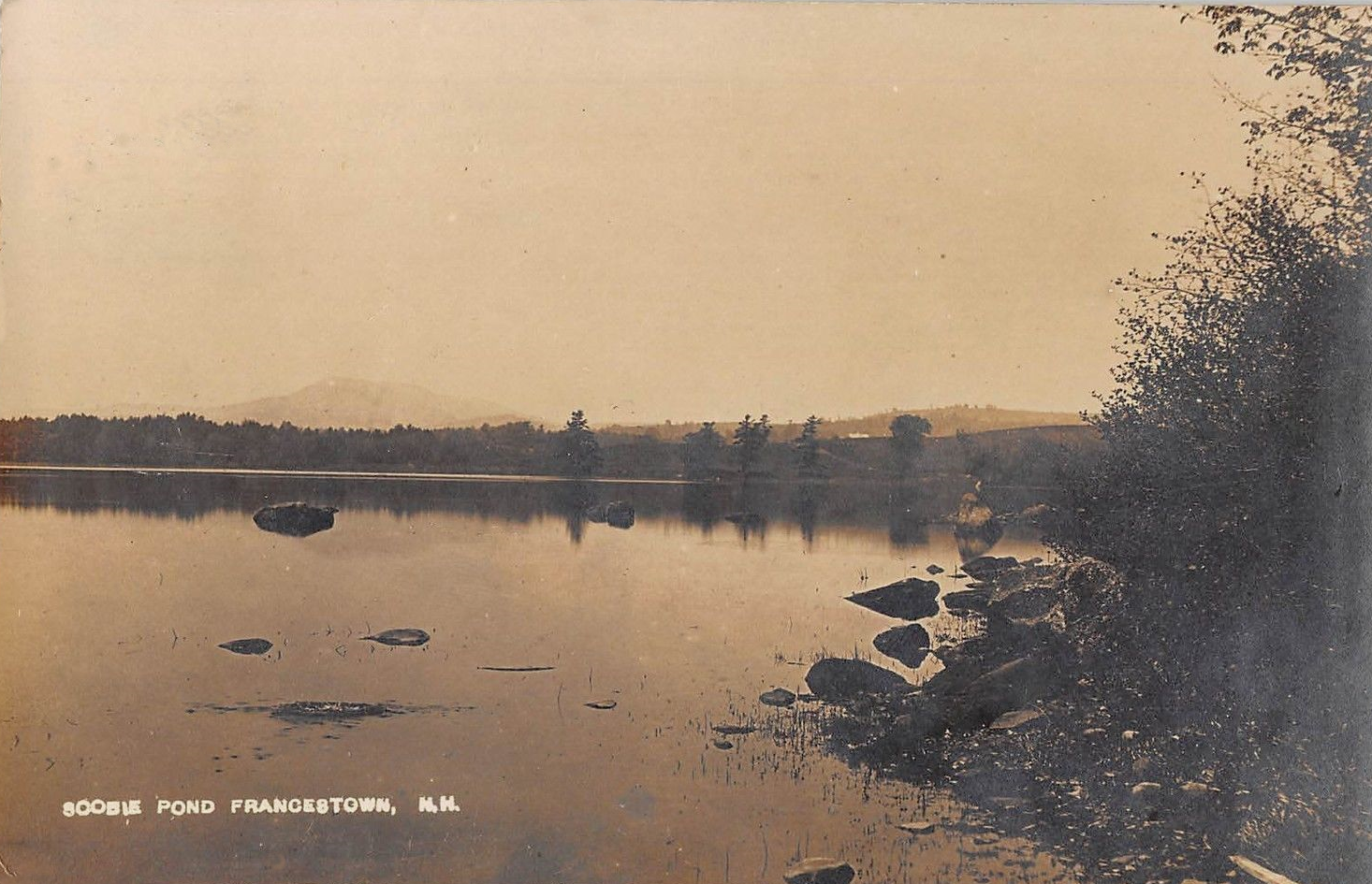
Image from old postcard of Scoby (AKA Scobie) Pond
However, there are other possible origins for the name (and for these, go to the link for the History of Francestown below and start on Page 432).
One story holds that the children (and likely grandchildren) of David Scoby made tremendous sport out of running about in the dark to frighten people (described delightfully in the history as "Liquor-Laden Loafers") by pretending to be spirits and monsters. Given that a similar thing seems to be the origin of ghost stories at California's Rispin Mansion, I have to admit to a fondness for this explanation. That said, the "Scoby Boys" weren't active until the 1780s at the earliest, and, as noted above, the lake was referred to as "Haunted Lake" by 1753, so while this may have kept the name going, the name likely inspired the Scobys and was probably not inspired by their antics.
Another story says that two travelers bought land in the area, and in the 1740s, travelled to the area, starting out separately but eventually meeting and traveling together. One night, while camping near, or on the shore of, the pond, they fought, and one killed the other. The murders gave the victim a half-hearted burial and left the body. When Matthew Patten (a land surveyor) was sent out to perform surveys of the area, he and his chain men (people who assisted the surveyor by using chains that helped to measure distance) camped on the shore of the lake, and heard groaning and shrieking, as if from a man in desperate pain. The work crew, despite Pattens' efforts, left for Bedford the next day without completing the survey.
Yet another story holds that Davis Scoby found a skeleton of a large, but young, man while preparing the land for his mill. It is not specifically said that there are any haunting elements associated with this discovery, but that would seem appropriate for the lake's name.
Finally, one more story: Two hunters set out to hunt and trap near the lake. They would camp together at night, but head out in different directions during the day. One evening, one of the campers failed to return to camp. When the other camper went out to find him the next day, he discovered that his companion had been killed by one of the animals that prowled the area. The surviving hunter headed back for the
The odd thing is that, aside from the lake's name, and the 18th century reference to the sounds of pained shrieks and moans, there is little to indicate that anyone has had weird experiences out here. This is disappointing, but there you go.
That said, there is a lengthy list of deaths that occurred (or, at least, are said to have occurred) at the lake up through the late 19th century. None of them are said to be supernatural, but it will still make you feel somewhat creeped out.
Commentary: This is a fun one. Most likely, the name haunted lake is due either to an eerie post-fire appearance, as noted above, or to bits of local folklore with little basis in reality. It's just the way that these things tend to go. But, that said, every community needs its local haunted property, and given that it is filled with water and typically literally opaque to humans, a lake makes for a good one.
There really isn't too much to say about the story itself, but I would like to discuss something having to do with two of the sources that, given what I do as my day job, I find interesting. The first is the diary of Matthew Patten - diaries such as these were kept by many people in the 18th and 19th centuries, and most were lost, a few found there way into special collections, and a few of those were published. These are often used by researchers who have to do historic research, and I found myself often consulting my copy of a similar diary, though this of a sailor, called Three Years Before the Mast when working on my masters thesis (this contained discussions of early Santa Barbara, California, and as my masters thesis looked, in part, at the archaeology of culture contact, this was a useful resource).
The second thing that is interesting is the late 19th century town history of Francestown. Books like this were common in the late 19th and early 20th century, and for people doing any sort of historical research, or research into local folklore, these are gold mines. I often use these when writing historic contexts for my day job, and have found them consistently useful. Plus, it's fun to find out what all of the various places names in your town actually mean.
Sources: iO9, Cow Hamphshire Blog, Diary of Matthew Patten, Published Book, History of Francestown, New Hampshire's Haunted Places,
Wednesday, June 7, 2017
Devils Gate, Pasadena, Los Angeles County
At Devil's Gate Gorge in Arroyo Seco there sits a large rock outcrop that many believe is shaped like Satan's head, hence the name of the location. Factual information about the location's history is hard to come by, having been buried in tall tales and folklore, and these have, in turn, influenced much of what people say and have written about it in the tight circle of fact and nonsense that is human collective memory.
Holy crap, I read what I just wrote and realize that I have been listening to a lot of Aaron Mehnke's podcast* lately.
Regardless, what become common belief tends to color what people wish to write about and tends to change stories that we hold to be true of older stories. So, keep in mind that, especially when talking about Tongva beliefs below, there is a fair chance that the story is more nonsense than sense. But it's entertaining nonsense, and in the end, isn't that the highest form of truth? The answer is no.
Okay, I promise that I have all of that out of my system now.
As noted above, the rock formation, from one angle, looks like a devil's head. See what you think:

Local stories holds that the sounds of the river moving through the gorge sounds like laughing, which was allegedly thought by members of the local Tongva ethnolinguistic group to be the culture hero Coyote laughing**. Some telling shold that the Tongva felt that the location was supernaturally powerful and to be avoided, and others that it was the gateway to the afterlife and therefore to be shunned by the living. I am skeptical of the claim that the Tongva had these story, especially the variations about avoiding the location - this sort of embellishment is often added to ghost stories to make them seem more authentic, but is almost always false.
In 1920, the gorge was dammed to create a reservoir and control flooding in the Los Angeles river system. However, the Devil's Head remained above water and continues to be visible
As time went on, the place began to collect other stories, the most entertaining of which involve Alastair Crowley, L. Ron Hubbard, and their friend, Jet Propulsion Laboratory c-founder and scientist and all around really weird guy, Jack Parsons. According to the story, Ol' Al , Ron, and Jack were convinced that the Devil's Gate Gorge was a gateway to Hell (one of specifically seven) and full of all manner of supernatural power. Some folks have claimed that the location of the Jet Propulsion laboratory was intended to use power from the Devil's Gate, and is tied in to the various occult movement that have become popular in Los Angeles and Hollywood during the 20th century. While these stories tend to breakdown into incoherency pretty quickly, they are fun to hear and tell.
Among the stories are claims that Hubbard and Parsons too part in rituals at the gorge with the intention of tapping into the Hell gate's energy, possibly to create a Moon Child, a being that would embody a feminine divine force. Parsons and Hubbard did, in fact, engage in rituals for this purpose in 1946, though whether they did anything at Devils Gorge is not reported anywhere.
In the 1950s, a series of children went missing in the area, including 13-year-old Donald Lee Baker and 11-year old Brenda Howell in 1956, and 8 year-old Tommy Bowman in 1957 and 6-year-old Bruce Kremen in 1960. Bruce Kremen is especially baffling, as the boy was attending a YMCA camp, and left the counselors to walk 300 yards back to the camp lodging, only to vanish. The 1956 disappearances were explained years later when serial killer Mack Ray Edwards was caught. The later disappearances are still unsolved, and may have been tied in to Edwards, or may be due to some other cause. Regardless, they have added to the grisly history of the area.
Modern L.A.-area ghost hunters like too claim that these rituals opened the gate, allowing evil entities into our world. And they flock to the location hunting for these entities (I wonder what the OSHA requirements for protective equipment are? A Mojo hand? a gris-gris bag?). Stories for the location include the (disappointedly mundane given the history above) usual orbs in photos and phantom voices. In one case, someone did report hearing singing coming from the metal gate shown in the picture above, and seeing red eyes peering from the back of the tunnel.
The folks at Offbeat L.A. provided a short and enjoyable description of the area, though they refer to mysterious wood structures that, to this individual who deals with utilities, look exactly like transmission line structures, so, you know, grain of salt and all.
*Which, if you haven't been listening to it, I have to ask, what is wrong with you? If you like the sordid tales that I post here, Aaron Mehnke's providing you the stronger stuff, and in excellent, if sometimes very wordy, format.
** I am not a specialist in Tongva mythology, but I am a professional archaeologist and anthropologist that works in California, and this explanation of allegedly local Native American belief sounds to me more like a 20th-century white-person claim than an actual part of the local Native Folklore, but, again, as I am not an expert on the stories of this particular region (my graduate research was performed farther north in the Santa Barbara area, and my professional life has been primarily in the San Joaquin Valley and Sierra Nevadas), I may be wrong and it is possible that this place was forbidden in the Tongva belief system. Incidentally, as I refer to utility companies later in this entry, I am an archaeologist employed currently by a utility company to help them comply with federal and state cultural resources laws - so I help protect archaeological sites, historic buildings, and spots important to Native Americans - yep, it's an actual job with a good career path and decent pay, so if you decide to get a Masters degree in archaeology, yes you can actually have a good job, no matter what all of those condescending assholes will imply.
Commentary: Naturally, the ghost hunters who visit the area are looking for the "norm" of our time - orbs, cold spots, and the like. Which is disappointing given the allegedly deep supernatural meaning of this place. I have to admit that, in reading LA Ghost Portal's write-up, I was a put off by their description of trying to reach out to the spirits of missing and dead children. That just seemed really tasteless to me. On the other hand, I included them in my description here, so perhaps I am guilty of the same tastelessness.
What I like about this story is the way that it weaves numerous different strands present in other ghost stories together. Appeals to Los Angeles supposed hedonism? Check! Reference to a cult? Check, and bonus (both Crowley's temple and Scientology make an appearance!)! Reference to dark rituals? Check! Reference to Native American sacred sites? Check! Turning the mundane (a gate) into something creepy? Check!
The story is, undoubtedly, mostly bullshit, though, wonderfully, the one element that might be true is the most outlandish - while I can't confirm that Parsons and Hubbard ever engaged in rituals at the Devils Gate, it would not have been any weirder than things that these two were confirmed to have gotten up to around that point in time.
Source: Atlas Obscura, LA Ghost Portal, Timeout, Offbeat L.A., Weird U.S.
Subscribe to:
Posts (Atom)


 Posts

