In the water near Venice sits Poveglia Island, a curious place on the whole. The island has clearly been modified by humans - it has far too many straight lines and smooth curves in it's outline to be completely natural - as both a place of residence and as a military fort, and later as a waiting station for ships entering Venice and finally as a hospital. Stories hold that Romans used the island as a quarantine station for plague victims, and that the same was done with victims of the black plague, whose bodies were then buried in plague pits (mass graves of plague victims) on the island. Many of the bodies are said to have been burned, and it has been claimed that the ashes have created a distinctive dust on the island. These stories hold that over 160,000 people died over the course of the island's history. And the presence of the dead is said to still lurk on the island, making it a dark and forboding place approached only by the brave. Typically non-specific stories of strange shadows, disembodied voices, and shoves (or even blows) from unseen assailants abound.
Oh, and the pits in which the remains were placed is said to be below an area that was once used for growing wine grapes. How's that for a strange vintage?
Legends further state that a building constructed in the 1920s housed psychiatric patients, who were overseen by a very literal mad scientist - a psychiatrist who performed cruel experiments upon his charges, and performed other additional acts of cruelty with no pretense towards research. He is also said to have performed neurosurgery with crude tools such as hammers and chisels. It is said that this psychiatrist eventually completely snapped after telling other hospital employees that he had encountered ghosts, climbed the bell tower (in which some stories hold he had performed his grisly work), and flung himself towards the ground. He survived the fall, but a white mist (possibly composed of ashes) rose from the ground, and enveloped and strangled the psychiatrist.
In addition to the torments inflicted on them by this psychiatrist, the patients are also said to have seen ghosts of Roman and Renaissance plague bearers, and to have heard disturbing whispers emanating from the walls of the building.
One story holds that the last people who attempted to settle on the island was a family that had been granted permission to build a vacation home. After the home was completed, they cut their first night short when their daughter was attacked "by something" and had her face split open, requiring 20 stitches.
And, of course, stories hold that the evil psychiatrist was interred in the bell tower, and that people in Venice can hear the bell tolling at night.
Sleep well, Venetians!
Commentary: Supernatural claims aside, Poveglia has an interesting history. In the early 5th century, people from Padua and Este settled on the island, fleeing from the barbaric invasions unfortunately common in Italy during the late Roman Empire. people continued to settle on the island, and over the centuries, a series of structures were built as the town formed.
In 1379, Venice and Genoa went to war, and the people of the island were removed as the island was converted for military use. A fort known as "the Octagon" was built, and the island become the home of a proper medieval town, but it was abandoned in the 14th century.
A couple of sources hold that in 1576, when the Black Death hit Venice, and the local authorities took the bodies of victims to Poveglia to dump them into mass graves, as well as a dumping ground for the bodies. But it appears to be the case that it was not Poveglia, but another island was used for quarantine. Mass graves of plague victims were pretty common throughout Europe during outbreaks, and in a place like Venice, where land is at a premium, an uninhabited island would be a good dumping ground, but it does appear that it was another island that was used and not Poveglia (though, I would not be surprised if documentation surfaced indicating that this island was also used).
Two hundred years later, in 1777, the island came under the jurisdiction of the Magistrato alla Sanita (or, as we'd call it in English, the Public Health Department), and it became a check point for ships entering and leaving Venice. In 1793, cases of plague were identified on two ships, and the island was used as a quarantine station for those who were suffering illness, and lodgings built. Napoleon Bonaparte made this function permanent in 1804, but the lodgings were demolished in 1814. It was again used as a quarantine station in the early 20th century.
And then, in 1922, the hospital was built to provide long-term care to the mentally ill. The construction of isolated hospitals for the mentally ill or those carrying contagious diseases was not uncommon in the late 19th and early 20th century, and many such hospitals (including one off shore from New York City) were built at that time. Naturally, many of these locations are now reputed to be haunted.
The hospital was eventually converted to a retirement home/convalescent hospital (or may have had one as part of it from the get-go, the sources are inconsistent on this point), but even it appears to have shut down in 1968. That said, what descriptions I could find of the latter days of the place make it sound amazingly pleasant.
Given this history, it's only natural that the island is home to a whole host of ghost stories. Even for Venice, a place that boasts more than its share of ghost stories, this place is invitingly creepy. The place is officially off-limits...but a quick Google search reveals that so many people have managed to spend the night there that the ban is clearly poorly enforced. This has, therefore, become quite the destination for legend trippers.
That said, the identities of the victims of ghostly violence always seem to be obscured. It's "the last family to settle here", not "John and Marsha Smith, who built a cabin in 1977." This is often a sign of the story being more non-specific urban legend than truth.
The only thing that amazes me is that there has been no horror movie, as of yet.
Note: Some great photos of the island are available here. And if you are wealthy, you might just have a chance to buy the island.
Sources: Messy Nessy Chic, Wikipedia, Mental Floss, Gizmodo, news.com.au
Friday, May 15, 2015


Sunday, February 22, 2015
Popobawa - Zanzibar, Africa
Okay, I'm going to give a content warning here: This entry is probably not fit for younger readers, people who are sensitive to discussions of sexual assault, and it is definitely not fit for twelve-year old boys who will just use it as an excuse to crack inappropriate jokes about anal sex*. You have been warned.
Also, I can see some readers getting into a racist "oh, these primitive Africans" rant, and I'll talk about why you shouldn't be so confident in the Commentary section.
There is something haunting Tanzania. Called the Popobawa - a bat-like creature that is said to sexually assault people in the night. In addition to these assaults, it is also said to generally haunt the home of its chosen victims, making noise, moving objects, and trying to frighten them. Once it has gotten it's fill of terror in one home, it moves on to the next one, usually in the same neighborhood.
Although the Popobawa may attack anyone in the household, it is alleged to prefer to anally rape men, and then threaten to return to repeat the action if the men do not tell others about the attack. As a result, men who have been attacked must confess the violation to others, compounding the trauma of the event.
Popobawa, which appears to translate to "bat wing" in Swahili, is a shape-shifter and can appear in many forms, but it's natural form is said to be that of a large bat-like creature with one eye and a gigantic penis, though this "natural form" may be more a creation of western media than an aspect of the Tanzanian folklore regarding the creature. In Tanzanian folklore, it appears that the creature has no true shape, and that the name refers to the shadow that it casts when it appears. The creature's appearance is said to be accompanied by scraping noises on the walls and roof, and a sulfurous smell.
The Popobawa prefers to attack people in their homes when they are alone, and so, during Popobawa panics, many men choose to spend their nights outdoors, sometimes in the streets (often the only open place in some of the crowded towns and cities), which has led to fatalities from automobile traffic.
It is also said that the Popoabawa may be frightened away by gatherings of people, or by recitations of passages from the Koran.
The origins of the Popobawa are unclear. While many people in Europe and the Americas like to think of it as a cryptid (that is, a creature not formally discovered by science but alleged by believers to exist, a'la Bigfoot or the Loch Ness Monster), it's pretty clear that the people of Tanzania consider it to be a spirit or demon of some sort. One story holds that a sheikh (a respected member of the community with informal authority) summoned a djinn (an spirit in Islamic folklore, in many ways comparable to the demons of Christian folklore) in order to attack neighbors with whom he was having difficulties, but that he lost control of the djinn and that it is now loose as the Popobawa.
*I was a twelve-year-old boy once. I know how you work.
Commentary: Okay, let's get the first thing out of the way - I know that there are people reading this and thinking "oh, those primitive/superstitious Africans/Muslims! They have such dumb beliefs!" To which I will point out that panics regarding spectral sexual assault are not in any way unique to Africa or to the Muslim world. Christian and general European folklore is filled with stories of spectral rapists - Succubi, Incubi, "old hag", and many a faerie story - not to mention more recent stories about aliens abducting people and subjecting them to various sexual probes and experiments. And massive panics regarding this sort of thing are not unheard of in the west - consider the amount of claims of "Satanic Ritual Abuse" that appeared during the late 1970s and early 1980s. So, if you are inclined to look at this as a sign of gullibility or foolishness in a poor and underdeveloped part of the world, just be aware that your own culture is perfectly capable of producing very similar things.
Alright, that rant done, it's time to talk about this story. We have a story about a creature that goes about terrorizing households, and sexually assaulting members of the household (though allegedly prefering the male members). Let's assume, as I am inclined to, that this is all folklore. What does it mean?
Well, a number of different hypotheses have been put forward. Including:
- That this story is used to describe or cover up actual sexual assaults.
- That this story simply reflects a local variation on folklore surrounding the phenomenon of sleep paralysis.
- That this story reflects feelings of male inadequacies in a changing and poor region of Africa, with the metaphorical rape being used to metaphorically describe fears of emasculation.The insistence by the creature that mean admit to their violation in order to prevent further violation seems very much in line with this.
- That the story reflects fears of political instability. In fact, Popobabwa panics, during which many people report encounters and men often take to sleeping outdoors, typically accompany elections.
- That the story is a metaphorical discussion of Zanzibar's past as a slave market used by Arab traders. While plausible, the Popobawa first appeared on the island of Pemba in the 1970s, and so it seems unlikely that it would reflect directly the experience of 19th century slaves and slave traders.
Of course, none of these explanations are exclusive of the others, and it may well be that the Popobawa is a folkloric conglomeration of the anxieties, concerns, and very real assaults experienced by people living in Tanzania. It would appear to be a way in which ghostly folklore represents real-world issues, a phenomenon known the world over.
Sources: Podcast, BBC News, Wikipedia, Center for Inquiry, Cryptid Wiki, The Demon-Hunters Compendium,
Haunted Spooky MacBook of Spookiness!
It's been far to long since last I posted here. But it's a cold, overcast day, my wife and daughter are off doing fun stuff, and I am sitting calmly in a coffee shop, as I was during so many of my early entries onto this blog, and so it seems an excellent day to post a new ghost story.
This one is rather silly, but I think it's a mark of things to come for ghost stories, and as such, I am happy to have a chance to write about it.What we have here is something that sounds like it came out of one of Roger Corman's lesser attempts: a haunted computer.
A seller posted this to Ebay, trying to sell his old 2007 MacBook, claiming that it was haunted. I am just going to quote the Ebay page here:
Also, the computer has taken to writing...but not on it's screen:
Lest you be concerned about the presence of an evil computer (it is a Mac, just get used to the evil*), the seller assures us that the computer "is NOT haunted by a demon or "devil man" negative entity." In fact, the computer has vacuumed Ken's home (the seller must be Ken, he's married to Barbie, after all), helped in his son's talent show, and apparently helped Ken and Barbie get through a rough patch in their marriage.
Oh, and if you are concerned that this is just a joke on the part of Ken, no worries - it comes with a certificate provided by a psychic proving that it's haunted! So you know it must be legit! Self-proclaimed psychics** are never involved in scams, after all!
*Don't worry Apple-eaters, were it a PC, I'd be making snide comments about Microsoft. But I don't make any negative comments about Android, because I do not want to anger our new overlords in the event of the inevitable Android uprising. ALL HAIL SKYNET!
**I was about to make a comment about how all psychics are self-proclaimed. Then I remembered a guy named Ben who I knew in college. Ben convinced himself that I was psychic, for reasons too stupid to go into (though the short version is that I knew amazing things about people, and Ben couldn't accept that I knew them because people told me things because, unlike Ben, I wasn't a dick...so, I must know them due to being psychic and not from practicing my amazing not-an-asshole-powers). So, sometimes psychics aren't self-proclaimed, but instead proclaimed by idiots.
Commentary: Hotels and restaurants have known for a very long time that claiming a haunting can drive up revenues, and ghost story connoisseurs will know that we have a long history of haunted objects. This isn't the first attempt to sell a "haunted" object on Ebay (an earlier attempt, which was itself probably not the first attempt, was the alleged "Dibbuk Box"). So, this is likely an attempt to make a large profit while offloading an obsolete piece of equipment. At the time that Cnet ran their story on it, the laptop had a bids up to $6,200 - for an 8-year-old laptop. So, it would appear that this is working.
However, I'm particularly charmed by the way in which Ken is so obviously trolling believers. Changing music to "scary" music? Loading Edgar Allen Poe stories? "Devil man" entities? Psychic guarantees of haunting? I mean, yeah, to most of us these are all signs that Ken is joking - he's practically begging you to see the joke! Hell, he placed THIS photo in the listing:

Nonetheless, I have come across a few folks who seem to believe this nonsense. So, I guess it's once again an example of the internet proving just how gullible people can be. Good luck, Mr. Gorsky!
Of course, I am frustrated by the fact that I didn't think of this first, and now I don't have a way to make huge amounts of money off of my old Dell laptop.
Sources: ABC News, CNet, Time (although the laptop appeared on Ebay and the ad is here, the ad is likely to vanish after the sale, so I have settled on the less transitory sources for this entry)
This one is rather silly, but I think it's a mark of things to come for ghost stories, and as such, I am happy to have a chance to write about it.What we have here is something that sounds like it came out of one of Roger Corman's lesser attempts: a haunted computer.
A seller posted this to Ebay, trying to sell his old 2007 MacBook, claiming that it was haunted. I am just going to quote the Ebay page here:
Well, I took the computer home (still in perfect working condition) and, folks, this is when things started to get downright weird. First, I noticed that ALL of my songs in iTunes had become scary or haunted. Second, the desktop background was changed to a scary photo. The following week, we (my wife, Barbie, and I) noticed some of our stuff around the house had been mysteriously rearranged. One night, we went out to dinner with my wife’s parents and their friends and some people from my wife’s work and some of their parents. When we came home, my baseball cards were all out of order and my wife’s rare American coins were in total disarray. To make matters spookier, I occasionally saw the computer levitating. In some cases the screen and keyboard would open and shut quickly, as though the computer were attempting to speak.The computer was levitating and flapping it's gums....Uhh...Okay...
Also, the computer has taken to writing...but not on it's screen:
The way he communicates with us is by grasping a pen between the keyboard and monitor and writing on pieces of printer paper from our home office...As such, I am given to believe that this ghost may have lived in a time before computers, for he appears to be quite unaware of the purpose of the machine he inhabits...
Lest you be concerned about the presence of an evil computer (it is a Mac, just get used to the evil*), the seller assures us that the computer "is NOT haunted by a demon or "devil man" negative entity." In fact, the computer has vacuumed Ken's home (the seller must be Ken, he's married to Barbie, after all), helped in his son's talent show, and apparently helped Ken and Barbie get through a rough patch in their marriage.
Oh, and if you are concerned that this is just a joke on the part of Ken, no worries - it comes with a certificate provided by a psychic proving that it's haunted! So you know it must be legit! Self-proclaimed psychics** are never involved in scams, after all!
*Don't worry Apple-eaters, were it a PC, I'd be making snide comments about Microsoft. But I don't make any negative comments about Android, because I do not want to anger our new overlords in the event of the inevitable Android uprising. ALL HAIL SKYNET!
**I was about to make a comment about how all psychics are self-proclaimed. Then I remembered a guy named Ben who I knew in college. Ben convinced himself that I was psychic, for reasons too stupid to go into (though the short version is that I knew amazing things about people, and Ben couldn't accept that I knew them because people told me things because, unlike Ben, I wasn't a dick...so, I must know them due to being psychic and not from practicing my amazing not-an-asshole-powers). So, sometimes psychics aren't self-proclaimed, but instead proclaimed by idiots.
Commentary: Hotels and restaurants have known for a very long time that claiming a haunting can drive up revenues, and ghost story connoisseurs will know that we have a long history of haunted objects. This isn't the first attempt to sell a "haunted" object on Ebay (an earlier attempt, which was itself probably not the first attempt, was the alleged "Dibbuk Box"). So, this is likely an attempt to make a large profit while offloading an obsolete piece of equipment. At the time that Cnet ran their story on it, the laptop had a bids up to $6,200 - for an 8-year-old laptop. So, it would appear that this is working.
However, I'm particularly charmed by the way in which Ken is so obviously trolling believers. Changing music to "scary" music? Loading Edgar Allen Poe stories? "Devil man" entities? Psychic guarantees of haunting? I mean, yeah, to most of us these are all signs that Ken is joking - he's practically begging you to see the joke! Hell, he placed THIS photo in the listing:
Nonetheless, I have come across a few folks who seem to believe this nonsense. So, I guess it's once again an example of the internet proving just how gullible people can be. Good luck, Mr. Gorsky!
Of course, I am frustrated by the fact that I didn't think of this first, and now I don't have a way to make huge amounts of money off of my old Dell laptop.
Sources: ABC News, CNet, Time (although the laptop appeared on Ebay and the ad is here, the ad is likely to vanish after the sale, so I have settled on the less transitory sources for this entry)
Monday, October 28, 2013
Henry Treat Rogers Mansion, Cheesman Park, Denver, Colorado
In Cheesman Park, a park and neighborhood in Denver, Colorado, there once stood an impressive mansion. The Henry Treat Rogers Mansion stood on 13th Street, at the northern edge of the neighborhood.
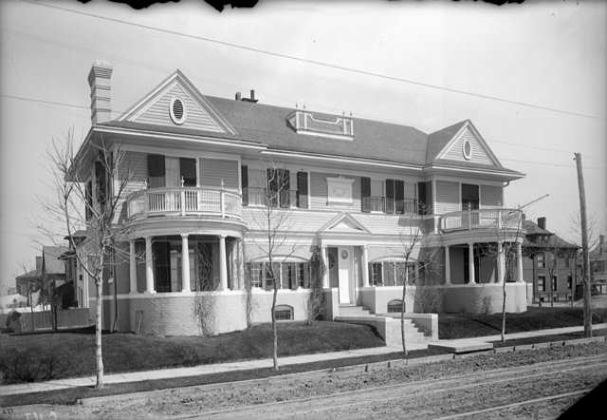
In 1968, Russell Hunter - who worked as a musical arranger for television, but would go on to be a notable screenwriter and playwright - moved to Denver. He found the mansion, and was shocked at it's unbelievably low rent ($200 a month!). So, he quickly moved in, and discovered why the rent was so low. It seems that the house couldn't keep a tenant.
I must beg the reader's indulgence here. All of the sources are pretty consistent in how the sequence of events is described, so this is paraphrased and condensed from the Haunted Colorado and the Spooky Mountain News sites. I recommend checking them out for further details:
Within a couple weeks of moving in, Hunter began to hear banging and crashing from a bedroom fireplace. The noise stopped when, one morning, Hunter yelled "stop it!" in the direction of the racket. However, after the noises stopped, they were replaced by even stranger phenomenon. Doors began opening on their own. The walls began to vibrate, knocking hung objects onto the floor.
As time went on, Hunter met a woman at a bridge game* who told him that she knew there was a poltergeist in the house, and a man at a social gathering (of type left unspecified*) who informed him that there was a hidden third floor that could be accessed through a stairway hidden in one of the house's many closets.
Once he found the staircase (one source states that he had to get help to bash open the back of a closet), Hunter found a hidden bedroom in the attic containing the journal of a nine-year-old boy who was crippled, and whose family had locked him in the attic bedroom to hide him away. The journal stated that the favorite toy of the child was a red rubber ball, which then began appearing around the house.
Hunter called on a well-known medium (whose name is never given in any of the sources that I have seen - readers, if you have found it, please let me know) to come and help him understand what was happening. The medium held a seance, and during the ritual it came out the the spirit haunting the house was indeed that of the 9-year-old. He had been placed in the attic, but stood to inherit a fortune from his grandfather. The child died before receiving it, but was replaced with an adopted orphan who had a similar appearance (though better health). This replacement child grew up to be a successful industrialist, gaining advantages from the money inherited from the dead child's grandfather. Meanwhile, the body of the actual grandson was buried in a secret grave, and a house was later built at this site. The medium told Hunter that, should he go digging below the bedroom of the house over the grave, he would find a gold medal that would prove that this was the final resting place of the child. As a final step, the spirit threatened harm on the family living in the house if they did not allow the grave to be exhumed.
Seeking to make his house livable again, Hunter approached the family who lived in the house to see if they would let him dig up the grave. Although reluctant at first, the family gave permission after a series of incidents that nearly harmed their children. A gold medal was, indeed, found in the designated location under the house.
Still, this didn't bring hunter peace. A glass door blew up, injuring Hunter. Bedroom walls shook. When the house was later demolished in the 1970s, some of the walls exploded, killing a bulldozer operator.
Hunter moved to another residence, but continued to experience the same sorts of troubles. Finally, Hunter called in an Episcopalian priest who performed and exorcism. And it is there that the story seems to end...
...except that people still report strange happenings throughout Cheesman Park, including at the location of the now-demolished house. It's the usual stuff: orbs in photos, voices, cold spots, feelings of dread, etc. Still, it was probably inevitable for a neighborhood built on what was once a cemetery.
*Seriously, this young show-business guy was spending time at bridge games? Maybe the sixties weren't as swinging as everyone likes to claim.
*So, as it is never stated what the gathering was, I choose to restore some of this guy's sixties cred and declare with no evidence whatsoever that is was a LSD-infused Beatles listening party/orgy.
Commentary: Russell Hunter wrote what is easily my all-time favorite horror movie: The Changeling. If you have not seen The Changeling (the 1980 horror movie, not the 2008 drama), then you really should. It is a very effective, spooky movie that really earns its scares - there is no gore and little action, this one simply piles on the eeriness and dread until everything seems menacing. To date, every time that I have shown the movie to people, there is one scene where everyone jumps: two characters walk into a hall and see a particular object - the object doesn't move, doesn't do anything at all...but it isn't supposed to be there, and by this point in the film, THAT is enough to get the audience scared.
If the haunted house movies of the 1950s had aged better and were still seen as scary (rather than just cheesy), they might look like the Changeling.
But what of this story? Well, the story, as told, bears a striking resemblance to the plot of The Changeling, and Hunter claims that the film was based on his experiences in this house in Colorado. However, the main source for information comes from a 1980 interview...around the same time that the film was released, which makes me think that there is more marketing than menace in the house. The newspaper reports (linked to via the sources below) also cite a priest who is said to have performed an exorcism as a source, but it is unclear as to whether he was interviewed, or if that was also taken from the 1980 Hunter interview and then simply repackaged in a later newspaper story. Add to this that the people who Hunter states told him about the hauntings are never clearly identified, and the name of the "famous medium" - the person who would likely be the easiest to identify and ask about the story - is never given...and we find ourselves with a story that is impossible to check out...almost as if someone intended to create a story that couldn't be falsified in order to publicize a movie...hmmmm....
More recently, bodies were found during infrastructure work at Cheesman Park - not too terribly shocking as the park was the Mt. Prospect Cemetery from the mid-19th century until ca. 1893, and the bodies were removed when it was converted into a park and residential area. My own experience of 19th century cemeteries is that there are often bodies that are easy to miss if you don't know where to look...and reports from the time indicate that the workers weren't showing much respect to the remains. Although some have tried to claim that these bodies are the source of the hauntings, I have been unable to confirm that the bodies were even found near the house, plus this veers into "built on an Indian Burial Ground" territory. So, yeah, I'm not feeling so compelled by this line of argument.
Still, it's a great old haunted house story, and it is tied to one of my favorite movies...so while I may not buy it, I do like the story and I do intend to tell it as often as I can.
Bonus Video: And here is the trailer to The Changeling.
Sources: Wikipedia, Haunted Colorado, Spooky Mountain News, The Illustrious Internet, TV News, The History of Cheesman Park
Tags: Colorado, Haunted House, Poltergeist, Landmark, movies/film, Denver County
In 1968, Russell Hunter - who worked as a musical arranger for television, but would go on to be a notable screenwriter and playwright - moved to Denver. He found the mansion, and was shocked at it's unbelievably low rent ($200 a month!). So, he quickly moved in, and discovered why the rent was so low. It seems that the house couldn't keep a tenant.
I must beg the reader's indulgence here. All of the sources are pretty consistent in how the sequence of events is described, so this is paraphrased and condensed from the Haunted Colorado and the Spooky Mountain News sites. I recommend checking them out for further details:
Within a couple weeks of moving in, Hunter began to hear banging and crashing from a bedroom fireplace. The noise stopped when, one morning, Hunter yelled "stop it!" in the direction of the racket. However, after the noises stopped, they were replaced by even stranger phenomenon. Doors began opening on their own. The walls began to vibrate, knocking hung objects onto the floor.
As time went on, Hunter met a woman at a bridge game* who told him that she knew there was a poltergeist in the house, and a man at a social gathering (of type left unspecified*) who informed him that there was a hidden third floor that could be accessed through a stairway hidden in one of the house's many closets.
Once he found the staircase (one source states that he had to get help to bash open the back of a closet), Hunter found a hidden bedroom in the attic containing the journal of a nine-year-old boy who was crippled, and whose family had locked him in the attic bedroom to hide him away. The journal stated that the favorite toy of the child was a red rubber ball, which then began appearing around the house.
Hunter called on a well-known medium (whose name is never given in any of the sources that I have seen - readers, if you have found it, please let me know) to come and help him understand what was happening. The medium held a seance, and during the ritual it came out the the spirit haunting the house was indeed that of the 9-year-old. He had been placed in the attic, but stood to inherit a fortune from his grandfather. The child died before receiving it, but was replaced with an adopted orphan who had a similar appearance (though better health). This replacement child grew up to be a successful industrialist, gaining advantages from the money inherited from the dead child's grandfather. Meanwhile, the body of the actual grandson was buried in a secret grave, and a house was later built at this site. The medium told Hunter that, should he go digging below the bedroom of the house over the grave, he would find a gold medal that would prove that this was the final resting place of the child. As a final step, the spirit threatened harm on the family living in the house if they did not allow the grave to be exhumed.
Seeking to make his house livable again, Hunter approached the family who lived in the house to see if they would let him dig up the grave. Although reluctant at first, the family gave permission after a series of incidents that nearly harmed their children. A gold medal was, indeed, found in the designated location under the house.
Still, this didn't bring hunter peace. A glass door blew up, injuring Hunter. Bedroom walls shook. When the house was later demolished in the 1970s, some of the walls exploded, killing a bulldozer operator.
Hunter moved to another residence, but continued to experience the same sorts of troubles. Finally, Hunter called in an Episcopalian priest who performed and exorcism. And it is there that the story seems to end...
...except that people still report strange happenings throughout Cheesman Park, including at the location of the now-demolished house. It's the usual stuff: orbs in photos, voices, cold spots, feelings of dread, etc. Still, it was probably inevitable for a neighborhood built on what was once a cemetery.
*Seriously, this young show-business guy was spending time at bridge games? Maybe the sixties weren't as swinging as everyone likes to claim.
*So, as it is never stated what the gathering was, I choose to restore some of this guy's sixties cred and declare with no evidence whatsoever that is was a LSD-infused Beatles listening party/orgy.
Commentary: Russell Hunter wrote what is easily my all-time favorite horror movie: The Changeling. If you have not seen The Changeling (the 1980 horror movie, not the 2008 drama), then you really should. It is a very effective, spooky movie that really earns its scares - there is no gore and little action, this one simply piles on the eeriness and dread until everything seems menacing. To date, every time that I have shown the movie to people, there is one scene where everyone jumps: two characters walk into a hall and see a particular object - the object doesn't move, doesn't do anything at all...but it isn't supposed to be there, and by this point in the film, THAT is enough to get the audience scared.
If the haunted house movies of the 1950s had aged better and were still seen as scary (rather than just cheesy), they might look like the Changeling.
But what of this story? Well, the story, as told, bears a striking resemblance to the plot of The Changeling, and Hunter claims that the film was based on his experiences in this house in Colorado. However, the main source for information comes from a 1980 interview...around the same time that the film was released, which makes me think that there is more marketing than menace in the house. The newspaper reports (linked to via the sources below) also cite a priest who is said to have performed an exorcism as a source, but it is unclear as to whether he was interviewed, or if that was also taken from the 1980 Hunter interview and then simply repackaged in a later newspaper story. Add to this that the people who Hunter states told him about the hauntings are never clearly identified, and the name of the "famous medium" - the person who would likely be the easiest to identify and ask about the story - is never given...and we find ourselves with a story that is impossible to check out...almost as if someone intended to create a story that couldn't be falsified in order to publicize a movie...hmmmm....
More recently, bodies were found during infrastructure work at Cheesman Park - not too terribly shocking as the park was the Mt. Prospect Cemetery from the mid-19th century until ca. 1893, and the bodies were removed when it was converted into a park and residential area. My own experience of 19th century cemeteries is that there are often bodies that are easy to miss if you don't know where to look...and reports from the time indicate that the workers weren't showing much respect to the remains. Although some have tried to claim that these bodies are the source of the hauntings, I have been unable to confirm that the bodies were even found near the house, plus this veers into "built on an Indian Burial Ground" territory. So, yeah, I'm not feeling so compelled by this line of argument.
Still, it's a great old haunted house story, and it is tied to one of my favorite movies...so while I may not buy it, I do like the story and I do intend to tell it as often as I can.
Bonus Video: And here is the trailer to The Changeling.
Sources: Wikipedia, Haunted Colorado, Spooky Mountain News, The Illustrious Internet, TV News, The History of Cheesman Park
Tags: Colorado, Haunted House, Poltergeist, Landmark, movies/film, Denver County
Thursday, October 24, 2013
Dudleytown
In Cornwall, Connecticut, there is a location within the ominously-named Dark Entry Forest that is said to be among the most haunted locations in the Americas. The location is the ruins of Dudleytown, a once-prosperous town that was founded by a cursed family, and which was doomed as a result. All that remains now are the cellar pits and odd bits of rock wall where once there were buildings and fences. And there are those that say that spirits or demons also remain.
Legend holds that Dudleytown is the earthly receptical of a curse that began in 1510, when Edmund Dudley was beheaded after he was revealed to be conspiring to overthrow the King of England. His son, John Dudley, tried to marry his son to Lady Jane Grey, thus entering the royal family...and all three were executed. Shortly afterwards, John Dudley's other son returned from France, bringing the plague with him and unleashing an outbreak that killed thousands of people. John Dudley's third son decided to get out while the gettin' was good and left for the Americas in 1630. Once there, he had sons, who would later settle in Connecticut...
Or, an alternate version is that Governor Thomas Dudley of the Massachusetts Bay Company was related to Edmund Dudley, and was the uncle of four Dudley Brothers who settled in Connecticut. In this version of the story, Thomas Dudley is a horrible tyrant who executes those who are not Puritans...
But regardless of the exact version, four brothers, Abijah, Barzillai, and Abiel, founded Dudleytown in the late 17th or early 18th century. Depending on which version of the story you are going with, these four brothers carried a curse with them, or one of Thomas Dudley's victims cursed him and all who dwellt near him (including his nephews), damning the land on which he lived, which would become Dudleytown. In the Governor Dudley version of the story, he is murdered - hacked to death and his body left on his land - and the murderer is never found.
The three Dudley borthers lived the rest of their lives in Dudleytown, Abijah and Barzillai dying of natural causes, apparently. But Abiel...oh, Abiel went insane! He lost his mind, and shorlty afterwards lost his fortune and even his home, dying a pauper
While Abiel was still alive, Nathaniel Carter bought Abiel's house (the unfortunate fellow could no longer afford it) in 1759, thus activating the curse*. After displacing poor, mad Abiel, the Carter family moved out of Dudleytown in 1763 and went to reside in Bimghamton, New York...but somehow left their 13 year old son behind. The result, rather unexpectedly, was that the son survived the rest of the family when a Native American raiding party attacked the Carter's New York homestead in 1764, gruesomely killing and scalping Nathaniel Carter, his wife, and even their infant child. In 1774, Nathaniel's borther, Adoniram, and his entire family died of cholera, thus adding more lives to the Dudleytown curse.
And the horror kept on coming. In 1792, Gershon Hollister is said to have been murdered at the home of William Tanner. Afterwards, Tanner reported seeing strange animals in the forest as well as demons, and this eventually drove him insane. In 1804, a General by the name of Swift was at home with his wife, when she walked out to the front porch and was killed after being struck by a bolt of lightning. Mary Cheney was born in Dudleytown in 1811...and the curse followed her after she left, leading to disaster in her hsuband's career and sickness on her part, and she finally committed suicide in the 1830s. An unspecified plague hit the town in 1813, killing all of one family (the Jones family) and killing off many others.
As the 19th century wore on, crops failed, farm animals routinely vanished without explanation, and unexplained deaths continued. Come the end of the 19th century, only the Brophy family (transplants from elsewhere who arrived in 1892) remained. First the Brophy sheep began vanishing, then his sons vanished (though it is worth noting that they were wanted by local law enforcement...so, "on the lam" might be a better description than "vanished"). After a few years, Mrs. Brophy died of unknown causes. He was sometimes seen around Cornwall, muttering about "demons"...and then his house burned to the ground and he vanished, as well.
Dudleytown remained abandoned to whatever demons Mr. Brophy had encountered until 1930, when Dr. William Clark, a pathologist from New York, decided to build a summer home at that location. Things were quiet until 1937, when Dr. Clark left on a business trip, leaving his wife behind. When he returned home, he found her in an upstairs room, cackling to herself, having gone quite mad. She never recovered, eventually dying in an asylum.
Dr. Clark was the last resident, but the Clarks weren't the last people to encounter evil at Dudleytown. Local folklore tells of a satanic biker gang that enters the Dudleytown area to hold rituals. People report being attacked by demonic creatures with cloven hoofs and strange green eyes. People report seeing shadow people, floating balls of light, dark human forms rising out of the cellar pits, having weird images show up on film (or in digital pictures), and that animals seem to be strangely absent from the area. And, as is so often the case, stories persist that a TV news crew arrived to film a story around Halloween, only to have their equipment fail while they were present.
*For the life of me, I can not figure out why the curse is said to begin with one of the Dudley ancestors...when A) they weren't actually related, and B) the alleged displacement of an unfortunate madman seems to be reason enough to cause the curse without the convoluted stuff from the previous centuries.
Commentary: As ghost stories go, this is one of the greats. Dudleytown is creepy, famous, and a real place...all of which make for a good story. The story of the curse, the demonic creatures having been sighted by residents, and the fact that the ruins are still there (though entry is prohibited by the current landowners, and people do get arrested for trespassing, so, really, stay out), it all makes this particular tale all the more delicious as ghost stories go.
Unfortunately, for all of the giddy creepy thrill that the story supplies, it really doesn't stand up to any sort of scrutiny. As at least one source has pointed out, the story of the curse and the early deaths/madness actually doesn't hold up very well, even using just the information provided in the common versions of the story itself - pretty much everyone who is said to have died or been driven insane by the curse was quite elderly at the time...and, well, therefore would be expected to be experiencing dementia or death (for example, Abiel was 90, and the symptoms of his madness are pretty consistent with dementia). Moreover, the number of people who are said to have died in various versions of the stories are, actually, well short of what you would expect for a rural 18th/19th century community, indicating that being in Dudleytown might actually have been good for your health. So, ya'know, not so scary, that.
A short but accurate and useful write-up of Dudleytown's history if provided on it's Wikipedia entry (accessed October 23, 2013):
Then, even the mysterious or horrifying deaths turn out to be more mundane than legend would hold. Records show that Gershon Hollister was not, in fact, murdered, but instead died due to an accident during a barn raising. Mary Cheney did not kill herself, but died of a lung disease, likely tuberculosis, and she had never been to Dudleytown - her death is especially easy to trace, as she married Horace Greeley. Harriet Clarke did commit suicide, but in New York, not Dudleytown. General Swift lived in another location near, but outside of, Dudleytown (also, Swift was, like Abiel, quite elderly when he "went mad" so it was probably just dementia again). Mrs. Clark was not driven insane, and in fact continued to live in the area after her husband's death in 1943. And so on and so forth...
What's more, the verifiable history of Dudleytown is rather different than the legend holds. There's no known relation between the Dudleys of Connecticut and Edmund Dudley. Similarly, if you match up the time the periods during which the Dudleys of Dudleytown lived (the mid-to-late 18th century) with the life of Thomas Dudley...that he was their uncle seems remarkably unlikely...and they didn't settle in the area until after others already had, so their uncle would not have lived there, and in fact he died of natural causes at his home in Roxbury in 1653. Also, the Dudley brothers were actually Gideon, Barzillai, and Abiel, there wasn't an Abijah.
What's more, there is plenty of evidence that the town was deserted not because of weird supernatural goings-on, but because of the difficulty in obtaining freshwater, poor conditions for agriculture (rocky ground and a placement that resulted in shade from the hills and trees pretty much all the damned time), and variations in the local iron industry all provided potential causes for abandonment. Add to this that Dudleytown was never really a town (stories of it having been a more substantial settlement are false), but rather part of Cornwall, and, well, many residents probably just moved to other parts of the town or county when land became available.
One Reverend Dudley, the author of the Legend of Dudleytown page linked to below, traces the origin of the ghost stories to the 1938 publication of the book They Found a Way, though it is conceivable that elements of the story already existed in local folklore, but even that isn't too terribly odd a thought. After all, frequently shadowy location with an abandoned town? If you don't make up a ghost story for that, then you are just being a lazy sod.
Still, even knowing all of this, I still love this story. It still creeps me out, and if I ever find out that I will be visiting Connecticut, I will try to get permission to visit this site.
Sources: Wikipedia, The Legend of Dudleytown, Cornwall Historic Society, Prairie Ghosts, Ghostvillage, Damned Connecticut, ghosttowns.com (wildly inaccurate information, but a fun read), The Illustrious Internet!, The Ghosts Of Ohio (because, of course, a website about Ohio will cover Connecticut), Exciting Earth, paranoid ramblings from the Illustrious Internet
Legend holds that Dudleytown is the earthly receptical of a curse that began in 1510, when Edmund Dudley was beheaded after he was revealed to be conspiring to overthrow the King of England. His son, John Dudley, tried to marry his son to Lady Jane Grey, thus entering the royal family...and all three were executed. Shortly afterwards, John Dudley's other son returned from France, bringing the plague with him and unleashing an outbreak that killed thousands of people. John Dudley's third son decided to get out while the gettin' was good and left for the Americas in 1630. Once there, he had sons, who would later settle in Connecticut...
Or, an alternate version is that Governor Thomas Dudley of the Massachusetts Bay Company was related to Edmund Dudley, and was the uncle of four Dudley Brothers who settled in Connecticut. In this version of the story, Thomas Dudley is a horrible tyrant who executes those who are not Puritans...
But regardless of the exact version, four brothers, Abijah, Barzillai, and Abiel, founded Dudleytown in the late 17th or early 18th century. Depending on which version of the story you are going with, these four brothers carried a curse with them, or one of Thomas Dudley's victims cursed him and all who dwellt near him (including his nephews), damning the land on which he lived, which would become Dudleytown. In the Governor Dudley version of the story, he is murdered - hacked to death and his body left on his land - and the murderer is never found.
The three Dudley borthers lived the rest of their lives in Dudleytown, Abijah and Barzillai dying of natural causes, apparently. But Abiel...oh, Abiel went insane! He lost his mind, and shorlty afterwards lost his fortune and even his home, dying a pauper
While Abiel was still alive, Nathaniel Carter bought Abiel's house (the unfortunate fellow could no longer afford it) in 1759, thus activating the curse*. After displacing poor, mad Abiel, the Carter family moved out of Dudleytown in 1763 and went to reside in Bimghamton, New York...but somehow left their 13 year old son behind. The result, rather unexpectedly, was that the son survived the rest of the family when a Native American raiding party attacked the Carter's New York homestead in 1764, gruesomely killing and scalping Nathaniel Carter, his wife, and even their infant child. In 1774, Nathaniel's borther, Adoniram, and his entire family died of cholera, thus adding more lives to the Dudleytown curse.
And the horror kept on coming. In 1792, Gershon Hollister is said to have been murdered at the home of William Tanner. Afterwards, Tanner reported seeing strange animals in the forest as well as demons, and this eventually drove him insane. In 1804, a General by the name of Swift was at home with his wife, when she walked out to the front porch and was killed after being struck by a bolt of lightning. Mary Cheney was born in Dudleytown in 1811...and the curse followed her after she left, leading to disaster in her hsuband's career and sickness on her part, and she finally committed suicide in the 1830s. An unspecified plague hit the town in 1813, killing all of one family (the Jones family) and killing off many others.
As the 19th century wore on, crops failed, farm animals routinely vanished without explanation, and unexplained deaths continued. Come the end of the 19th century, only the Brophy family (transplants from elsewhere who arrived in 1892) remained. First the Brophy sheep began vanishing, then his sons vanished (though it is worth noting that they were wanted by local law enforcement...so, "on the lam" might be a better description than "vanished"). After a few years, Mrs. Brophy died of unknown causes. He was sometimes seen around Cornwall, muttering about "demons"...and then his house burned to the ground and he vanished, as well.
Dudleytown remained abandoned to whatever demons Mr. Brophy had encountered until 1930, when Dr. William Clark, a pathologist from New York, decided to build a summer home at that location. Things were quiet until 1937, when Dr. Clark left on a business trip, leaving his wife behind. When he returned home, he found her in an upstairs room, cackling to herself, having gone quite mad. She never recovered, eventually dying in an asylum.
Dr. Clark was the last resident, but the Clarks weren't the last people to encounter evil at Dudleytown. Local folklore tells of a satanic biker gang that enters the Dudleytown area to hold rituals. People report being attacked by demonic creatures with cloven hoofs and strange green eyes. People report seeing shadow people, floating balls of light, dark human forms rising out of the cellar pits, having weird images show up on film (or in digital pictures), and that animals seem to be strangely absent from the area. And, as is so often the case, stories persist that a TV news crew arrived to film a story around Halloween, only to have their equipment fail while they were present.
*For the life of me, I can not figure out why the curse is said to begin with one of the Dudley ancestors...when A) they weren't actually related, and B) the alleged displacement of an unfortunate madman seems to be reason enough to cause the curse without the convoluted stuff from the previous centuries.
Commentary: As ghost stories go, this is one of the greats. Dudleytown is creepy, famous, and a real place...all of which make for a good story. The story of the curse, the demonic creatures having been sighted by residents, and the fact that the ruins are still there (though entry is prohibited by the current landowners, and people do get arrested for trespassing, so, really, stay out), it all makes this particular tale all the more delicious as ghost stories go.
Unfortunately, for all of the giddy creepy thrill that the story supplies, it really doesn't stand up to any sort of scrutiny. As at least one source has pointed out, the story of the curse and the early deaths/madness actually doesn't hold up very well, even using just the information provided in the common versions of the story itself - pretty much everyone who is said to have died or been driven insane by the curse was quite elderly at the time...and, well, therefore would be expected to be experiencing dementia or death (for example, Abiel was 90, and the symptoms of his madness are pretty consistent with dementia). Moreover, the number of people who are said to have died in various versions of the stories are, actually, well short of what you would expect for a rural 18th/19th century community, indicating that being in Dudleytown might actually have been good for your health. So, ya'know, not so scary, that.
A short but accurate and useful write-up of Dudleytown's history if provided on it's Wikipedia entry (accessed October 23, 2013):
Dudleytown was never an actual town. The name was given at an unknown date to a portion of Cornwall that included several members of the Dudley family. The area that became known as Dudleytown was settled in the early 1740s by Thomas Griffis, followed by Gideon Dudley and, by 1753, Barzillai Dudley and Abiel Dudley; Martin Dudley joined them a few years later. Other families also settled there.
As with every other part of Cornwall, Dudleytown was converted from forest to farm land. Families tilled the land for generations. Located on top of a high hill, Dudleytown was not ideally suited for farming. When more fertile and spacious land opened up in the mid-West in the late 19th century, and as the local iron industry wound down, Cornwall's population declined.
During the early 20th century, old farms in Cornwall were sold to New Yorkers seeking a better life in the countryside. Much of the Dudleytown area land was acquired by the Dark Entry Forest Association, which planted thousands of trees. During the 1930s, New York's Skidreiverein Club spent their winter weekends skiing on trails they built in Dudleytown; in the summers, they canoed down the Housatonic River.
Then, even the mysterious or horrifying deaths turn out to be more mundane than legend would hold. Records show that Gershon Hollister was not, in fact, murdered, but instead died due to an accident during a barn raising. Mary Cheney did not kill herself, but died of a lung disease, likely tuberculosis, and she had never been to Dudleytown - her death is especially easy to trace, as she married Horace Greeley. Harriet Clarke did commit suicide, but in New York, not Dudleytown. General Swift lived in another location near, but outside of, Dudleytown (also, Swift was, like Abiel, quite elderly when he "went mad" so it was probably just dementia again). Mrs. Clark was not driven insane, and in fact continued to live in the area after her husband's death in 1943. And so on and so forth...
What's more, the verifiable history of Dudleytown is rather different than the legend holds. There's no known relation between the Dudleys of Connecticut and Edmund Dudley. Similarly, if you match up the time the periods during which the Dudleys of Dudleytown lived (the mid-to-late 18th century) with the life of Thomas Dudley...that he was their uncle seems remarkably unlikely...and they didn't settle in the area until after others already had, so their uncle would not have lived there, and in fact he died of natural causes at his home in Roxbury in 1653. Also, the Dudley brothers were actually Gideon, Barzillai, and Abiel, there wasn't an Abijah.
What's more, there is plenty of evidence that the town was deserted not because of weird supernatural goings-on, but because of the difficulty in obtaining freshwater, poor conditions for agriculture (rocky ground and a placement that resulted in shade from the hills and trees pretty much all the damned time), and variations in the local iron industry all provided potential causes for abandonment. Add to this that Dudleytown was never really a town (stories of it having been a more substantial settlement are false), but rather part of Cornwall, and, well, many residents probably just moved to other parts of the town or county when land became available.
One Reverend Dudley, the author of the Legend of Dudleytown page linked to below, traces the origin of the ghost stories to the 1938 publication of the book They Found a Way, though it is conceivable that elements of the story already existed in local folklore, but even that isn't too terribly odd a thought. After all, frequently shadowy location with an abandoned town? If you don't make up a ghost story for that, then you are just being a lazy sod.
Still, even knowing all of this, I still love this story. It still creeps me out, and if I ever find out that I will be visiting Connecticut, I will try to get permission to visit this site.
Sources: Wikipedia, The Legend of Dudleytown, Cornwall Historic Society, Prairie Ghosts, Ghostvillage, Damned Connecticut, ghosttowns.com (wildly inaccurate information, but a fun read), The Illustrious Internet!, The Ghosts Of Ohio (because, of course, a website about Ohio will cover Connecticut), Exciting Earth, paranoid ramblings from the Illustrious Internet
Hauntings at Fresno State
Fresno State, located near the center of California in the large agricultural area known as the San Joaquin Valley, is, of course, said to be haunted.
Let's start with the music building....
Music students report hearing strange, unexplained noises at night in the music building's practice rooms. Some reports are more specific and describe voices and whistling when the building is empty save for the person hearing the noises.
A plaque dedicated to the memory of journalism professor Roger Tatarian sits right outside of McKee Fisk Hall. At least one person reports that automated doors to the building opening and closing when he greeted the plaque by saying "hello Roger."
Anatomy classes held in McLane Hall involve cadavers*. Although no ghost stories are associated with the room in which they are kept, the cold, morgue-like feeling is commented on in the stories that I found.
Commentary: As I have noted on other entries, the folks from Hometown Tales used to like to point out that every college is said to be haunted, because it's a way for the boys and the girls to interact. California State University Fresno (AKA Fresno State) is no different.
I am just disappointed that the ghost stories at Fresno State are so lame.
A few thoughts:
An ex-girlfriend of mine was a student at Oberlin College's conservatory of music, and she told me that stories much like the music building stories at Fresno State were also common at Oberlin. Similarly, when I was a graduate student at UC Santa Barbara, I heard a few of the undergrad music majors telling similar stories there. I wonder if, rather like theaters, music practice rooms have a reputation for hauntings, or if it is just that people are isolated in these rooms listening intently and hearing normal sounds that they wouldn't normally notice.
The story linked to in the Sources section has a sentence which paraphrases as "some of the rooms have tools not normal for an educational facility: cadavers!" which, really, leads me wonder whether this person has ever considered how anatomy is taught. Cadavers are fairly common on university campuses. Also, are people genuinely surprised to discover that a room that houses cadavers would have a "cold, morgue-like" feeling? What else would it be like?
The sources to which I link bring up the murder of Tracy Leroy Nute by former professor Maz Bernard Franc...even though the murder happened off-campus and no ghost stories are associated with it. I don't get why the murder is brought up. I mean, it was a disturbing, grisly event that occurred and which had a loose connection to the campus...but there is nothing allegedly supernatural about it, it's just disturbing. And given that the victim's family still lives in the area, it seems callous to use it for cheap Halloween thrills in the student newspaper when it's not even really connected to the alleged point of the article.
Sources: College Newspaper, Weird Fresno (mostly a re-print of the newspaper article), Los Angeles Times
Let's start with the music building....
Music students report hearing strange, unexplained noises at night in the music building's practice rooms. Some reports are more specific and describe voices and whistling when the building is empty save for the person hearing the noises.
A plaque dedicated to the memory of journalism professor Roger Tatarian sits right outside of McKee Fisk Hall. At least one person reports that automated doors to the building opening and closing when he greeted the plaque by saying "hello Roger."
Anatomy classes held in McLane Hall involve cadavers*. Although no ghost stories are associated with the room in which they are kept, the cold, morgue-like feeling is commented on in the stories that I found.
Commentary: As I have noted on other entries, the folks from Hometown Tales used to like to point out that every college is said to be haunted, because it's a way for the boys and the girls to interact. California State University Fresno (AKA Fresno State) is no different.
I am just disappointed that the ghost stories at Fresno State are so lame.
A few thoughts:
An ex-girlfriend of mine was a student at Oberlin College's conservatory of music, and she told me that stories much like the music building stories at Fresno State were also common at Oberlin. Similarly, when I was a graduate student at UC Santa Barbara, I heard a few of the undergrad music majors telling similar stories there. I wonder if, rather like theaters, music practice rooms have a reputation for hauntings, or if it is just that people are isolated in these rooms listening intently and hearing normal sounds that they wouldn't normally notice.
The story linked to in the Sources section has a sentence which paraphrases as "some of the rooms have tools not normal for an educational facility: cadavers!" which, really, leads me wonder whether this person has ever considered how anatomy is taught. Cadavers are fairly common on university campuses. Also, are people genuinely surprised to discover that a room that houses cadavers would have a "cold, morgue-like" feeling? What else would it be like?
The sources to which I link bring up the murder of Tracy Leroy Nute by former professor Maz Bernard Franc...even though the murder happened off-campus and no ghost stories are associated with it. I don't get why the murder is brought up. I mean, it was a disturbing, grisly event that occurred and which had a loose connection to the campus...but there is nothing allegedly supernatural about it, it's just disturbing. And given that the victim's family still lives in the area, it seems callous to use it for cheap Halloween thrills in the student newspaper when it's not even really connected to the alleged point of the article.
Sources: College Newspaper, Weird Fresno (mostly a re-print of the newspaper article), Los Angeles Times
Wednesday, October 9, 2013
The Haunting of Harvey House, Barstow, California
In the town of Barstow, California, there is a delightful example of early 20th century architecture: The Harvey House/Casa de Desierto.

The Casa de Desierto (Desert House), one of the Harvey House chain of hotels and restaurants that once were common along the railroads, was built in 1911, to replace an earlier structure that had been destroyed in a fire. It is a rather beautiful building, standing next to the railroad tracks, and conspicuous, as the rest of Barstow's architecture, while quite pleasant and often gorgeous in its own right, tends to be more utilitarian than this former hotel.
Naturally, it is said to be haunted.
The most common experiences reported are, as is so often the case, vague feelings of uneasiness, "being watched," and the ubiquitous "cold spots." More interesting are the apparitions that people report seeing, including Harvey Girls (travelling waitresses who worked for the Harvey company) who are seen walking the halls of the building (including one who appears to simply walk the same route from the kitchen to the dining room, with something in her hand, repeating the walk again and again), and a woman named Rachel who is seen on the balcony, depending on the telling, is either a Harvey Girl or a young woman waiting for her fiance or husband to return from the war (I assume WWI). In the latter tellings, Rachel is said to have committed suicide - a common ghost story motif.
In addition to the apparitions, there are smells and sounds. The smell of tobacco smoke is said to signify the presence of Buchanan, a man who was crushed between two rail cars and whose dying wishes were to see his family and to have a cigarette. A little girl names Emily is said to occasionally laugh as people walk by, and her apparition plays "peek-a-boo" as people walk up the lobby stairs.
Commentary: The Harvey Houses were an interesting institution - a chain of hotels linked by the railroads, known for their quality and comfort when these were rare during travel through the western United States. People often claimed (no doubt with encouragement from the Harvey Company's marketing office) that the Harvey Houses "tamed the wild west." This is, of course, not true. However, they did provide amenities that might otherwise be scarce in the Great Basin and desert Southern California.
That this one has had ghost stories attached to it is unsurprising. As noted above, the building really does stand out. Barstow is located on Route 66, and has it's fair share of historic and unique buildings and rather friendly people - for all of it's sometimes bad reputation as a destination, I have always found Barstow to be a pleasant place when I have traveled there for work - but the Casa de Desierto stands apart from the rest. It's a mix of east-coast brick, neo-classical, and Moorish designs that looks...well, the best word that I can think of is "classy." It's a very nice building that looks very out of place next to the railroad tracks and a dry riverbed.
Given that it is both a conspicuous structure and that it has long been a landmark for those riding the trains as well as those living in Barstow, it is unsurprising that it has gathered ghost stories. I must admit that I am a bit disappointed that the stories are so pedestrian. The sightings of Emily are reminiscent of the sightings of another ghostly child at the Brookdale Lodge, but the stranger and more menacing apparitions at the Santa Cruz County hotel are missing in Barstow.
Still, what the stories at Casa de Desierto lack in originality, they make up for in colorfulness. The smoke that calls to mind Buchanan's demise, the details regarding where Rachel will be standing (and the alternating versions of her reason for being there), and the fact that the stories are folded within the manufactured mythology of the Harvey Company make for an enjoyable set of tales.
Sources: Newspaper, Internet, Internet, Strangeusa.com, Wikipedia, and, again, Wikipedia
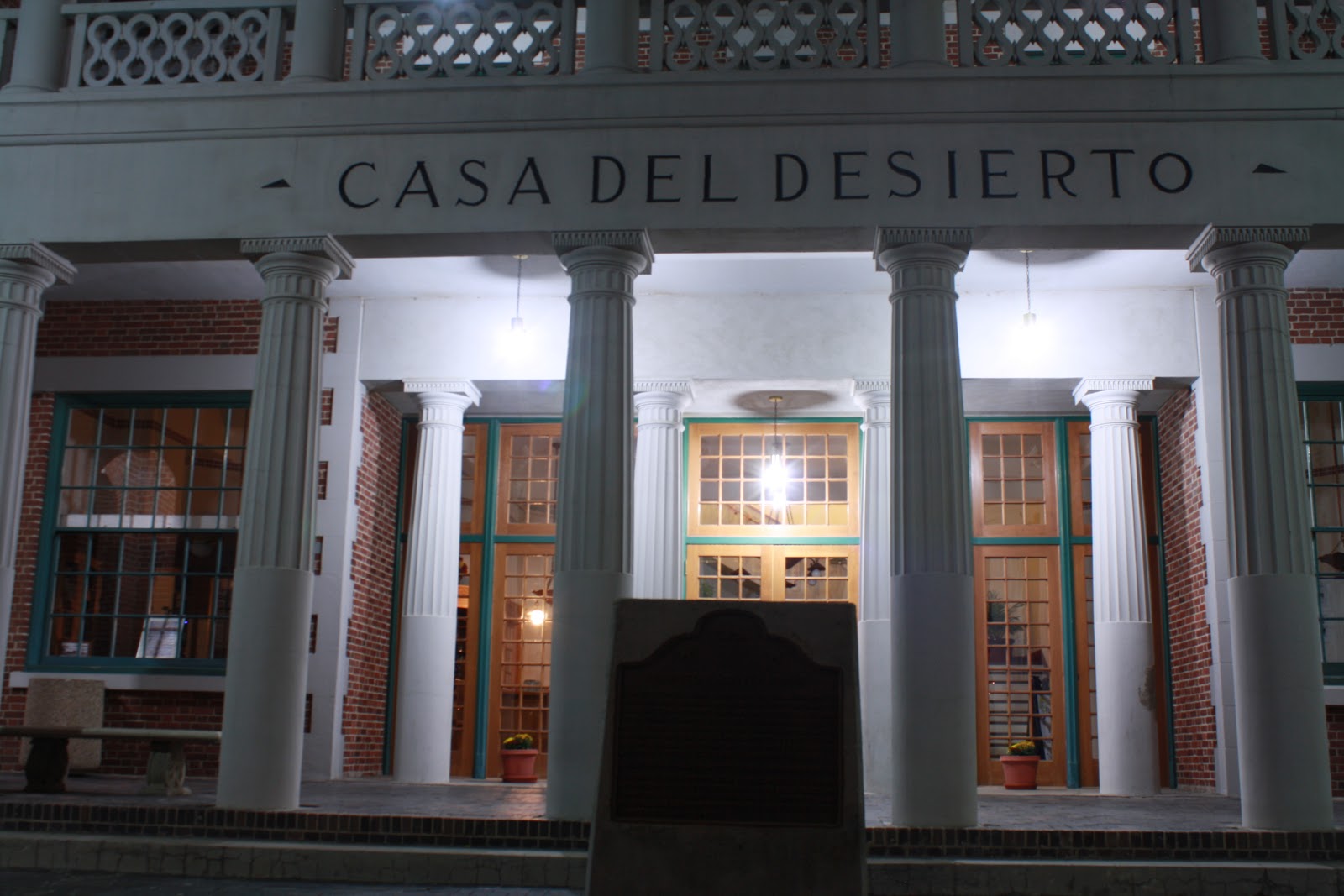
The Casa de Desierto (Desert House), one of the Harvey House chain of hotels and restaurants that once were common along the railroads, was built in 1911, to replace an earlier structure that had been destroyed in a fire. It is a rather beautiful building, standing next to the railroad tracks, and conspicuous, as the rest of Barstow's architecture, while quite pleasant and often gorgeous in its own right, tends to be more utilitarian than this former hotel.
Naturally, it is said to be haunted.
The most common experiences reported are, as is so often the case, vague feelings of uneasiness, "being watched," and the ubiquitous "cold spots." More interesting are the apparitions that people report seeing, including Harvey Girls (travelling waitresses who worked for the Harvey company) who are seen walking the halls of the building (including one who appears to simply walk the same route from the kitchen to the dining room, with something in her hand, repeating the walk again and again), and a woman named Rachel who is seen on the balcony, depending on the telling, is either a Harvey Girl or a young woman waiting for her fiance or husband to return from the war (I assume WWI). In the latter tellings, Rachel is said to have committed suicide - a common ghost story motif.
In addition to the apparitions, there are smells and sounds. The smell of tobacco smoke is said to signify the presence of Buchanan, a man who was crushed between two rail cars and whose dying wishes were to see his family and to have a cigarette. A little girl names Emily is said to occasionally laugh as people walk by, and her apparition plays "peek-a-boo" as people walk up the lobby stairs.
Commentary: The Harvey Houses were an interesting institution - a chain of hotels linked by the railroads, known for their quality and comfort when these were rare during travel through the western United States. People often claimed (no doubt with encouragement from the Harvey Company's marketing office) that the Harvey Houses "tamed the wild west." This is, of course, not true. However, they did provide amenities that might otherwise be scarce in the Great Basin and desert Southern California.
That this one has had ghost stories attached to it is unsurprising. As noted above, the building really does stand out. Barstow is located on Route 66, and has it's fair share of historic and unique buildings and rather friendly people - for all of it's sometimes bad reputation as a destination, I have always found Barstow to be a pleasant place when I have traveled there for work - but the Casa de Desierto stands apart from the rest. It's a mix of east-coast brick, neo-classical, and Moorish designs that looks...well, the best word that I can think of is "classy." It's a very nice building that looks very out of place next to the railroad tracks and a dry riverbed.
Given that it is both a conspicuous structure and that it has long been a landmark for those riding the trains as well as those living in Barstow, it is unsurprising that it has gathered ghost stories. I must admit that I am a bit disappointed that the stories are so pedestrian. The sightings of Emily are reminiscent of the sightings of another ghostly child at the Brookdale Lodge, but the stranger and more menacing apparitions at the Santa Cruz County hotel are missing in Barstow.
Still, what the stories at Casa de Desierto lack in originality, they make up for in colorfulness. The smoke that calls to mind Buchanan's demise, the details regarding where Rachel will be standing (and the alternating versions of her reason for being there), and the fact that the stories are folded within the manufactured mythology of the Harvey Company make for an enjoyable set of tales.
Sources: Newspaper, Internet, Internet, Strangeusa.com, Wikipedia, and, again, Wikipedia
Subscribe to:
Posts (Atom)


 Posts
Posts

